


The next US arms sale package to Taiwan is likely to include advanced command and control systems, surface-to-air missiles, radars, and counter-drone capabilities, a source said yesterday.
The government official made the remarks in response to a Financial Times report published last week stating that Washington plans to sell Taiwan up to US$20 billion worth of weapons.
The US is preparing an arms package to facilitate President William Lai’s (賴清德) proposal to build the “T-Dome” to defend the nation against Chinese strikes, a source with knowledge on the matter said, commenting on condition of anonymity.
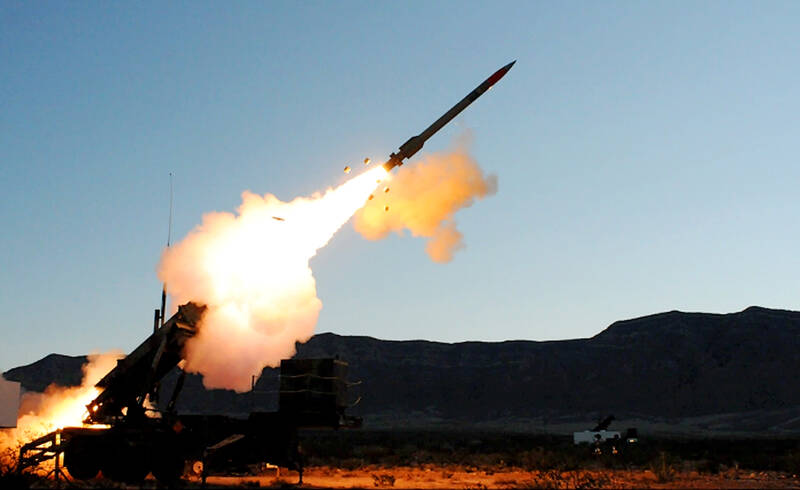
Photo: Screen grab from the Defense Visual Information Distribution System’s Web site
The Integrated Battle Command Systems (IBCS), Patriot Advanced Capability-3 Missile Segment Enhancement systems (PAC-3 MSE), National Advanced Surface-to-Air Missile Systems (NASAMS), and Lower Tier Air and Missile Defense Sensors (LTAMDS) are likely to be part of the sale, he said.
The IBCS, an advanced system used by the US’ armed forces, is capable of integrating various types of air defense missiles Taiwan already has or plans to use, the official said.
The PAC-3 MSE would be furnished in sufficient quantity to arm a new air defense battalion, he said.
The NASAMS would provide a low to medium-altitude air defense capability, while the LTAMDS, the latest radar technology, would replace the original radars of the Patriot air defense system, the official said.
These systems would join Taiwan’s fleet of PAC-3 and Tien Kung (天弓, “Sky Bow”) family of air defense missiles to form an integrated defense, he said.
Separately, the US is believed to be preparing a number of Mobile-Acquisition, Cueing and Effector system (M-ACE) counter-drone defenses with soft-kill and hard-kill capabilities, the official said.
M-ACE is an integrated system composed of a radar, electro-optical infrared sensors, a 30mm autocannon, jammers and an electronic warfare suite that could be installed on trucks or light tactical vehicles, he said.
This could support mobile groups of anti-drone defense teams with artificial intelligence (AI)-boosted command capabilities, the official said, adding that it would bolster the nation’s ability to engage drone swarms.
Military police units tasked with defending key government structures in the Boai (博愛) special zone initiated talks with the US regarding obtaining a hard-kill capability to complement their single-operator drone jammer guns two years ago, leading to the proposed sale of M-ACE, the official said.
In November last year, Chief of the General Staff Admiral Mei Chia-shu (梅家樹) told the public that the T-Dome program would add an integrated command system and Tien Kung IV missiles to Taiwan’s air defense arsenal.
The project aims to enable the Taiwanese armed forces to engage threats at different altitudes and performance envelopes, controlled by an AI-enhanced integrated command system, he said.
South Korea has adjusted its electronic arrival card system to no longer list Taiwan as a part of China, a move that the Ministry of Foreign Affairs said would help facilitate exchanges between the two sides. South Korea previously listed “Taiwan” as “Taiwan (China)” in the drop-down menus of its online arrival card system, where people had to fill out where they came from and their next destination. The ministry had requested South Korea make a revision and said it would change South Korea’s name on Taiwan’s online immigration system from “Republic of Korea” to “Korea (South),” should the issue not be

Tainan, Taipei and New Taipei City recorded the highest fines nationwide for illegal accommodations in the first quarter of this year, with fines issued in the three cities each exceeding NT$7 million (US$220,639), Tourism Administration data showed. Among them, Taipei had the highest number of illegal short-term rental units, with 410. There were 3,280 legally registered hotels nationwide in the first quarter, down by 14 properties, or 0.43 percent, from a year earlier, likely indicating operators exiting the market, the agency said. However, the number of unregistered properties rose to 1,174, including 314 illegal hotels and 860 illegal short-term rental

Both sides of the Taiwan Strait share a political foundation based on the “1992 consensus” and opposition to Taiwanese independence, Chinese Nationalist Party (KMT) Chairwoman Cheng Li-wun (鄭麗文) today said during her meeting with Chinese President Xi Jinping (習近平). Both sides of the Strait should plan and build institutionalized and sustainable mechanisms for dialogue and cooperation based on that foundation to make peaceful development across the Strait irreversible, she said. Peace is a shared moral value across the Strait, and both sides should move beyond political confrontation to seek institutionalized solutions to prevent war, she said. Mutually beneficial cross-strait relations are what the

ECONOMIC COERCION: Such actions are often inconsistently applied, sometimes resumed, and sometimes just halted, the Presidential Office spokeswoman said The government backs healthy and orderly cross-strait exchanges, but such arrangements should not be made with political conditions attached and never be used as leverage for political maneuvering or partisan agendas, Presidential Office spokeswoman Karen Kuo (郭雅慧) said yesterday. Kuo made the remarks after China earlier in the day announced 10 new “incentive measures” for Taiwan, following a landmark meeting between Chinese President Xi Jinping (習近平) and Chinese Nationalist Party (KMT) Chairwoman Cheng Li-wun (鄭麗文) in Beijing on Friday. The measures, unveiled by China’s Xinhua news agency, include plans to resume individual travel by residents of Shanghai and China’s Fujian


 RSS
RSS