


The Taiwan People’s Party (TPP) does not oppose prioritizing the Executive Yuan’s proposed special defense budget alongside its own version for review after the Lunar New Year holiday, TPP caucus convener Chen Ching-lung (陳清龍) said yesterday.
He added that the party is not seeking to block the Cabinet’s proposal.
TPP deputy convener Wang An-hsiang (王安祥) said the party’s version of the special defense budget was still being worked on and it was “willing to make some adjustments,” should the details of US arms sales change.
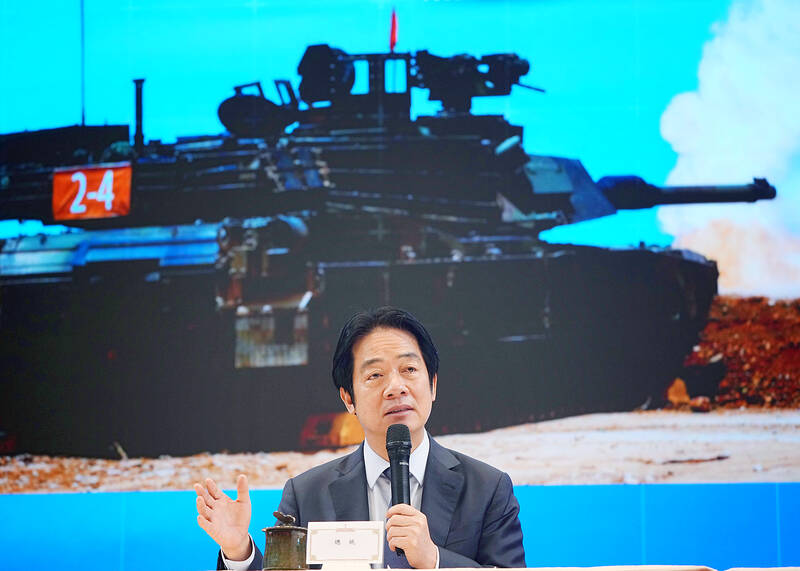
Photo: CNA
There is ample room for discussion before the draft act passes the third reading, he said.
Asked whether the TPP would support the Chinese Nationalist Party’s (KMT) proposal, Chen declined to comment, adding that the KMT version has yet to be proposed.
KMT Culture and Communications Committee head and Legislator Wu Tsung-hsien (吳宗憲) said the KMT’s version would demand transparency for all US arms procurement contracts.
President William Lai (賴清德) urged the opposition to expedite reviews of the Executive Yuan’s special defense budget in the upcoming legislative session, warning that if the budget fails to pass, Washington might no longer consider Taiwan a priority for US arms provision.
“National defense, so closely tied to national security, sovereignty and our very survival, should be an area where we unite and present a common front to the outside,” Lai told a news conference in Taipei.
Countries such as Japan, South Korea and the Philippines are all boosting defense spending, he said, adding that failure to pass the budget could affect Taiwan’s credibility.
“China’s threat is becoming increasingly serious. Taiwan’s defense budget must be passed smoothly. This represents Taiwan’s resolve, and it also shows that Taiwan is fulfilling its responsibilities as a member of the international community,” he said.
At the same news conference — attended by the heads of the army, navy and air force — Minister of National Defense Wellington Koo (顧立雄) said the government had had intensive talks with the US on what weapons Taiwan needed.
“In the Indo-Pacific region, especially among the countries in the first island chain, Taiwan plays a uniquely critical, almost fated, role,” Koo said, referring to an area that stretches from Japan through Taiwan and into the Philippines. “We do not want Taiwan to become the rupture in the Indo-Pacific collective deterrence posture.”
Shortly after Lai spoke, the Ministry of National Defense said it had detected 11 Chinese military aircraft — including nuclear-capable H-6K bombers — operating to Taiwan’s east and southwest for long-distance training in the Pacific Ocean.
US lawmakers have pushed the legislature to pass the spending plans, and some have criticized the opposition for blocking Lai’s plans and cozying up to Beijing.
Separately, KMT caucus whip Fu Kun-chi (傅?萁) criticized Lai, saying the president was using obfuscatory language to confuse the country.
Lai should state when the NT$700 billion (US$22.24 billion) in military equipment already paid for would be delivered, Fu said.
To say that delays in the budget review would cause Taiwan to drop off the priority list is misleading, as Taiwan has been a priority, as the US put itself, members of the “Five Eyes” Alliance and the EU first, he said.
The president should explain how national defense procurement deals work, as in the past, wallpaper companies, toilet businesses and construction companies won national defense contracts, Fu said.
The KMT will present its own budget proposal, which would ensure funding is used appropriately, he said, adding that whichever budget passes the legislature would not be the Executive Yuan’s version.
Democratic Progressive Party caucus chief executive Chung Chia-pin (鍾佳濱) said he hoped the KMT would place the interests of Taiwan ahead of the party’s.
Additional reporting by Reuters

A signaling system malfunction disrupted high-speed rail (HSR) services beginning at 8am today, with trains temporarily reduced to three northbound and three southbound trains per hour as authorities conduct inspections. The malfunction occurred on a section of track in Miaoli County during pre-operation checks early this morning, forcing northbound and southbound trains to use a single track, the HSR operator said. The regular schedule has been replaced with three hourly trains offering only nonreserved seating in each direction, stopping at every station, it said, adding that business class cars would still have reserved seating. Departures from terminal stations are scheduled at the top
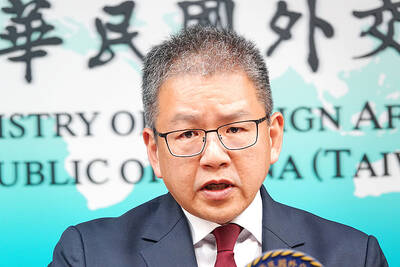
Taiwan is still in the process of assessing the possibility of recruiting workers from Eswatini, the Ministry of Foreign Affairs said yesterday, adding that its goal is to help Eswatini upgrade its vocational training centers. If there are plans to recruit workers from Eswatini, safeguarding national security, protecting public health and ensuring the employment rights of Taiwanese would be prerequisites, Department of West Asian and African Affairs Director-General Yen Chia-liang (顏嘉良) told a news conference. Key considerations would also include filling labor shortages in specific industries, and fostering bilateral professional and technical exchanges, he said. Yen was asked about the progress of labor

VERBOSE VESSELS: A CGA cutter and a China Coast Guard exchanged verbal barbs for more than a day in Taiwanese-controlled waters before the Chinese vessel left The Taiwanese and Chinese coast guards had a standoff near the strategically located Pratas Islands (Dongsha Islands, 東沙群島) in the north of the South China Sea, the Coast Guard Administration (CGA) said yesterday. The two sides engaged in intense radio exchanges over sovereignty claims during the 33-hour standoff. China Coast Guard vessel 3501 eventually left the restricted waters, 26.6 nautical miles (49.2km) west of the Pratas Islands, at 5pm yesterday, the CGA said. Lying approximately between southern Taiwan and Hong Kong, the Taiwan-controlled Pratas are seen by some security experts as vulnerable to Chinese attack due to their distance — more than

A US uncrewed surface vessel (USV) encountered multiple Chinese warships during an autonomous transit of the Taiwan Strait, US defense company Seasats said in a statement on Wednesday. Seasats announced that a Lightfish USV had completed the first autonomous transit of the Taiwan Strait. Over five days, the USV traversed the entire length of the Strait while constantly monitoring surface vessel traffic, the company said. The Lightfish encountered multiple Chinese warships, one of which was a Chinese People’s Liberation Army Navy (PLAN) Type 056 corvette, it said. The Chinese vessels were operating “well within Taiwan’s exclusive economic zone without transmitting their identity via the


 RSS
RSS