

The sentencing yesterday of former Hong Kong media magnate Jimmy Lai (黎智英) raised concerns from international governments, while Chinese and Hong Kong authorities defended it, saying it reflected the spirit of the rule of law.
Lai, a 78-year-old prominent democracy advocate, was sentenced to 20 years in prison after being found guilty in December of conspiracy to collude with foreign forces and conspiring with others to publish seditious articles.
His codefendants, who entered guilty pleas to the collusion-related charge, received prison terms ranging between six years and three months, and 10 years.
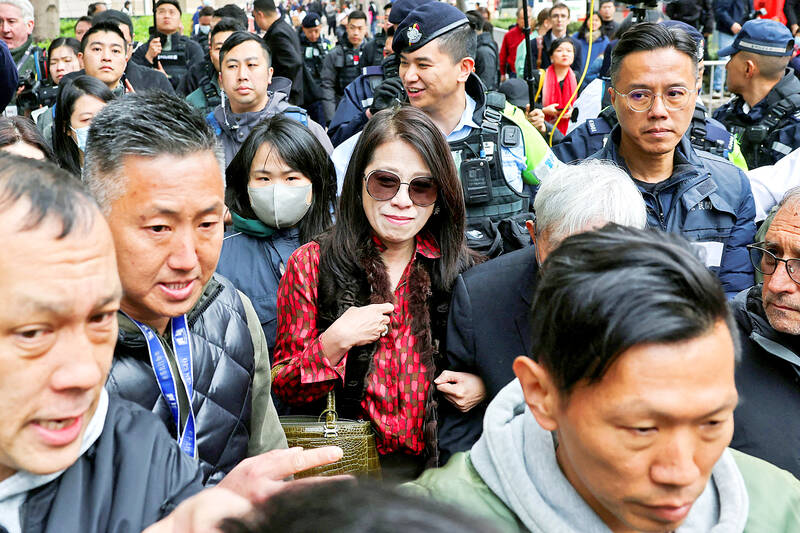
Photo: Reuters
Lai smiled and waved at his supporters when he arrived for the sentence, but before he left the courtroom, he looked serious, as some people in the public gallery cried.
Asked whether they would appeal, his lawyer Robert Pang (彭耀鴻) said no comment.
In a statement, Lai’s son, Sebastien, said the “draconian” prison term was devastating for his family and life-threatening for his father.
“It signifies the total destruction of the Hong Kong legal system and the end of justice,” he said.
His sister Claire called the sentence “heartbreakingly cruel” in the same statement.
“If this sentence is carried out, he will die a martyr behind bars,” she said.
Some foreign governments and rights groups condemned the sentencing and called for the release of Lai, a British citizen. However, the Chinese Ministry of Foreign Affairs maintained that Lai is a Chinese citizen, and urged other countries to respect its sovereignty and the rule of law in Hong Kong.
UN High Commissioner for Human Rights Volker Turk deplored the sentence, saying Lai was punished for “exercising rights protected under international law” and that the sentence must be quashed.
His office raised concerns that the broad scope of the charges risks criminalizing legitimate activities of civil society organizations and journalists.
“This outcome highlights how the vague and overly broad provisions of Hong Kong’s national security legislation can lead to being interpreted and enforced in violation of Hong Kong’s international human rights obligations,” Turk said. “This is part of a broader repressive trend in Hong Kong, where hundreds have been arrested and prosecuted under these laws.”
The EU reiterated its call for the immediate and unconditional release of Lai, citing his advanced age and health condition.
“The politically motivated prosecution of Jimmy Lai and the former Apple Daily executives and journalists harms Hong Kong’s reputation,” it said in a statement. “The EU calls on the Hong Kong authorities to restore confidence in press freedom in Hong Kong, one of the pillars of its historic success as an international financial center, and to stop prosecuting journalists.”
British Secretary of State for Foreign, Commonwealth and Development Affairs Yvette Cooper said Lai was sentenced for exercising his right to freedom of expression after a “politically motivated prosecution.”
She was concerned for Lai’s health and called on the Hong Kong authorities to release him on humanitarian grounds so that he may be reunited with his family.
The British government also said that it is expanding an immigration route to more residents of Hong Kong, a former British colony, “amid continuing deterioration of rights and freedoms in the territory.”
It estimated that about 26,000 Hong Kongers could relocate to the UK in the next five years.
In Beijing, Chinese Ministry of Foreign Affairs spokesman Lin Jian (林劍) told reporters at a daily briefing that Lai is a Chinese citizen, calling him a major planner and participant in a series of anti-China destabilizing activities in Hong Kong.
The judicial cases are purely Hong Kong’s internal affairs, Lin said, urging “relevant countries” to avoid interfering in Hong Kong’s judicial affairs or China’s internal affairs.
Beijing’s office in Hong Kong affairs said Lai’s sentence reflected Hong Kong’s determination in safeguarding national security and demonstrated the spirit of the rule of law.
Hong Kong Chief Executive John Lee (李家超) said Lai’s crimes are heinous and that he had used Apple Daily to “poison” residents and incite hatred.
Lai deserved the sentence because he openly asked for foreign sanctions against China, as well as Hong Kong and harmed their interests, he said.

‘GLOBAL WARNING’: The infiltration is not just a local problem, as Beijing has been deploying the same tactics worldwide against Western democracies, a report said Between 50,000 and 100,000 Chinese spies are operating in Taiwan, far more than the National Security Bureau’s previous estimate of 5,000, German journalist and author Jurgen Kremb said on Monday. Kremb presented his research, titled “The War of Spies: How China’s Intelligence Services Are Infiltrating Taiwan — and What Europe Must Learn from It,” at a joint event held by the Taiwan offices of the Friedrich Naumann Foundation and the European Values Center for Security Policy. The report was published in June in the Ministry of Justice Investigation Bureau’s Prospect & Exploration Monthly (展望與探索月刊). By spies, he said he was referring to informants,

PRICE STABILIZATION: The Ministry of Economic Affairs has urged the legislature to support the Cabinet’s supplementary budget for state-owned energy companies State-owned oil supplier CPC Corp, Taiwan (CPC, 台灣中油) on Saturday announced that it would raise domestic gasoline prices by NT$0.7 (US$0.02) per liter and diesel prices by NT$0.6 per liter this week after international crude oil prices rose above US$100 per barrel last week. Formosa Petrochemical Corp (台塑石化) yesterday said that it matched CPC’s price adjustments for this week. The decisions end a six-week period during which CPC and Formosa kept fuel prices in Taiwan unchanged. Retail gasoline prices this week would rise to NT$31.2, NT$32.7 and NT$34.7 per liter for 92, 95 and 98-octane unleaded gasoline respectively at CPC
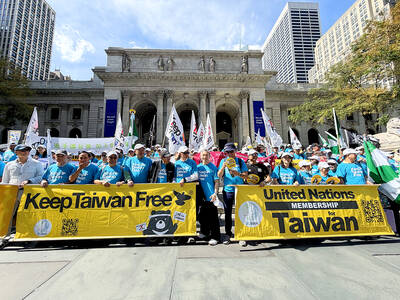
More than 100 Taiwanese-Americans, Taiwanese lawmakers and members of civic groups on Saturday marched through New York City to call for Taiwan’s participation in the UN, with Marshall Island Permanent Representative to the UN John Silk joining the event to show support. Participants chanted: “UN for Taiwan” and “Keep Taiwan Free” as they marched through central Manhattan, passing Times Square and Bryant Park before ending near the New York Public Library. The annual march brought together Taiwanese community groups from across the US East Coast. Silk expressed hope that Taiwan would one day be able to participate in UN meetings
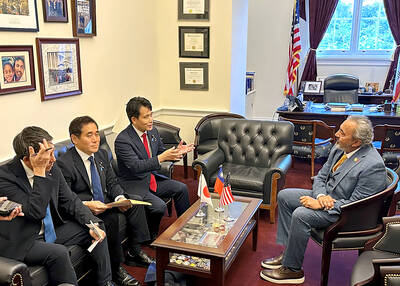
WASHINGTON MEETING: Japan’s Hirofumi Takinami said participants rejected the idea that the US should limit its defensive perimeter to the Second Island Chain US and Japanese lawmakers agree that the US must defend the First Island Chain, including Taiwan, and should not fall back to the Second Island Chain, while “a Taiwan contingency is a Japan contingency and therefore a US-Japan alliance contingency,” media reported after a meeting between officials of the two nations in Washington on Tuesday. A delegation of Japanese lawmakers from the Liberal Democratic Party met with US Senator Thom Tillis, co-chair of the Senate Taiwan Caucus, and US Representative Ami Bera, co-chair of the US Congressional Taiwan caucus, to discuss issues concerning East Asia and the Taiwan Strait. The Japanese and


 RSS
RSS