

A bill aimed at deepening space cooperation between Taiwan and the US cleared the committee stage in the US House of Representatives on Wednesday.
The Taiwan and American Space Assistance Act (TASA Act) was included as an amendment to the NASA Reauthorization Act, which the US House Committee on Science, Space and Technology passed with a 37-0 vote.
The TASA Act was first introduced in September last year by US representatives French Hill and Gabe Amo.
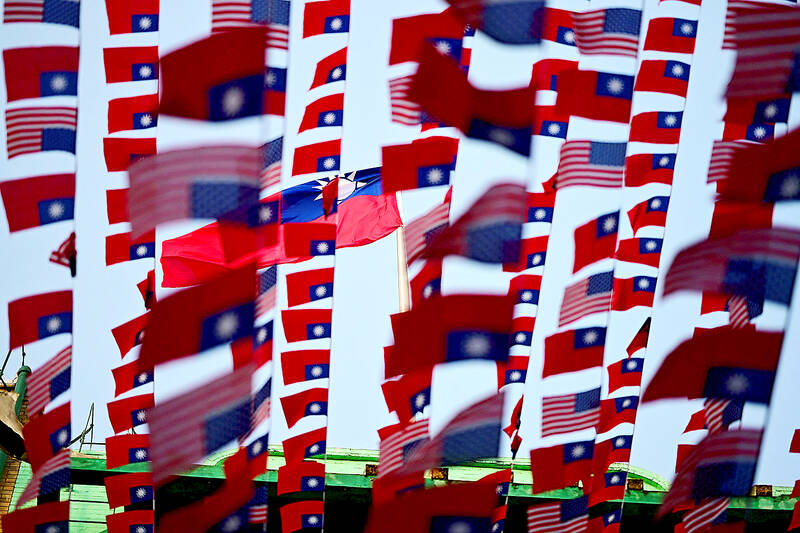
Photo: Reuters
Because of the US government’s “one China policy,” NASA and the National Oceanic and Atmospheric Administration (NOAA) had “limited” authority to work with the Taiwan Space Agency, which was launched in 2022, they said in a statement.
The TASA Act would not only give NASA and NOAA additional authority, but would also instruct them to “work with Taiwan in areas of mutual benefit, including satellite programs, space exploration programs, and atmospheric and weather programs,” the representatives said.
The bill would provide an avenue for “voluntary exchange of personnel from NASA and the NOAA to the Taiwan Space Agency to further advance Taiwan’s space capabilities,” the statement said.
The TASA Act was one of 41 amendments added to a bill authorizing US$24.4 billion in funding for NASA — a slight dip from last year’s budget of US$24.88 billion, but significantly more than the US$18 billion put forth by US President Donald Trump in his budget proposal for this year.
The amendments must be passed by the US House of Representatives and the US Senate, then signed into law by the president to take effect.
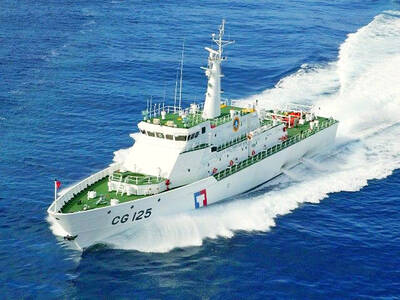
GEOPOLITICAL SIGNIFICANCE: The CGA’s nonmilitary role makes it a tool to avert diplomatic issues, an official said, while confirming the donation of a ship to Manila Coast Guard Administration (CGA) ships are scheduled to sail to the Philippines bearing the words “Taiwan Coast Guard” in a high-profile visit in October next year, the first such visit by a Taiwanese maritime law enforcement vessel to the Southeast Asian nation, the agency said yesterday. The CGA also confirmed that it had donated one of its decommissioned patrol vessels to the Philippines in a rare transfer of a retired ship to a nondiplomatic ally. The Republic of China (ROC) Navy last made such a visit in 1974, shortly before the Philippines switched diplomatic recognition to the People’s Republic of China in

‘GLOBAL WARNING’: The infiltration is not just a local problem, as Beijing has been deploying the same tactics worldwide against Western democracies, a report said Between 50,000 and 100,000 Chinese spies are operating in Taiwan, far more than the National Security Bureau’s previous estimate of 5,000, German journalist and author Jurgen Kremb said on Monday. Kremb presented his research, titled “The War of Spies: How China’s Intelligence Services Are Infiltrating Taiwan — and What Europe Must Learn from It,” at a joint event held by the Taiwan offices of the Friedrich Naumann Foundation and the European Values Center for Security Policy. The report was published in June in the Ministry of Justice Investigation Bureau’s Prospect & Exploration Monthly (展望與探索月刊). By spies, he said he was referring to informants,

PRICE STABILIZATION: The Ministry of Economic Affairs has urged the legislature to support the Cabinet’s supplementary budget for state-owned energy companies State-owned oil supplier CPC Corp, Taiwan (CPC, 台灣中油) on Saturday announced that it would raise domestic gasoline prices by NT$0.7 (US$0.02) per liter and diesel prices by NT$0.6 per liter this week after international crude oil prices rose above US$100 per barrel last week. Formosa Petrochemical Corp (台塑石化) yesterday said that it matched CPC’s price adjustments for this week. The decisions end a six-week period during which CPC and Formosa kept fuel prices in Taiwan unchanged. Retail gasoline prices this week would rise to NT$31.2, NT$32.7 and NT$34.7 per liter for 92, 95 and 98-octane unleaded gasoline respectively at CPC
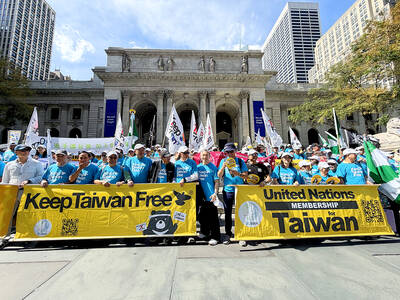
More than 100 Taiwanese-Americans, Taiwanese lawmakers and members of civic groups on Saturday marched through New York City to call for Taiwan’s participation in the UN, with Marshall Island Permanent Representative to the UN John Silk joining the event to show support. Participants chanted: “UN for Taiwan” and “Keep Taiwan Free” as they marched through central Manhattan, passing Times Square and Bryant Park before ending near the New York Public Library. The annual march brought together Taiwanese community groups from across the US East Coast. Silk expressed hope that Taiwan would one day be able to participate in UN meetings


 RSS
RSS