


Relations between Taiwan and the US are “rock solid,” and cooperation programs would not change, President William Lai (賴清德) said yesterday, after Chinese President Xi Jinping (習近平) in a phone call urged US President Donald Trump to handle arms sales to Taipei “with prudence.”
China’s state-run Xinhua news agency said Xi told Trump that the Taiwan question “is the most important issue in China-US relations,” and that Taiwan is an inseparable part of China.
“The US must handle the issue of arms sales to Taiwan with prudence,” Xi was quoted as saying.
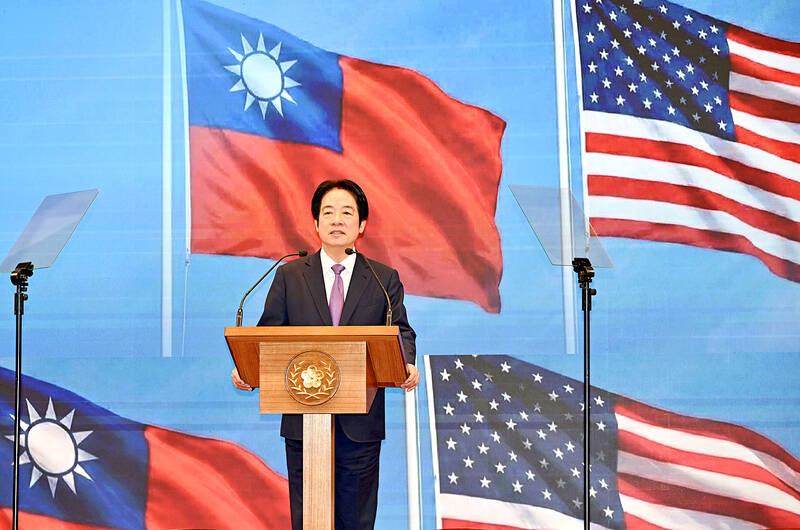
Photo: Lo Pei-de, Taipei Times
Trump in a post on Truth Social said he had an “excellent, long and thorough” conversation with Xi, covering topics such as trade, military affairs, his upcoming trip to China and Taiwan, but did not elaborate on the discussions about the nation.
Lai said Taipei and Washington have strong channels of communication.
“Taiwan-US relations are rock-solid. All cooperation programs will continue and will not change,” Lai said, adding that US commitments to Taiwan also remain unchanged.
The fact that Taiwan is not part of the People’s Republic of China (PRC) also remains unchanged, he said.
Lai said that to the best of his knowledge, Trump reiterated the US’ long-held stance on the nation, based on the Taiwan Relations Act and the “six assurances.”
Deputy Minister of Foreign Affairs Chen Ming-chi (陳明祺) said the call would help “stabilize” the region as China increases military pressure on Taiwan.
“We do not worry too much about this whole telephone communication,” Chen said, describing the Taiwan-US relationship as “very solid and strong.”
“In fact, we believe that it will contribute to stabilize the situation, especially given the fact that China keeps on escalating the tension in the Taiwan Strait and this whole region,” he said. “I think we welcome the kind of effort to stabilize the ... security situation in this region.”
Chen said Xi’s comments would not threaten future defense purchases from the US.
“The only concern that is going to impact the future of arms sales is our opposition parties’ attitude ... toward the defense budget,” Chen said. “The US has already promised to sell Taiwan a certain amount of weapons.”
“So far we have not seen any cooperation” from the legislature, which has repeatedly blocked discussion of the government’s proposed US$40 billion special defense budget, he added.
Chen said he was not worried about Trump and Xi striking a “grand bargain” at Taiwan’s expense during their meeting in Beijing in April.
“Taiwan is unquestionably the core of the national interest to the global economy and the US,” Chen said. “You are not going to trade away your own national interest.”
Following the call, a US White House official reiterated that US policy regarding Taiwan has not changed.
“The US’ ‘one China’ policy, as our cross-strait policies are collectively known, is based on the Taiwan Relations Act, the Three US-PRC Joint Communiques and the six assurances to Taiwan,” an unnamed official said.
The US administration would continue to cooperate with both sides of the Taiwan Strait, as it did during Trump’s first presidential term, the official added.
In related news, in response to accusations from Taiwan People’s Party Chairman Huang Kuo-chang (黃國昌) that American Institute in Taiwan (AIT) Director Raymond Greene was interfering “too deeply in Taiwan’s internal affairs” by supporting the Cabinet’s defense budget, a US Department of State yesterday official reiterated Washington’s support.
As the department and AIT have repeatedly stated, the US welcomes Taiwan’s announcement of the US$40 billion special defense budget, the official said.

SILENCING CRITICS: In addition to blocking Taiwan, China aimed to prevent rights activists from speaking out against authoritarian states, a Cabinet department said The Ministry of Foreign Affairs (MOFA) yesterday condemned transnational repression by Beijing after RightsCon, a major digital human rights conference scheduled to be held in Zambia this week, was abruptly canceled due to Chinese pressure over Taiwanese participation. This year’s RightsCon, the world’s largest conference discussing issues “at the intersection of human rights and technology,” was scheduled to take place from tomorrow to Friday in Lusaka, and expected to draw 2,600 in-person attendees from 150 countries, along with 1,100 online participants. However, organizers were forced to cancel the event due to behind-the-scenes pressure from China, the ministry said, expressing its “strongest condemnation”
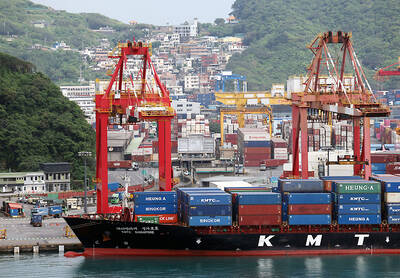
Taiwan’s economy grew far faster than expected in the first quarter, as booming demand for artificial intelligence (AI) applications drove a surge in exports, spilling over into investment and consumption, the Directorate-General of Budget, Accounting and Statistics (DGBAS) said yesterday. GDP growth was 13.69 percent year-on-year during the January-to-March period, beating the DGBAS’ February forecast by 2.23 percentage points and marking the most robust growth in nearly four decades, DGBAS senior official Chiang Hsin-yi (江心怡) told a news conference in Taipei. The result was powered by exports, which remain the backbone of Taiwan’s economy, Chiang said. Outbound shipments jumped 51.12 percent year-on-year to
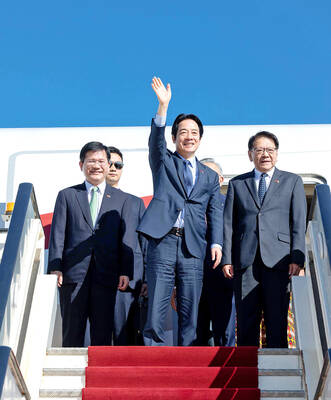
DELAYED BUT DETERMINED: The president’s visit highlights Taiwan’s right to international engagement amid regional pressure from China President Willaim Lai (賴清德) yesterday arrived in Eswatini, more than a week after his planned visit to Taiwan’s sole African ally was suspended because of revoked overflight permits. “The visit, originally scheduled for April 22, was postponed due to unforeseen external factors,” Lai wrote on social media. “After several days of careful arrangements by our diplomatic and national security teams, we successfully arrived today.” Lai said he looked forward to further deepening Taiwan-Eswatini relations through closer cooperation in the economy, agriculture, culture and education, as well as advancing the nation’s international partnerships. The president was initially scheduled to arrive in time to celebrate
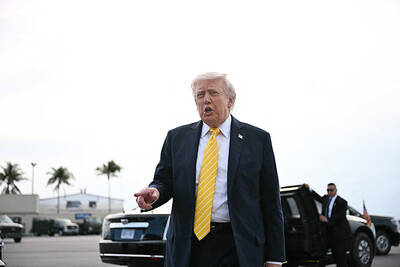
Iran’s Islamic Revolutionary Guard Corp (IRGC) yesterday said the US faced a choice between an “impossible” military operation or a “bad deal” with Tehran, after US President Donald Trump disparaged Iran’s latest peace proposal. Negotiations between the two countries have been deadlocked since a ceasefire came into effect on April 8, with only one round of direct peace talks held so far. Iran’s Tasnim and Fars news agencies reported that Tehran had submitted a 14-point proposal to mediator Pakistan, but Trump was quick to cast doubt on it. “I will soon be reviewing the plan that Iran has just sent to us, but


 RSS
RSS