


The Taiwan Artificial Intelligence College Alliance (TAICA) launched by the Ministry of Education has yielded positive results, with student enrollment and course completion rates having grown for three consecutive semesters.
The ministry launched TAICA in the second semester of the 2024 academic year to enhance artificial intelligence (AI) education through collaborative programs that integrate teaching resources, offer AI-related courses, provide expert mentorship, and streamline teaching assistant resources and course guidance services.
Statistics from the ministry show that enrollment surged from 2,465 students in the first semester to 6,109 in the third, and the course completion rate rose from 56.6 percent in the first semester to 75.7 percent in the second.

Photo: I-Hwa Cheng, AFP
TAICA was launched to address long-standing gaps in faculty and curriculum resources across higher education institutions, Higher Education Department section chief Chen Hao (陳浩) said yesterday.
The ministry implemented a cross-institutional course selection and credit program system, helping to lower the threshold for students to enroll in AI courses and expand overall AI talent cultivation capacity, he said.
TAICA includes 55 institutions, including National Taiwan University (NTU) and National Tsing Hua University (NTHU), as well as 22 other national universities, seven national vocational institutions, 19 private universities and seven private vocational institutions.
The alliance operates primarily through cross-institutional course selection and AI credit programs, while using the “NTU Cool” online teaching and learning platform for instruction, coursework and tracking learning progress.
Chen said that TAICA is positioned as a “platform for cross-university integration and resource sharing,” does not intend to replace existing AI courses, and serves to supplement the demand for interdisciplinary and cutting-edge curriculum that an individual school might struggle to provide.
A tracking mechanism for enrollment and completion rates has already been established, allowing for real-time monitoring of student registration, study progress and completion status, he said, adding that the data could be used for policy adjustments and resource allocation.
The ministry is also guiding TAICA members to strengthen pre-course orientation, learning counseling and teaching assistant allocations to help students adapt to cross-university and online learning models, reducing the risk of dropouts and ensuring the quality of the courses, he added.
TAICA project director Chen Yi-shin (陳宜欣), a professor at NTHU’s Department of Computer Science, said the alliance would launch new courses next semester, including “Large Language Models and Information Security Systems,” and “Generative AI Application Systems and Engineering.”
The alliance also plans to launch an “AI and Information Security Technology” program this academic year to address the high industrial demand for talent with integrated AI and cybersecurity skills, she said.
Chen Yi-shin said the ministry should consider providing subsidies or other policy incentives for participation and implementation effectiveness, to encourage continued investment in the alliance from member schools.
Regarding the next phase, Chen Hao said that the “AI and Information Security Technology” certificate program is being planned to address industrial demands.
Furthermore, the ministry would deliberate on extending TAICA courses to high schools and vocational schools, aimed to build an AI talent cultivation chain stretching from high school to university, for strengthening Taiwan’s international competitiveness.

SILENCING CRITICS: In addition to blocking Taiwan, China aimed to prevent rights activists from speaking out against authoritarian states, a Cabinet department said The Ministry of Foreign Affairs (MOFA) yesterday condemned transnational repression by Beijing after RightsCon, a major digital human rights conference scheduled to be held in Zambia this week, was abruptly canceled due to Chinese pressure over Taiwanese participation. This year’s RightsCon, the world’s largest conference discussing issues “at the intersection of human rights and technology,” was scheduled to take place from tomorrow to Friday in Lusaka, and expected to draw 2,600 in-person attendees from 150 countries, along with 1,100 online participants. However, organizers were forced to cancel the event due to behind-the-scenes pressure from China, the ministry said, expressing its “strongest condemnation”
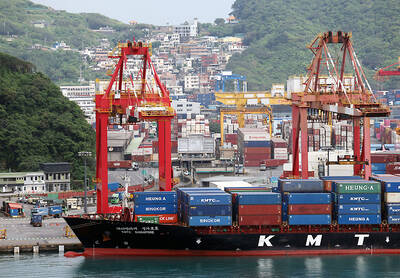
Taiwan’s economy grew far faster than expected in the first quarter, as booming demand for artificial intelligence (AI) applications drove a surge in exports, spilling over into investment and consumption, the Directorate-General of Budget, Accounting and Statistics (DGBAS) said yesterday. GDP growth was 13.69 percent year-on-year during the January-to-March period, beating the DGBAS’ February forecast by 2.23 percentage points and marking the most robust growth in nearly four decades, DGBAS senior official Chiang Hsin-yi (江心怡) told a news conference in Taipei. The result was powered by exports, which remain the backbone of Taiwan’s economy, Chiang said. Outbound shipments jumped 51.12 percent year-on-year to
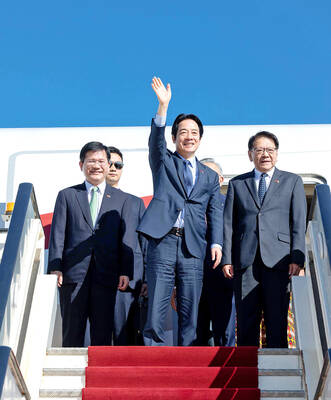
DELAYED BUT DETERMINED: The president’s visit highlights Taiwan’s right to international engagement amid regional pressure from China President Willaim Lai (賴清德) yesterday arrived in Eswatini, more than a week after his planned visit to Taiwan’s sole African ally was suspended because of revoked overflight permits. “The visit, originally scheduled for April 22, was postponed due to unforeseen external factors,” Lai wrote on social media. “After several days of careful arrangements by our diplomatic and national security teams, we successfully arrived today.” Lai said he looked forward to further deepening Taiwan-Eswatini relations through closer cooperation in the economy, agriculture, culture and education, as well as advancing the nation’s international partnerships. The president was initially scheduled to arrive in time to celebrate
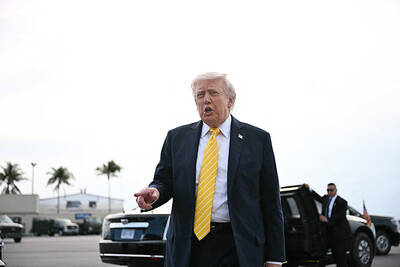
Iran’s Islamic Revolutionary Guard Corp (IRGC) yesterday said the US faced a choice between an “impossible” military operation or a “bad deal” with Tehran, after US President Donald Trump disparaged Iran’s latest peace proposal. Negotiations between the two countries have been deadlocked since a ceasefire came into effect on April 8, with only one round of direct peace talks held so far. Iran’s Tasnim and Fars news agencies reported that Tehran had submitted a 14-point proposal to mediator Pakistan, but Trump was quick to cast doubt on it. “I will soon be reviewing the plan that Iran has just sent to us, but


 RSS
RSS