


The economy last year grew at its fastest pace in nearly 15 years, fueled by a surge in exports tied to artificial intelligence (AI) and advanced computing, the Directorate-General of Budget, Accounting and Statistics (DGBAS) said yesterday.
GDP expanded 12.68 percent in the fourth quarter — the strongest quarterly pace in nearly 38 years — lifting full-year GDP growth to 8.63 percent.
That significantly exceeded the government’s 7.37 percent forecast, highlighting the nation’s importance in the global technology supply chain.
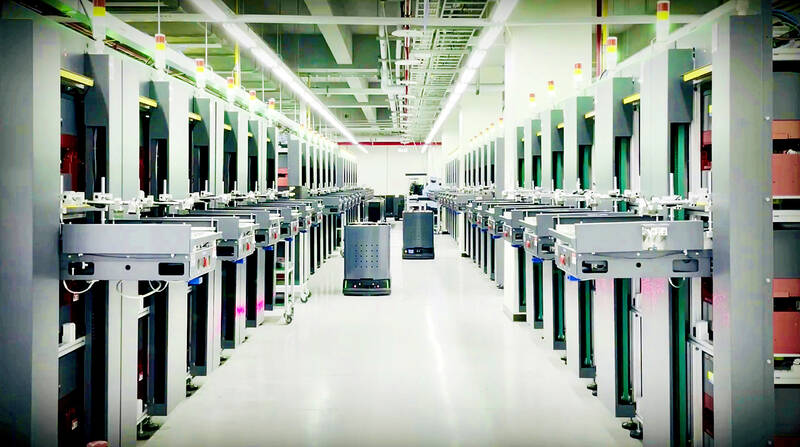
Photo courtesy of Hon Hai Precision Industry Co
“Taiwan’s economy has outpaced expectations, thanks to a remarkable surge in exports, particularly in technology and AI-linked products,” DGBAS senior official Chiang Hsin-yi (江心怡) said.
Goods exports in the fourth quarter, measured in US dollars, jumped 49.4 percent from a year earlier, surpassing prior forecasts by nearly 4 percentage points.
The agency cited strong demand from global cloud service providers as they accelerated capital spending to meet surging demand for AI and advanced computing applications.
Imports also rose sharply, increasing 24.27 percent year-on-year, as local companies boosted purchases of agricultural and industrial raw materials by 22.72 percent, and capital equipment by 40.44 percent.
Machinery and equipment imports climbed 22.86 percent, which included a 23.89 percent gain in semiconductor production tools, reflecting firms’ efforts to expand capacity in response to global demand.
Domestic demand contributed to the growth momentum, albeit at a more modest pace.
Private consumption increased 3.43 percent in the fourth quarter, slightly above earlier forecasts, supported by year-end holiday promotions, government cash handouts and expanded vehicle tax incentives that bolstered auto sales.
Government spending grew 1.83 percent, contributing 0.25 percentage points to overall GDP growth, although it was slower than projected.
Overall domestic demand rose 0.89 percent, accounting for 0.77 percentage points of the economy’s expansion.
Chiang dismissed concerns that Taiwan Semiconductor Manufacturing Co’s (TSMC, 台積電) investments in the US might displace private investment.
Since TSMC announced its expansion in the US in 2020, private-sector investments have maintained an average annual growth rate of more than 6 percent, while the economy grew at an average of 4.8 percent, the official said, adding that overseas expansion has not crowded out domestic investment.
Per capita GDP reached US$39,477 last year, approaching the US$40,000 milestone and highlighting Taiwan’s rising economic standing amid strong global demand for technology goods, Chiang said.
The data reflected export-driven growth and resilient domestic consumption, underscoring Taiwan’s integral role in the global AI and semiconductor ecosystem.
The economy is poised to sustain its robust expansion into this year, and the DGBAS is scheduled to give an official growth update next month.

‘NO SECURITY RISK’: The Railway Bureau reassured the public that the technicians’ activities were limited to technical guidance and did not involve sensitive systems The Railway Bureau yesterday said it had invited eight Chinese technicians to assist with an airport MRT construction project. The bureau issued the confirmation after an Internet user said Chinese nationals had entered the construction zone of Taiwan Taoyuan International Airport’s Terminal 3 project. They asked why “individuals from an enemy state” were allowed access to such a major national infrastructure project, which raised serious concerns over Taiwan’s industrial safety, sensitive systems and information security. The bureau’s Northern Region Engineering Branch Office said subcontractor Taiwan Handle Industrial Co (台灣手把工業) of the Taoyuan airport MRT’s “Contract No. CU05 Project A14 Station Civil, MEP &

A US uncrewed surface vessel (USV) encountered multiple Chinese warships during an autonomous transit of the Taiwan Strait, US defense company Seasats said in a statement on Wednesday. Seasats announced that a Lightfish USV had completed the first autonomous transit of the Taiwan Strait. Over five days, the USV traversed the entire length of the Strait while constantly monitoring surface vessel traffic, the company said. The Lightfish encountered multiple Chinese warships, one of which was a Chinese People’s Liberation Army Navy (PLAN) Type 056 corvette, it said. The Chinese vessels were operating “well within Taiwan’s exclusive economic zone without transmitting their identity via the

Taiwan is still in the process of assessing the possibility of recruiting workers from Eswatini, the Ministry of Foreign Affairs said yesterday, adding that its goal is to help Eswatini upgrade its vocational training centers. If there are plans to recruit workers from Eswatini, safeguarding national security, protecting public health and ensuring the employment rights of Taiwanese would be prerequisites, Department of West Asian and African Affairs Director-General Yen Chia-liang (顏嘉良) told a news conference. Key considerations would also include filling labor shortages in specific industries, and fostering bilateral professional and technical exchanges, he said. Yen was asked about the progress of labor
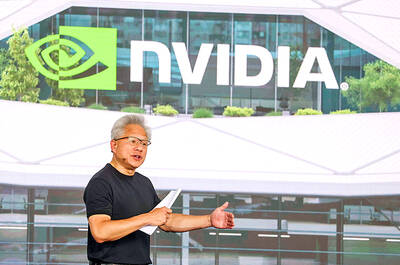
‘BOOMING’: ’ The number of partners we have here is incredible. You can see from their stock prices. They’re doing so well, they’re so happy,’ Jensen Huang said Nvidia Corp’s spending in Taiwan has ballooned to about US$150 billion a year, 10 times the US$10 billion to US$15 billion the company spent five years ago, Nvidia chief executive officer Jensen Huang (黃仁勳) said yesterday, suggesting Taiwan’s strategic importance in the global artificial intelligence (AI) supply chain. “Taiwan is the epicenter of the AI revolution. This is where the chips come, packaging comes. This is where the systems are made. This is where AI supercomputers were created,” Huang said at a meeting for the company’s employees in Beitou-Shilin Technology Park (北投士林科技園區) in Taipei, the planned site of Nvidia’s Taipei headquarters. “Taiwan


 RSS
RSS