


US President Donald Trump on Monday threatened to hike tariffs on goods imported from South Korea to 25 percent, citing what he said was the failure of the country’s legislature to codify the trade deal the two nations reached last year.
Trump in a social media post said the new rate would apply to vehicles, lumber, pharmaceutical products and “all other Reciprocal TARIFFS.”
Under the existing agreement, the US president set a 15 percent levy on South Korean exports.
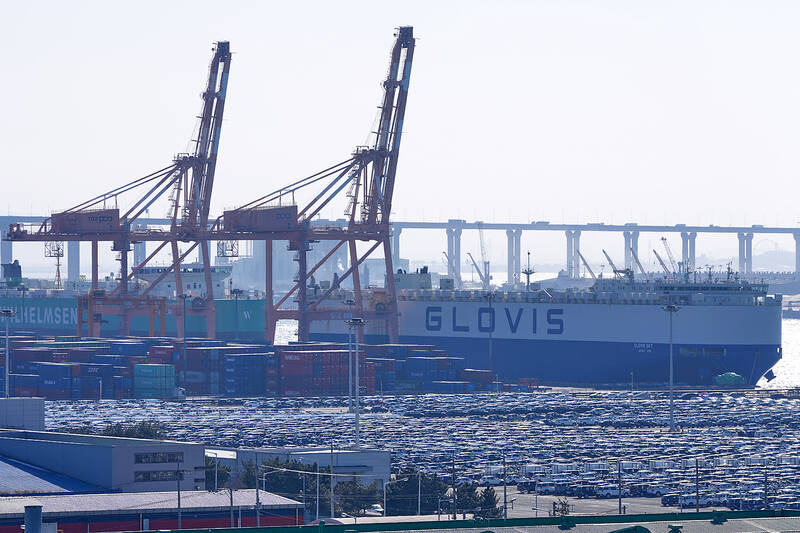
Photo: AP
“South Korea’s Legislature is not living up to its Deal with the United States,” Trump wrote. “In each of these Deals, we have acted swiftly to reduce our TARIFFS in line with the Transaction agreed to. We, of course, expect our Trading Partners to do the same.”
If implemented, the move could have wide-ranging effects on major South Korean companies, such as Hyundai Motor Co, which exported 1.1 million vehicles to the US in 2024.
Trump’s announcement marks his latest move to ratchet up trade tensions with allies. In the past few weeks, he has threatened to raise duties on Canadian products to 100 percent if Ottawa signed a trade deal with China and to slap new charges on European countries’ goods over his quest to seize control of Greenland.
Still, Trump’s tariff threats have often been scaled back or reversed. Data compiled by Bloomberg show that about 27 percent of such threats since late 2024 were fully executed, with the share that remained in place lower at about 20 percent.
South Korea has been lauded as a model ally by the US for raising its defense spending to 3.5 percent of GDP, but tensions remain over the pace at which Seoul provides investment to the US under its earlier trade deal, and regulations seen to be inhibiting US digital commerce firms.
There is also a lack of clarity over an agreement to help with US shipbuilding, the construction of nuclear submarines and the provision of nuclear fuel for submarines.
Following last year’s trade deal announcement, a domestic bill called the “special law on strategic investment with the US” was introduced to the South Korean parliament in late November last year, triggering a retroactive cut in US auto tariffs from 25 percent to 15 percent.
Once passed, it would give South Korea’s government the legal authority to manage and carry out the large-scale investments it pledged to the US under the trade deal, but it has not been put on the fast track for approval for now.
A Bloomberg report last week said Seoul would hold off this year on implementing its annual US investment pledge that was part of the trade deal framework amid concerns over capital outflows and currency volatility.
South Korean Minister of Finance Koo Yun-cheol subsequently said the government was not intentionally delaying the investment, but was still in the process of selecting projects and completing required procedures.
He said it would be difficult for the funds to be allocated in the first half of the year given the time needed to identify sites, finalize designs and carry out approvals.

A signaling system malfunction disrupted high-speed rail (HSR) services beginning at 8am today, with trains temporarily reduced to three northbound and three southbound trains per hour as authorities conduct inspections. The malfunction occurred on a section of track in Miaoli County during pre-operation checks early this morning, forcing northbound and southbound trains to use a single track, the HSR operator said. The regular schedule has been replaced with three hourly trains offering only nonreserved seating in each direction, stopping at every station, it said, adding that business class cars would still have reserved seating. Departures from terminal stations are scheduled at the top

Taiwan is still in the process of assessing the possibility of recruiting workers from Eswatini, the Ministry of Foreign Affairs said yesterday, adding that its goal is to help Eswatini upgrade its vocational training centers. If there are plans to recruit workers from Eswatini, safeguarding national security, protecting public health and ensuring the employment rights of Taiwanese would be prerequisites, Department of West Asian and African Affairs Director-General Yen Chia-liang (顏嘉良) told a news conference. Key considerations would also include filling labor shortages in specific industries, and fostering bilateral professional and technical exchanges, he said. Yen was asked about the progress of labor

VERBOSE VESSELS: A CGA cutter and a China Coast Guard exchanged verbal barbs for more than a day in Taiwanese-controlled waters before the Chinese vessel left The Taiwanese and Chinese coast guards had a standoff near the strategically located Pratas Islands (Dongsha Islands, 東沙群島) in the north of the South China Sea, the Coast Guard Administration (CGA) said yesterday. The two sides engaged in intense radio exchanges over sovereignty claims during the 33-hour standoff. China Coast Guard vessel 3501 eventually left the restricted waters, 26.6 nautical miles (49.2km) west of the Pratas Islands, at 5pm yesterday, the CGA said. Lying approximately between southern Taiwan and Hong Kong, the Taiwan-controlled Pratas are seen by some security experts as vulnerable to Chinese attack due to their distance — more than

A US uncrewed surface vessel (USV) encountered multiple Chinese warships during an autonomous transit of the Taiwan Strait, US defense company Seasats said in a statement on Wednesday. Seasats announced that a Lightfish USV had completed the first autonomous transit of the Taiwan Strait. Over five days, the USV traversed the entire length of the Strait while constantly monitoring surface vessel traffic, the company said. The Lightfish encountered multiple Chinese warships, one of which was a Chinese People’s Liberation Army Navy (PLAN) Type 056 corvette, it said. The Chinese vessels were operating “well within Taiwan’s exclusive economic zone without transmitting their identity via the


 RSS
RSS