


A ferry with more than 340 people onboard sank early yesterday off the southern Philippines, killing at least 18 and leaving 10 still missing, the coast guard said.
Search-and-rescue efforts were expected to continue through the night, Philippine Coast Guard spokeswoman Noemie Cayabyab said, adding that an earlier tally of passengers had been reduced to 344 as some on the ship’s manifest never boarded.
The MV Trisha Kerstin 3 issued a distress signal at about 1:50am, a little over four hours after it departed the Port of Zamboanga City on the southwestern tip of Mindanao, the coast guard said in a statement.
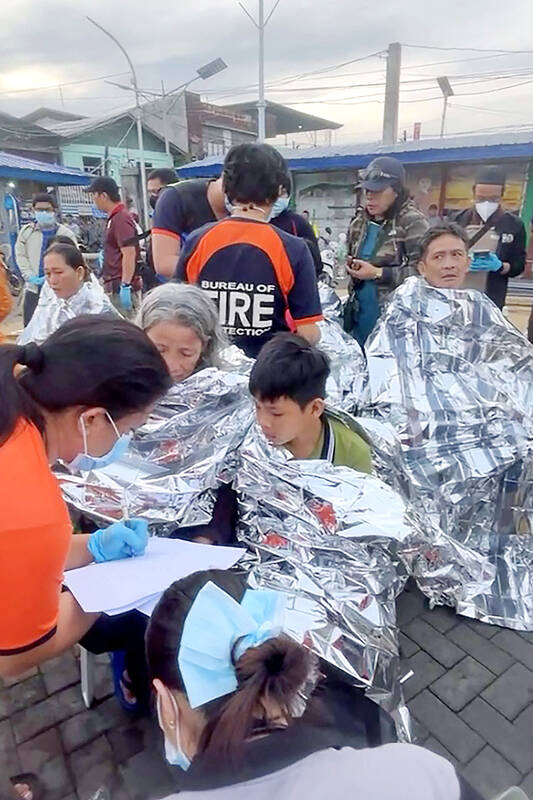
Photo: AFP/ Governor Mujiv Hataman
Video released by the governor of Basilan province showed barefoot survivors being wrapped in blankets and placed on gurneys, while victims of the sinking were carried past in body bags.
The triple-decker vessel sank on nearly the same route where 31 people died in 2023 after a fire aboard the Lady Mary Joy 3 ferry. Both ships were owned by locally based Aleson Shipping Lines.
Sheryl Balondo, a rescuer in Isabela City, one of two municipalities where survivors were being taken, said their office had received more than 100 phone calls from concerned family members.
“There’s a tug in our hearts whenever we pick up a call. Their voices sounded worried,” she said. “What we can only say is that, as of now, we don’t have the final list [of names], because the search-and-retrieval operation is ongoing.”
The 44m ferry went down about 5km east of Baluk-Baluk Island, part of the Basilan province chain of islands off the Zamboanga peninsula.
“Based on the account of some survivors, the waters in the area were rough at the time,” Cayabyab said in a televised interview.
At least two survivors disputed that account, saying the seas had been calm when the ship capsized.
“I hope they investigate this, because we did not have bad weather. Why did it sink when there was no storm?” asked Jun Guro, a lawyer whose interview was posted by the Isabela City government in Basilan.
Basilan emergency responder Ronalyn Perez said earlier that rescuers were struggling to handle the influx of survivors.
“The challenge really is the number of patients that are coming in. We are short-staffed at the moment,” Perez said in an interview, adding that at least 18 had been taken to one local hospital.
Philippine industry regulator the Maritime Industry Authority later said it had “dispatched an investigation team to determine the probable cause or any factors that may have contributed to the incident.”

‘NO SECURITY RISK’: The Railway Bureau reassured the public that the technicians’ activities were limited to technical guidance and did not involve sensitive systems The Railway Bureau yesterday said it had invited eight Chinese technicians to assist with an airport MRT construction project. The bureau issued the confirmation after an Internet user said Chinese nationals had entered the construction zone of Taiwan Taoyuan International Airport’s Terminal 3 project. They asked why “individuals from an enemy state” were allowed access to such a major national infrastructure project, which raised serious concerns over Taiwan’s industrial safety, sensitive systems and information security. The bureau’s Northern Region Engineering Branch Office said subcontractor Taiwan Handle Industrial Co (台灣手把工業) of the Taoyuan airport MRT’s “Contract No. CU05 Project A14 Station Civil, MEP &

The National Chungshan Institute of Science and Technology yesterday showcased its locally developed variants of the Vision 60 robotic patrol dog, which it plans to deploy on the nation’s outlying territories in the South China Sea. The variants were produced under the Joint Lab project — created by the institute and domestic companies — and assembled with domestically produced motors, lenses and artificial intelligence (AI) systems alongside licensed tech from the US, Missile and Rocket Systems Research Division deputy director Jen Kuo-kang (任國光) told the media event at a military base in Taipei’s Dazhi (大直) area. Taiwan has built up its strengths
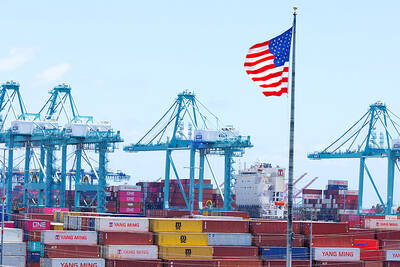
NOT IMMEDIATE: Taiwan has a chance to appeal the proposed 10 percent tariff before it starts, while other countries face a 12.5 percent tariff from the trade office Taiwan is among 60 economies determined by the US to have failed to impose or enforce a ban on the importation of goods produced with forced labor, according to a notice released on Tuesday by the Office of the US Trade Representative (USTR), which proposed imposing an additional 10 percent or more tariff on them. The USTR in a statement said that following an investigation, it had determined under Section 301 of the Trade Act of 1974 that the failure of the 60 economies to impose and effectively enforce a prohibition on the importation of goods produced with forced labor is

TIT-FOR-TAT: The US allegedly revoked the visa of a Chinese national working at Xinhua News Agency in the US in response to Beijing’s expulsion of Vivian Wang The Presidential Office yesterday condemned China for expelling a New York Times correspondent from Beijing following the newspaper’s interview with President William Lai (賴清德), saying the move highlighted Beijing’s suppression of press freedom and its threat to international news media. Taiwan has noted a series of recent incidents in which Beijing used similar tactics to “threaten and pressure international media outlets and journalists,” Presidential Office spokeswoman Karen Kuo (郭雅慧) said in a statement. “This concerns not only press freedom and freedom of expression, but also the safety of journalists, and Taiwan and relevant partners are paying close attention to the situation,” she


 RSS
RSS