


Taiwan aims to build a “democratic” high-tech supply chain with the US and form a strategic artificial intelligence (AI) partnership under the new tariffs deal it sealed with Washington last week, Taipei’s top negotiator in the talks said yesterday.
US President Donald Trump has pushed Taiwan, a major producer of semiconductors which runs a large trade surplus with the US, to invest more in the US, specifically in chips that power AI.
Under the terms of the long-negotiated deal, chipmakers such as Taiwan Semiconductor Manufacturing Co (TSMC, 台積電) that expand US production would incur a lower tariff on semiconductors or related manufacturing equipment, and products they import into the US, and would be able to import some items duty-free.
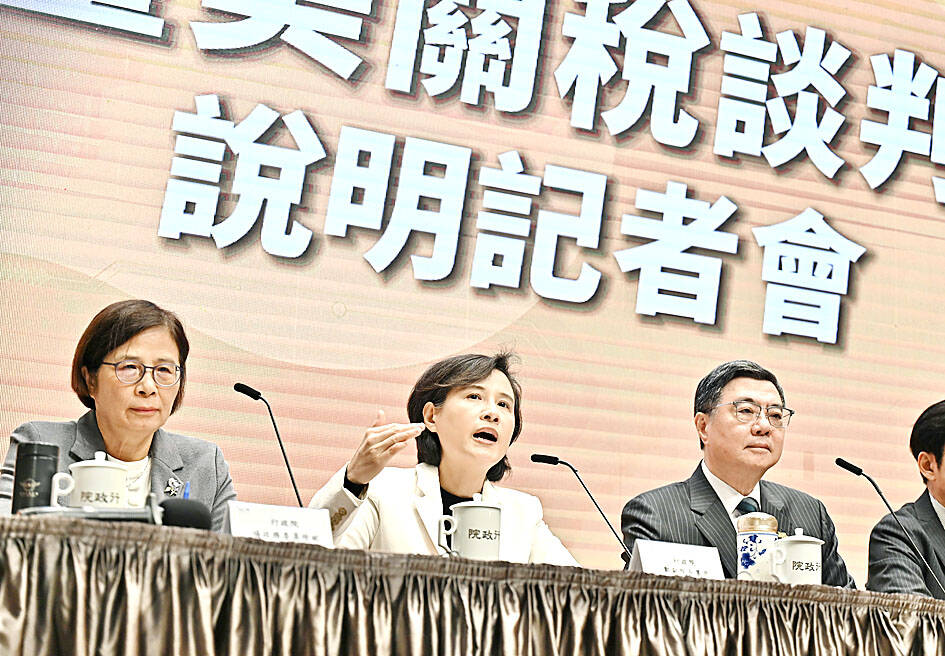
Photo: Tu Chien-jung, Taipei Times
Broad tariffs that apply to most other Taiwanese exports to the US would fall from 20 percent to 15 percent.
Taiwanese companies are to invest US$250 billion to boost the production of semiconductors and AI in the US, while Taiwan would also guarantee an additional US$250 billion in credit to facilitate further investment.
Vice Premier Cheng Li-chiun (鄭麗君) told a news conference in Taipei that the deal was not about hollowing out Taiwan’s chip industry, which is so important for the economy it is widely referred to as a “sacred mountain protecting the country.”
“This is not supply-chain relocation; rather it is support for Taiwan’s high-tech industries to extend their strength abroad — through addition and even multiplication — to expand a strong international footprint in the United States,” she said.
Under the agreement, chipmakers that expand in the US would be able to import up to 2.5 times their new capacity of semiconductors and wafers with no extra tariffs during an approved construction period. Preferential treatment would apply to chips that exceed that quota.
Taiwan has also secured preferential treatment in advance under any Section 232 measures on semiconductors, which is an ongoing US national security investigation into imports of key products such as chips and pharmaceuticals, Cheng said.
“As for what the actual Section 232 semiconductor tariff would be, [US] Secretary [of Commerce Howard] Lutnick mentioned a possible rate of 100 percent, but this remains undecided,” she said.
“Regardless, under any future tariff scenario, we have ensured that the US would grant Taiwan the most favorable treatment — zero tariffs within the quota and preferential tariffs even outside the quota,” she added.
Premier Cho Jung-tai (卓榮泰) said that the US$250 billion in private investment by enterprises and the US$250 billion in credit guarantees provided by the government are separate, urging the media to stop reporting them as a combined total of US$500 billion.
Asked to elaborate on the credit guarantees, Cheng said the estimated funding required for the credit guarantee mechanism is between US$6.25 billion and US$10 billion, which would be planned in five phases, with participation from the National Development Fund, and public and private banks.
As for how the credit guarantee mechanism would be established, Cheng said that, in principle, the government would not use the Ministry of Economic Affairs’ Small and Medium Enterprise Credit Guarantee Fund.
That is because the National Development Council already has a national financing guarantee mechanism in place, which has previous experience in offshore wind power and major public infrastructure projects, she said, adding that a project-specific national financing guarantee mechanism would be established under this framework.
Taiwan has negotiated with the US to exempt more than 1,000 items from tariffs and the Taiwan-US Agreement on Reciprocal Trade would be signed in a few weeks, she added.
Many of the provisions involve trade facilitation, non-tariff barriers, economic security, labor protection, environmental protection, as well as business investment and commercial opportunities, Cheng said, adding that after the agreement is signed, a full explanation would be provided to the public.
When asked if market opening includes reducing tariffs on US car imports, chief trade negotiator Minister Without Portfolio Yang Jen-ni (楊珍妮) said the US has requested full market opening, aligning with the market openings of neighboring nations.
The opening of the automobile market and tariff reductions would be part of these negotiations, she said, adding the final text would need to be submitted to the Legislative Yuan for review.
Minister of Economic Affairs Kung Ming-hsin (龔明鑫) said that after the reciprocal tariff is reduced to 15 percent, Taiwan’s tariffs would be aligned with those of Japan, South Korea and the EU.
Compared with traditional competitive nations such as Vietnam and China, Taiwan’s performance would improve, particularly in industries such as bicycles and hardware for water systems, he said.
He said that analysis by two research think tanks of the overall impact on industries suggested that now that the tariffs have been lowered to 15 percent, the overall impact has shifted from negative to positive.
Additional reporting by Chen Yu-fu and CNA
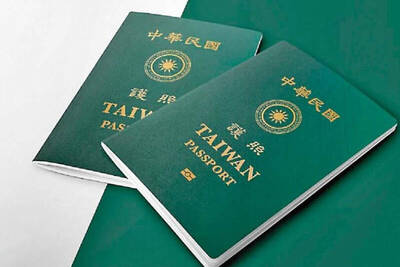
The Taiwanese passport ranked 33rd in a global listing of passports by convenience this month, rising three places from last month’s ranking, but matching its position in January last year. The Henley Passport Index, an international ranking of passports by the number of designations its holder can travel to without a visa, showed that the Taiwan passport enables holders to travel to 139 countries and territories without a visa. Singapore’s passport was ranked the most powerful with visa-free access to 192 destinations out of 227, according to the index published on Tuesday by UK-based migration investment consultancy firm Henley and Partners. Japan’s and
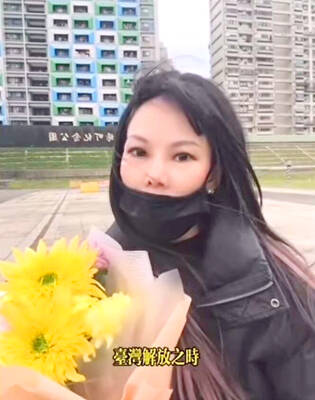
NATIONAL SECURITY THREAT: An official said that Guan Guan’s comments had gone beyond the threshold of free speech, as she advocated for the destruction of the ROC China-born media influencer Guan Guan’s (關關) residency permit has been revoked for repeatedly posting pro-China content that threatens national security, the National Immigration Agency said yesterday. Guan Guan has said many controversial things in her videos posted to Douyin (抖音), including “the red flag will soon be painted all over Taiwan” and “Taiwan is an inseparable part of China,” while expressing hope for expedited “reunification.” The agency received multiple reports alleging that Guan Guan had advocated for armed reunification last year. After investigating, the agency last month issued a notice requiring her to appear and account for her actions. Guan Guan appeared as required,
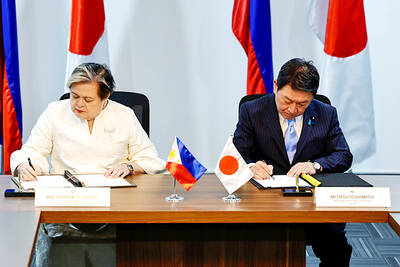
Japan and the Philippines yesterday signed a defense pact that would allow the tax-free provision of ammunition, fuel, food and other necessities when their forces stage joint training to boost deterrence against China’s growing aggression in the region and to bolster their preparation for natural disasters. Japan has faced increasing political, trade and security tensions with China, which was angered by Japanese Prime Minister Sanae Takaichi’s remark that a Chinese attack on Taiwan would be a survival-threatening situation for Japan, triggering a military response. Japan and the Philippines have also had separate territorial conflicts with Beijing in the East and South China
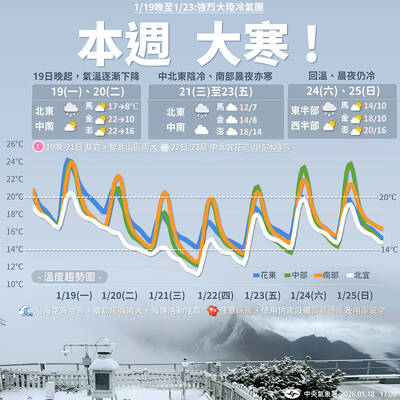
A strong cold air mass is expected to arrive tonight, bringing a change in weather and a drop in temperature, the Central Weather Administration (CWA) said. The coldest time would be early on Thursday morning, with temperatures in some areas dipping as low as 8°C, it said. Daytime highs yesterday were 22°C to 24°C in northern and eastern Taiwan, and about 25°C to 28°C in the central and southern regions, it said. However, nighttime lows would dip to about 15°C to 16°C in central and northern Taiwan as well as the northeast, and 17°C to 19°C elsewhere, it said. Tropical Storm Nokaen, currently


 RSS
RSS