


Voting concluded in Myanmar’s month-long election yesterday, with the dominant pro-military party on course for landslide victory in a junta-run poll critics say would only prolong the army’s grip on power.
The Southeast Asian nation has a long history of military rule, but the generals took a back seat for a decade of civilian-led reforms.
That ended in a 2021 military coup when democratic figurehead Aung San Suu Kyi was detained, civil war broke out, and the country descended into humanitarian crisis.
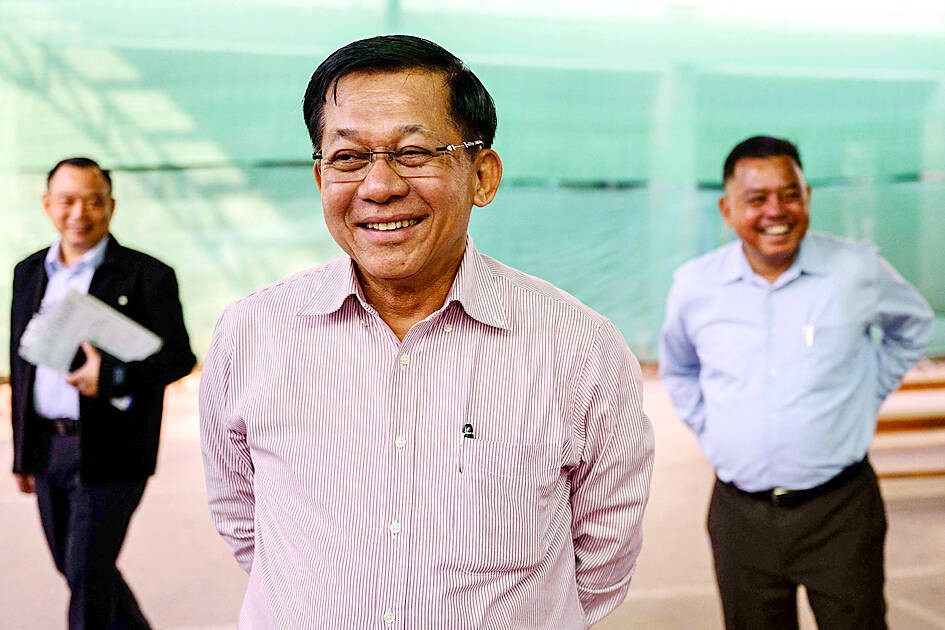
Photo: AFP
The election’s third and final phase closed after voting took place in dozens of constituencies across the country, just a week shy of the coup’s five-year anniversary.
The military pledges the election would return power to the people, but with Aung San Suu Kyi sidelined and her party dissolved, democracy advocates say the ballot is stacked with military allies.
Junta chief Min Aung Hlaing — who has not ruled out serving as president after the poll — toured voting stations in Mandalay, wearing civilian dress.
“This is the path chosen by the people,” he told reporters. “The people from Myanmar can support whoever they want to support.”
Voting is not being held in rebel-held parts of the country, and in junta-controlled areas rights monitors say the run-up has been characterized by coercion and the crushing of dissent.
Teacher Zaw Ko Ko Myint cast his vote at a Mandalay high school around dawn.
“Although I do not expect much, we want to see a better country,” the 53-year-old said. “I feel relieved after voting, as if I fulfilled my duty.”
The Union Solidarity and Development Party (USDP) — packed with retired officers and described by analysts as a military puppet — won more than 85 percent of elected lower house seats and two-thirds of those in the upper house in the poll’s first two phases.
“States that endorse the results of these polls will be complicit in the junta’s attempt to legitimize military rule through a fabricated vote,” UN Special Rapporteur on Human Rights in Myanmar Tom Andrews said in a statement on Friday.
A military-drafted constitution also gives the armed forces one-quarter of the seats in both houses of parliament, which would vote to pick the president.
“I don’t expect anything from this election,” a 34-year-old Yangon resident said earlier, requesting anonymity for security reasons. “Things will just keep dragging on.”
Aung San Suu Kyi’s National League for Democracy party thrashed the USDP in the last elections in 2020, before the military seized power on Feb. 1, 2021, making unfounded allegations of widespread vote-rigging.
The 80-year-old Nobel Peace Prize laureate remains detained incommunicado at an unknown location on charges rights monitors dismiss as politically motivated.
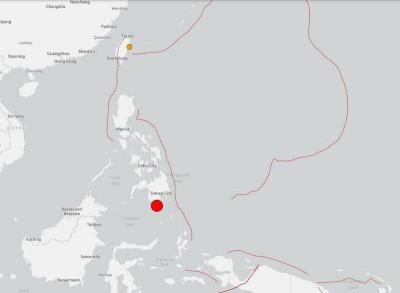
A magnitude 7.8 earthquake struck off the southern coast of Mindanao in the Philippines at 7:38am today, prompting the US Tsunami Warning System to issue an alert for neighboring countries, including Taiwan. The system issued a purple alert indicating a "tsunami threat." The potential threat zone includes Taiwan, the Philippines, Papua New Guinea, Yap and Palau. Philippine authorities were assessing the damage from the quake, with the office of civil defense seeking to verifying initial reports that 15 people had been killed and 129 injured in the region, mostly from falling debris. Arlene Hollero, disaster chief of Maasim town in the Philippines' Sarangani Province,

‘GRAY ZONE’ PRESSURE: Beijing’s activities are intended to create the deceitful impression that China has jurisdiction over the area around Taiwan, the CGA said Taiwan’s rights over its territorial waters and exclusive economic zone must not be violated by any country, the Mainland Affairs Council said yesterday, adding that it will not accept any unprovoked actions. The council issued the remarks in response to the China Coast Guard conducting maritime enforcement drills near eastern Taiwan and claiming to fully exercise China’s maritime administrative law enforcement authority. The Coast Guard Administration (CGA) has been closely monitoring the situation and is taking concrete steps to defend the nation’s sovereignty and secure its waters, the council said. China has no sovereign rights over the waters off eastern

RESILIENCE: Taiwan plays a key role in semiconductors, energy, information infrastructure and advanced manufacturing, AIT Director Raymond Greene said Taiwan’s continued investment in deterrence and resilience remains vital, especially in uncrewed systems and other emerging technologies, American Institute in Taiwan (AIT) Director Raymond Greene said yesterday. Greene made the remarks at the annual National Strategic Summit on Supply Chain Resilience held by the Research Institute for Democracy, Society and Emerging Technology (DSET), a government-backed think tank. As Taiwan last year became the US’ fourth-largest trading partner and supply chain security is becoming more important, cooperation in emerging technologies continues to deepen between the two countries, he said. The US is committed to accelerating innovation, building key infrastructure, strengthening cooperation

The National Chungshan Institute of Science and Technology yesterday showcased its locally developed variants of the Vision 60 robotic patrol dog, which it plans to deploy on the nation’s outlying territories in the South China Sea. The variants were produced under the Joint Lab project — created by the institute and domestic companies — and assembled with domestically produced motors, lenses and artificial intelligence (AI) systems alongside licensed tech from the US, Missile and Rocket Systems Research Division deputy director Jen Kuo-kang (任國光) told the media event at a military base in Taipei’s Dazhi (大直) area. Taiwan has built up its strengths


 RSS
RSS