


The Ministry of National Defense yesterday released information on seven categories of weapons systems to be procured under a stalled NT$1.25 trillion (US$39.57 billion) special defense budget, including precision artillery, long-range missiles, air defense anti-tank missiles and more than 200,000 uncrewed aerial vehicles (UAVs).
The Executive Yuan approved a draft version of the budget on Nov. 27 last year and submitted it to the legislature for review.
The legislature’s Foreign Affairs and National Defense Committee yesterday invited Minister of National Defense Wellington Koo (顧立雄) to deliver a classified briefing and answer questions at a closed-door session.
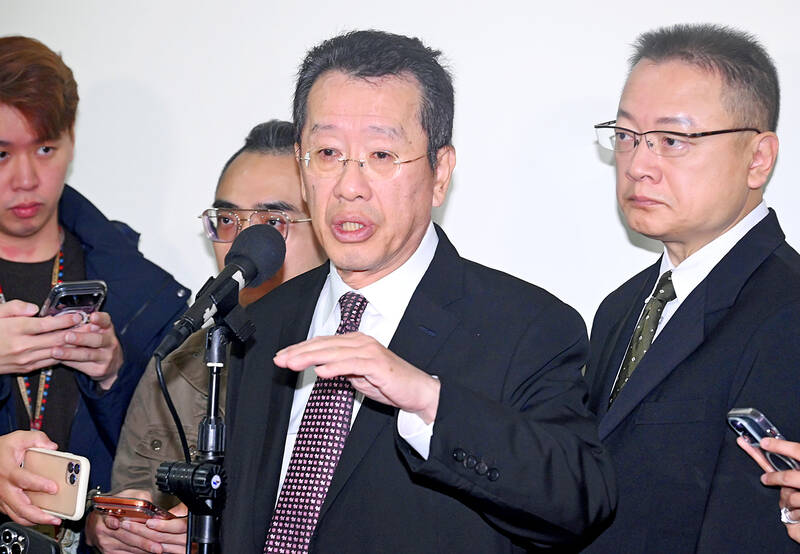
Photo: Liao Chen-huei, Taipei Times
Koo said he hoped to provide lawmakers across party lines with a detailed explanation of the proposal and urged that it be referred to committee review as soon as possible.
Following the briefing, the ministry submitted publicly releasable planning and implementation details for the proposed bill. The ministry said the special budget focuses on building a comprehensive defense system, integrating high technology and artificial intelligence (AI) to accelerate kill chains, and strengthening the domestic defense industry while establishing non-China-based supply chains.
The first category is precision artillery, including 60 M109A7 self-propelled howitzers, 4,080 rounds of precision munitions, 60 ammunition resupply vehicles, 13 recovery vehicles, and related shells and auxiliary equipment.
The second category is long-range precision strike missiles, including 82 High Mobility Artillery Rocket Systems (HIMARS), 1,203 pods of precision rockets and 420 tactical missiles.
The third category comprises uncrewed platforms and counterdrone systems. This includes anti-armor loitering munitions, with 1,554 Altius-700M units and 478 Altius-600ISR units; approximately 200,000 UAVs — including coastal surveillance and reconnaissance drones, and coastal attack drones — as well as more than 1,000 uncrewed surface vessels and a range of counterdrone systems.
The fourth category comprises air-defense, ballistic missile defense and anti-armor missiles, including 70 Javelin anti-armor missile systems with 1,050 missiles, 24 TOW-2B anti-armor missile systems with 1,545 missiles, and various air-defense missile systems and munitions.
The fifth category covers AI-assisted capabilities, including AI-based decision-support systems, tactical networks and rapid intelligence-sharing application packages for military units.
The sixth category focuses on equipment to enhance sustained combat capabilities. Plans include expanding military production to meet wartime consumption, covering the production of ammunition and propellants, small-arms primers, new armored vehicle assembly lines, high-energy explosives, chemical protection masks and night-vision devices. This category also includes mobile battlefield denial equipment to improve area-denial capabilities.
The budget also calls for the procurement of urgently needed munitions to boost readiness stockpiles and meet training requirements before local production can be ramped up. These include 120mm tank rounds, 105mm tank rounds, 30mm autocannon ammunition, 155mm howitzer propellant charges and high-powered explosives.
The seventh category involves equipment and systems jointly developed and procured by Taiwan and the US. The ministry said such cooperation would allow Taiwan to acquire emerging technologies to strengthen operational resilience and enhance asymmetric combat capabilities.
The ministry also briefed the committee on the progress of arms procurement contracts, or letters of offer and acceptance. Five items — M109A7 howitzers, HIMARS, Altius anti-armor loitering munitions, Javelin missiles and TOW-2B missiles — have completed the US notification process.
For the remaining cases, the US Department of Defense is expediting its internal review procedures, the ministry said.
While procurement quantities and costs have been confirmed based on operational needs, adjustments would be made as appropriate following the legislature’s final approval of the budget, it said.
The ministry said that China’s increasingly targeted military exercises based on scenarios for operations against Taiwan suggest an intent to shift “from exercises to drills, and from drills to war,” exacerbating instability in the Taiwan Strait.

A signaling system malfunction disrupted high-speed rail (HSR) services beginning at 8am today, with trains temporarily reduced to three northbound and three southbound trains per hour as authorities conduct inspections. The malfunction occurred on a section of track in Miaoli County during pre-operation checks early this morning, forcing northbound and southbound trains to use a single track, the HSR operator said. The regular schedule has been replaced with three hourly trains offering only nonreserved seating in each direction, stopping at every station, it said, adding that business class cars would still have reserved seating. Departures from terminal stations are scheduled at the top
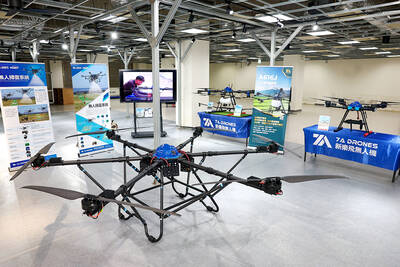
DRONE CENTRAL: Taiwan aims to become Asia’s democratic hub for drones, with most exports focused on high-quality military-grade models, an official said Taiwan’s drone industry is expected to expand significantly by 2030, producing 100,000 units per month and exporting half of them, the Ministry of Economic Affairs said yesterday. Current drone production capacity is about 15,000 units per month, but the industry can quickly scale up as demand increases, Industrial Development Administration Director-General Chiou Chyou-huey (邱求慧) told a news conference in Taipei. Taiwan’s drone output grew 2.5-fold last year to NT$12.9 billion (US$408.3 million) under a government program to develop the uncrewed vehicle sector, he said. The Executive Yuan in October last year approved plans to invest NT$44.2 billion into domestic production of uncrewed aerial

Taiwan is still in the process of assessing the possibility of recruiting workers from Eswatini, the Ministry of Foreign Affairs said yesterday, adding that its goal is to help Eswatini upgrade its vocational training centers. If there are plans to recruit workers from Eswatini, safeguarding national security, protecting public health and ensuring the employment rights of Taiwanese would be prerequisites, Department of West Asian and African Affairs Director-General Yen Chia-liang (顏嘉良) told a news conference. Key considerations would also include filling labor shortages in specific industries, and fostering bilateral professional and technical exchanges, he said. Yen was asked about the progress of labor

VERBOSE VESSELS: A CGA cutter and a China Coast Guard exchanged verbal barbs for more than a day in Taiwanese-controlled waters before the Chinese vessel left The Taiwanese and Chinese coast guards had a standoff near the strategically located Pratas Islands (Dongsha Islands, 東沙群島) in the north of the South China Sea, the Coast Guard Administration (CGA) said yesterday. The two sides engaged in intense radio exchanges over sovereignty claims during the 33-hour standoff. China Coast Guard vessel 3501 eventually left the restricted waters, 26.6 nautical miles (49.2km) west of the Pratas Islands, at 5pm yesterday, the CGA said. Lying approximately between southern Taiwan and Hong Kong, the Taiwan-controlled Pratas are seen by some security experts as vulnerable to Chinese attack due to their distance — more than


 RSS
RSS