


The Chinese Communist Party (CCP) has increased cross-border intimidation efforts against Hong Kongers in Taiwan over the past year, Hong Kong pro-democracy activist Henry Tong (湯偉雄) said.
Tong, who relocated to Taiwan after the anti-extradition bill protests in 2019, was placed on a “wanted list” by the Hong Kong government on Nov. 20 last year.
His Muay Thai gym was vandalized three days after the wanted list was issued, during which the gym’s surveillance camera was damaged and the main entrance was splashed with red paint.
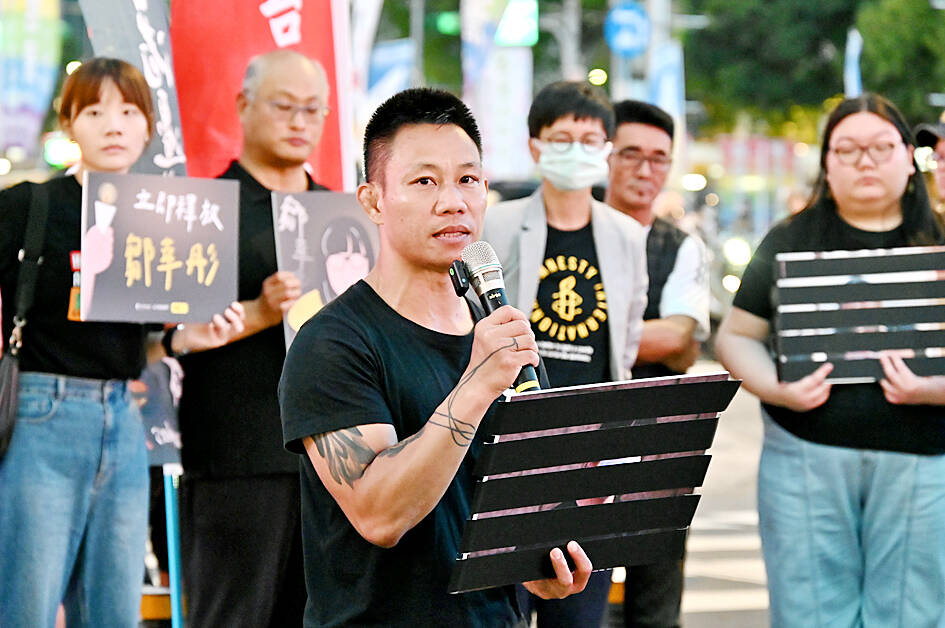
Photo: George Tsorng, Taipei Times
Police have identified two main suspects, who were from Hong Kong, Mainland Affairs Council Deputy Minister Liang Wen-chiang (梁文傑) said, adding that the suspects scouted the location before committing the crime and left Taiwan immediately after.
“The criminal act was meant to be a scare tactic to intimidate Tong and other Hong Kongers in Taiwan. The government would not tolerate anyone who complies with the CCP to repress Hong Kongers in Taiwan,” he added.
Tong, in an interview with the Liberty Times (the sister paper of the Taipei Times), said he believed the incident was connected to the CCP and Hong Kong authorities.
During Hong Kong’s legislative election campaign last year, he published several articles and urged Hong Kongers to boycott the vote, he said.
Several days after he was placed on a “wanted list” for allegedly contravening election laws, Tong said his studio was splashed with red paint.
The CCP previously relied on Taiwanese collaborators to threaten figures such as Lam Wing-kee (林榮基), the former owner of Hong Kong’s Causeway Bay Books, who had been detained by the CCP and later relocated to Taiwan, he said.
This time, the vandalism was carried out by operatives who were allegedly dispatched directly from Hong Kong, he added.
The purpose was to frighten him and make it harder for him to operate his business, and to warn and intimidate Hong Kongers living in Taiwan by sending a message that anyone who follows his example would face similar consequences, Tong said.
The CCP’s cross-border repression has gone beyond this incident, he said.
For example, during the private screenings of Deadline (自殺通告), a film directed by Kiwi Chow (周冠威) and banned in Hong Kong, unidentified people took photos of Hong Kongers in attendance, Tong said.
Similar surveillance acts have occurred at events he had organized or participated in, he said, citing as an example bomb threats during an event commemorating the Tiananmen Square Massacre on June 4 last year.
The CCP has stepped up its intimidation efforts over the past year, Tong said.
Hong Kong entities have also paid Taiwanese private detective firms to conduct surveillance, he said.
One firm hired happened to be run by an acquaintance of a friend, which was how he found out that Hong Kong was paying through legal channels to have people photographed, Tong said.
He also recalled an incident in October last year, during which Chinese tourists disrupted an event organized by Hong Kongers in Taiwan.
Although police provide protection, authorities often react only after incidents occur, he said, calling on the government to establish preventive mechanisms, including legal amendments imposing heavier penalties for cross-border repression.
This was an infringement on national security, not just a case of splashed paint, Tong said.
The CCP would be emboldened if no action is taken, he added.
An official familiar with the matter, speaking on the condition of anonymity, said Hong Kongers in Taiwan who encounter harassment, threats or unauthorized photography should report the incident to the police.
Prosecutors and investigators would handle cases involving cross-border repression in accordance with the law, they said, adding that authorities would not tolerate local private investigators or other collaborators that assist the CCP in its intimidation efforts.

SILENCING CRITICS: In addition to blocking Taiwan, China aimed to prevent rights activists from speaking out against authoritarian states, a Cabinet department said The Ministry of Foreign Affairs (MOFA) yesterday condemned transnational repression by Beijing after RightsCon, a major digital human rights conference scheduled to be held in Zambia this week, was abruptly canceled due to Chinese pressure over Taiwanese participation. This year’s RightsCon, the world’s largest conference discussing issues “at the intersection of human rights and technology,” was scheduled to take place from tomorrow to Friday in Lusaka, and expected to draw 2,600 in-person attendees from 150 countries, along with 1,100 online participants. However, organizers were forced to cancel the event due to behind-the-scenes pressure from China, the ministry said, expressing its “strongest condemnation”
Taiwan’s economy grew far faster than expected in the first quarter, as booming demand for artificial intelligence (AI) applications drove a surge in exports, spilling over into investment and consumption, the Directorate-General of Budget, Accounting and Statistics (DGBAS) said yesterday. GDP growth was 13.69 percent year-on-year during the January-to-March period, beating the DGBAS’ February forecast by 2.23 percentage points and marking the most robust growth in nearly four decades, DGBAS senior official Chiang Hsin-yi (江心怡) told a news conference in Taipei. The result was powered by exports, which remain the backbone of Taiwan’s economy, Chiang said. Outbound shipments jumped 51.12 percent year-on-year to
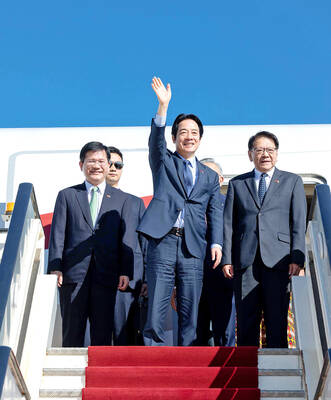
DELAYED BUT DETERMINED: The president’s visit highlights Taiwan’s right to international engagement amid regional pressure from China President Willaim Lai (賴清德) yesterday arrived in Eswatini, more than a week after his planned visit to Taiwan’s sole African ally was suspended because of revoked overflight permits. “The visit, originally scheduled for April 22, was postponed due to unforeseen external factors,” Lai wrote on social media. “After several days of careful arrangements by our diplomatic and national security teams, we successfully arrived today.” Lai said he looked forward to further deepening Taiwan-Eswatini relations through closer cooperation in the economy, agriculture, culture and education, as well as advancing the nation’s international partnerships. The president was initially scheduled to arrive in time to celebrate
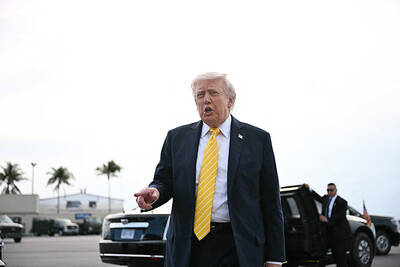
Iran’s Islamic Revolutionary Guard Corp (IRGC) yesterday said the US faced a choice between an “impossible” military operation or a “bad deal” with Tehran, after US President Donald Trump disparaged Iran’s latest peace proposal. Negotiations between the two countries have been deadlocked since a ceasefire came into effect on April 8, with only one round of direct peace talks held so far. Iran’s Tasnim and Fars news agencies reported that Tehran had submitted a 14-point proposal to mediator Pakistan, but Trump was quick to cast doubt on it. “I will soon be reviewing the plan that Iran has just sent to us, but


 RSS
RSS