


President William Lai (賴清德) yesterday offered to talk with Ukraine about a crackdown on sanctions-busting arms after Ukrainian President Volodymyr Zelenskiy named Taiwan as a source of illicit missile components.
Since Russia invaded Ukraine in 2022, Taiwan has continued updating export controls to stop high-tech goods from being used for military purposes, and has joined in wide, Western-led sanctions against Moscow.
Zelenskiy said Russia would not be able to produce missiles without “critical components sourced from China, Europe, the United States and Taiwan,” and showed excerpts published on the Ukrainian president’s Web site.
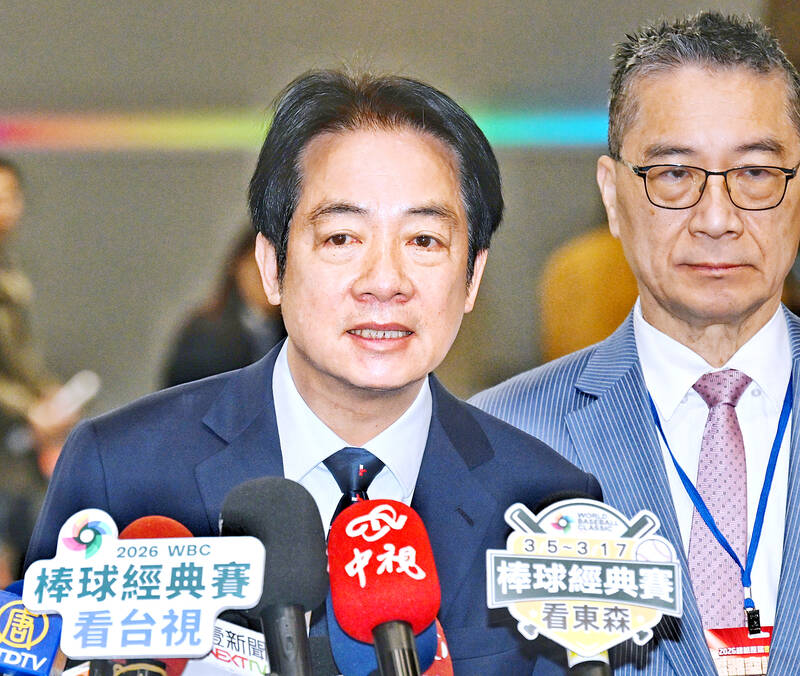
Photo: Fang Pin-chao, Taipei Times
Lai posted a response on X in English, saying that Taiwan has long worked with global partners to “staunchly support Ukraine through humanitarian aid & coordinated sanctions.”
“We welcome further exchanges of information with President @ZelenskyyUa to further clamp down on illegal 3rd country transshipment & concealed end-use,” he said, posting a picture of orchids in the color of Ukraine’s flag.
“There have been young Taiwanese who have sacrificed their lives to defend freedom in Ukraine,” Lai sai, referring to volunteer soldiers who have died fighting against Russia.
“We remain clear: any assistance to the aggressor or violations of int’l embargoes & export control regulations are unacceptable. We pray for peace to be restored to Ukraine soon,” he wrote.
Speaking to reporters in Taipei, Lai said he welcomed Zelenskiy to pass on any information to Taiwan about sanctions busting.
“We are willing to strengthen controls on goods that are routed through third countries while concealing their final destination, to prevent them from entering Russia and to protect Ukraine,” Lai added.
The Ukrainian Presidential Office could not be reached for comment outside of office hours.
In November last year, the government said that it was revising export controls to comply with the Wassenaar Arrangement, an international agreement which aimed to prevent weapons proliferation, although Taiwan is not an official signatory.
While senior officials have spoken directly with some Ukrainian city mayors, there has been no publicly acknowledged direct contact between the two governments.
Like most countries, Ukraine only has formal diplomatic relations with Beijing, not Taipei.
Taiwan and Ukraine do not have de facto embassies in each other’s capitals, and Taiwanese humanitarian aid to Ukraine has mostly been coordinated by Taiwan’s diplomatic offices in central and eastern Europe.
Taiwan has compared the Russian invasion of Ukraine to China’s military threat against Taiwan.
Late last year, a senior military officer told a forum in Poland that if Russia defeats Ukraine it would embolden China in its behavior toward Taiwan, adding that Taipei hoped Kyiv would emerge victorious.
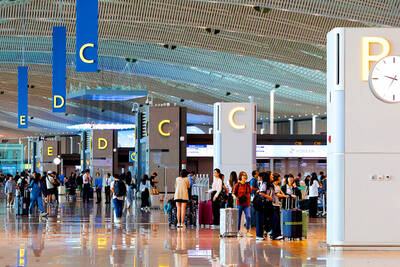
South Korea has adjusted its electronic arrival card system to no longer list Taiwan as a part of China, a move that the Ministry of Foreign Affairs said would help facilitate exchanges between the two sides. South Korea previously listed “Taiwan” as “Taiwan (China)” in the drop-down menus of its online arrival card system, where people had to fill out where they came from and their next destination. The ministry had requested South Korea make a revision and said it would change South Korea’s name on Taiwan’s online immigration system from “Republic of Korea” to “Korea (South),” should the issue not be

Tainan, Taipei and New Taipei City recorded the highest fines nationwide for illegal accommodations in the first quarter of this year, with fines issued in the three cities each exceeding NT$7 million (US$220,639), Tourism Administration data showed. Among them, Taipei had the highest number of illegal short-term rental units, with 410. There were 3,280 legally registered hotels nationwide in the first quarter, down by 14 properties, or 0.43 percent, from a year earlier, likely indicating operators exiting the market, the agency said. However, the number of unregistered properties rose to 1,174, including 314 illegal hotels and 860 illegal short-term rental
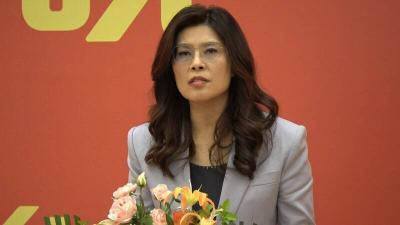
Both sides of the Taiwan Strait share a political foundation based on the “1992 consensus” and opposition to Taiwanese independence, Chinese Nationalist Party (KMT) Chairwoman Cheng Li-wun (鄭麗文) today said during her meeting with Chinese President Xi Jinping (習近平). Both sides of the Strait should plan and build institutionalized and sustainable mechanisms for dialogue and cooperation based on that foundation to make peaceful development across the Strait irreversible, she said. Peace is a shared moral value across the Strait, and both sides should move beyond political confrontation to seek institutionalized solutions to prevent war, she said. Mutually beneficial cross-strait relations are what the
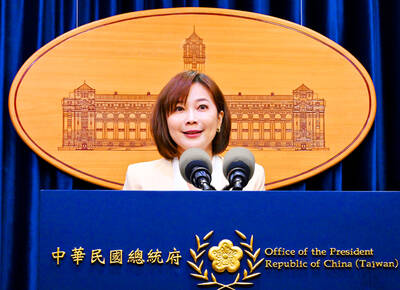
ECONOMIC COERCION: Such actions are often inconsistently applied, sometimes resumed, and sometimes just halted, the Presidential Office spokeswoman said The government backs healthy and orderly cross-strait exchanges, but such arrangements should not be made with political conditions attached and never be used as leverage for political maneuvering or partisan agendas, Presidential Office spokeswoman Karen Kuo (郭雅慧) said yesterday. Kuo made the remarks after China earlier in the day announced 10 new “incentive measures” for Taiwan, following a landmark meeting between Chinese President Xi Jinping (習近平) and Chinese Nationalist Party (KMT) Chairwoman Cheng Li-wun (鄭麗文) in Beijing on Friday. The measures, unveiled by China’s Xinhua news agency, include plans to resume individual travel by residents of Shanghai and China’s Fujian


 RSS
RSS