


Tokyo and Washington yesterday agreed to boost joint production of defense equipment, including missiles, and expand their military presence in waters southwest of Japan, as China ramps up pressure on its Asian neighbor.
The agreement came after Japanese Minister of Defense Shinjiro Koizumi met US Secretary of Defense Pete Hegseth in Washington, where they also pledged further cooperation on supply chains including critical minerals.
Japan is embroiled in a heated diplomatic spat with China, triggered by Japanese Prime Minister Sanae Takaichi’s suggestion last year that Japan could intervene militarily if China attacks Taiwan.

Photo: AP
China reacted angrily, blocking exports to Japan of “dual-use” items with potential military applications, fueling worries in Tokyo that Beijing could choke supplies of much-needed rare earths.
As the “security environment is rapidly growing severe” in Asia, “the two ministers confirmed the Japan-US alliance remains absolutely unwavering,” the Japanese Ministry of Defense said.
The two countries also agreed to further advance joint production of air-to-air missiles and surface-to-air interceptors, and work on the expansion of “more sophisticated and practical joint drills in various locations including the southwest region,” it said.
Beefing up defense around the so-called “southwest” region, which includes areas such as Okinawa, is one of Japan’s top priorities.
Okinawa, home to the vast majority of US military bases in Japan, serves as a key US outpost to monitor China, the Taiwan Strait and the Korean Peninsula, with Tokyo and Washington stressing its strategic importance.
Tokyo has also been increasing its military budget, including last month, when the government approved a record ¥9 trillion (US$57 billion) in defense spending for the upcoming fiscal year.
Hegseth praised Japan for that effort, calling it “hard-nosed realism; practical, common-sense approach that puts both of our vital national interests together,” according to the US Department of War, recently rebranded from the Department of Defense.

LEVERAGE: China did not ‘need to fire a shot’ to deny Taiwan airspace over Africa when it owns ‘half the continent’s debt,’ a US official said, calling it economic warfare The EU has raised concerns about overflight rights following the delay of President William Lai’s (賴清德) planned state visit to the Kingdom of Eswatini after three African nations denied overflight clearance for his charter at the last minute. Taiwanese allies Paraguay and Saint Kitts and Nevis, as well as several US lawmakers and the Inter-Parliamentary Alliance on China (IPAC) condemned China for allegedly pressuring the countries. Lai was scheduled to fly directly to Taiwan’s only African ally from yesterday to Sunday to celebrate the 40th anniversary of King Mswati III’s accession and his 58th birthday, but Seychelles, Mauritius and Madagascar suddenly revoked
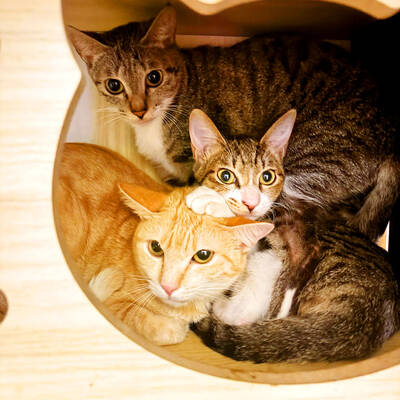
The number of pet cats in Taiwan surpassed that of pet dogs for the first time last year, reaching 1,742,033, a 32.8 percent increase from 2023, the Ministry of Agriculture said yesterday, citing a survey. By contrast, the number of pet dogs declined slightly by 1.2 percent over the same period to 1,462,528, the ministry said. Despite the shift, households with dogs still slightly outnumber those with cats by 1.2 percent. However, while the number of households with multiple dogs has remained relatively stable, households keeping more than two cats have increased, contributing to the overall rise in the feline population. The trend
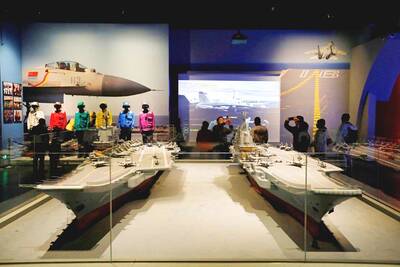
China on Wednesday teased in a video an aircraft carrier that could be its fourth, and the first using nuclear power, while making an allusion to Taiwan and vowing to further build up its islands, as it looks to boost maritime power, secure resources and bolster territorial claims. The video, issued on the eve of the 77th founding anniversary of the Chinese People’s Liberation Army Navy, featured fictional officers with names that are homophones of three commissioned aircraft carriers, the Liaoning (遼寧), Shandong (山東) and Fujian (福建). Titled Into the Deep, it showed a 19-year-old named “Hejian” (何劍) joining the group, sparking
BIG YEAR: The company said it would also release its A12 chip the same year to keep a ‘reliable stream of new silicon technologies’ flowing to its customers Taiwan Semiconductor Manufacturing Co (TSMC, 台積電) yesterday said its newest A13 chip is to enter volume production in 2029 as the chipmaker seeks to hold onto its tech leadership and demand for next-generation chips used in artificial intelligence (AI), high-performance-computing (HPC) and mobile applications. TSMC, the world’s biggest contract chipmaker, also unveiled its A12 chip at its annual technology symposium in Santa Clara, California. The A12 chip, which features TSMC’s super-power-rail technology to provide backside power delivery for AI and HPC applications, is also to enter volume production in 2029, a year after the scheduled release of the A14 chip. The technology moves


 RSS
RSS