


Taiwan Semiconductor Manufacturing Co (TSMC, 台積電) yesterday said it plans to spend a record-high US$52 billion to US$56 billion in capital expenditure this year to expand advanced chip capacity to meet “insatiable” demand for artificial intelligence (AI) applications.
The budget represents a surge of 27 to 37 percent compared with the US$40.9 billion spent last year.
About 70 to 80 percent of this year’s budget would be earmarked for leading-edge technology expansion, while about 10 to 20 percent would be allocated for advanced chip packaging technology, TSMC said.
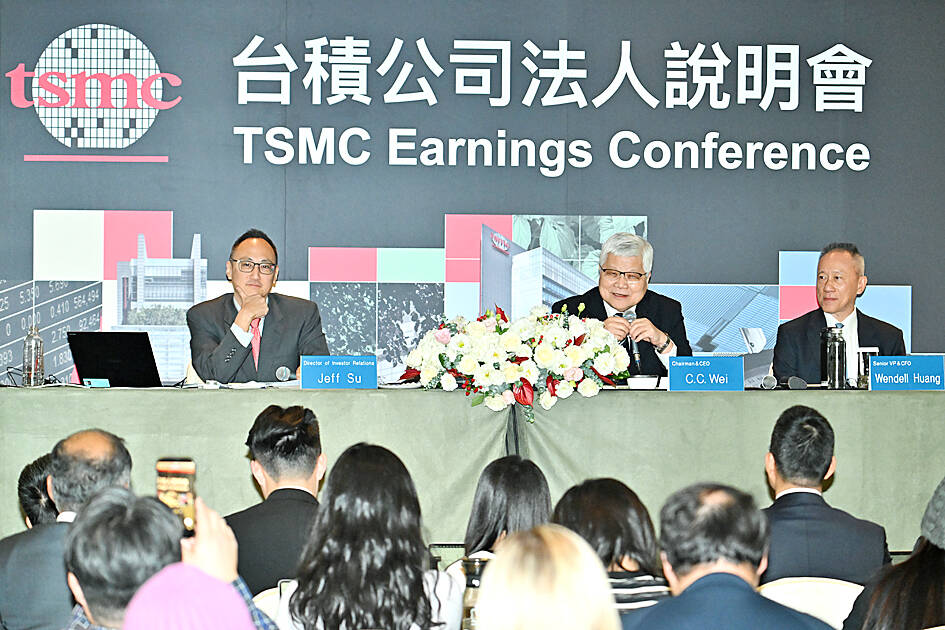
Photo: Tien Yu-hua, Taipei Times
The go-to chipmaker for Nvidia Corp and Apple Inc said the capital spending spree would carry through 2028 as it attempts to solve chip supply bottlenecks.
“We observe increasing AI model adoption across consumer, enterprise and sovereign AI segments. That is driving meaningful demand for more and more computation, which supports robust demand for leading-edge silicon,” TSMC chairman and chief executive officer C.C. Wei (魏哲家) told an earnings conference in Taipei.
As customers continue to provide a positive outlook — along with strong signals from businesses such as cloud service providers — TSMC is convinced that “the multiyear AI mega-trend remains strong. We believe that demand for semiconductors will continue to be fundamental,” Wei said.
“I believe the AI [boom] is real. Not only real, it has started growing into our daily life,” Wei said.
To address strong AI chip demand, TSMC said it is expanding chip manufacturing capacity in Taiwan, including 2-nanometer facilities in Hsinchu County and Kaohsiung, and advanced chip packaging capacity.
In the US, TSMC is stepping up capacity buildup in Arizona, as it plans to move in new manufacturing equipment this year for its second fab in the US state, in preparation for high-volume production of 3-nanometer chips in the second half of next year, the company said.
TSMC is building a third fab at the site and seeking construction permits for a fourth, as well as its first advanced chip packaging facility there, it said.
TSMC has also acquired a second plot of land in Arizona, where it plans to build multiple chip fabs to create a “gigafab” cluster, Wei said.
The company continues efforts to narrow the gap between customer demand and chip supply, and expects more healthy supply-demand dynamics in 2028 or 2029, he said.
TSMC also expects robust AI demand to boost its revenue growth by about 30 percent this year, with about 25 percent growth on average from 2024 to 2029.
Revenue this quarter is expected to grow about 4 percent sequentially, or 38 percent annually, to between US$34.6 billion and US$35.8 billion, the company said.
Gross margin is to climb to between 63 and 65 percent this quarter from 62.3 percent the previous quarter, as cost improvement and higher factory utilization help offset margin dilution from its overseas fabs, it said.
The company yesterday reported record-high net profit of NT$1.717 trillion (US$54.35 billion) for last year, soaring 46.4 percent from NT$1.173 trillion in 2024. Earnings per share rose to NT$66.25 from NT$45.25, and gross margin increased to 59.9 percent from 56.1 percent.

PROVOCATIVE: Chinese Deputy Ambassador to the UN Sun Lei accused Japan of sending military vessels to deliberately provoke tensions in the Taiwan Strait China denounced remarks by Japan and the EU about the South China Sea at a UN Security Council meeting on Monday, and accused Tokyo of provocative behavior in the Taiwan Strait and planning military expansion. Ayano Kunimitsu, a Japanese vice foreign minister, told the Council meeting on maritime security that Tokyo was seriously concerned about the situation in the East China and South China seas, and reiterated Japan’s opposition to any attempt to change the “status quo” by force, and obstruction of freedom of navigation and overflight. Stavros Lambrinidis, head of the EU delegation to the UN, also highlighted South China Sea

SILENCING CRITICS: In addition to blocking Taiwan, China aimed to prevent rights activists from speaking out against authoritarian states, a Cabinet department said The Ministry of Foreign Affairs (MOFA) yesterday condemned transnational repression by Beijing after RightsCon, a major digital human rights conference scheduled to be held in Zambia this week, was abruptly canceled due to Chinese pressure over Taiwanese participation. This year’s RightsCon, the world’s largest conference discussing issues “at the intersection of human rights and technology,” was scheduled to take place from tomorrow to Friday in Lusaka, and expected to draw 2,600 in-person attendees from 150 countries, along with 1,100 online participants. However, organizers were forced to cancel the event due to behind-the-scenes pressure from China, the ministry said, expressing its “strongest condemnation”
Taiwan Semiconductor Manufacturing Co (TSMC, 台積電), the world’s largest contract chipmaker, said it expects its 2-nanometer (2nm) chip capacity to grow at a compound annual rate of 70 percent from this year to 2028. The projection comes as five fabs begin volume production of 2-nanometer chips this year — two in Hsinchu and three in Kaohsiung — TSMC senior vice president and deputy cochief operating officer Cliff Hou (侯永清) said at the company’s annual technology symposium in Silicon Valley, California, last week. Output in the first year of 2-nanometer production, which began in the fourth quarter of last year, is expected to
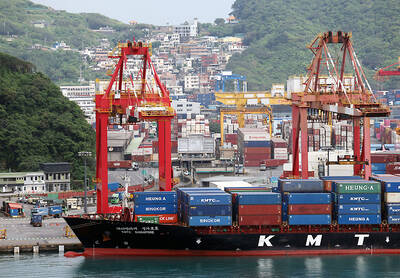
Taiwan’s economy grew far faster than expected in the first quarter, as booming demand for artificial intelligence (AI) applications drove a surge in exports, spilling over into investment and consumption, the Directorate-General of Budget, Accounting and Statistics (DGBAS) said yesterday. GDP growth was 13.69 percent year-on-year during the January-to-March period, beating the DGBAS’ February forecast by 2.23 percentage points and marking the most robust growth in nearly four decades, DGBAS senior official Chiang Hsin-yi (江心怡) told a news conference in Taipei. The result was powered by exports, which remain the backbone of Taiwan’s economy, Chiang said. Outbound shipments jumped 51.12 percent year-on-year to


 RSS
RSS