


Finance ministers from the G7 and other major economies on Monday met in Washington to discuss ways to reduce dependence on rare earths from China, including setting a price floor and new partnerships to build up alternative supplies, ministers said.
The meeting, convened by US Secretary of the Treasury Scott Bessent, included finance ministers from G7 members Japan, the UK, France, Germany, Italy, Canada and the US, as well as officials from Australia, Mexico, South Korea and India.
US Trade Representative Jamieson Greer and representatives from the US Export-Import Bank and JPMorgan also attended, but no joint statement was issued by the meeting’s participants.
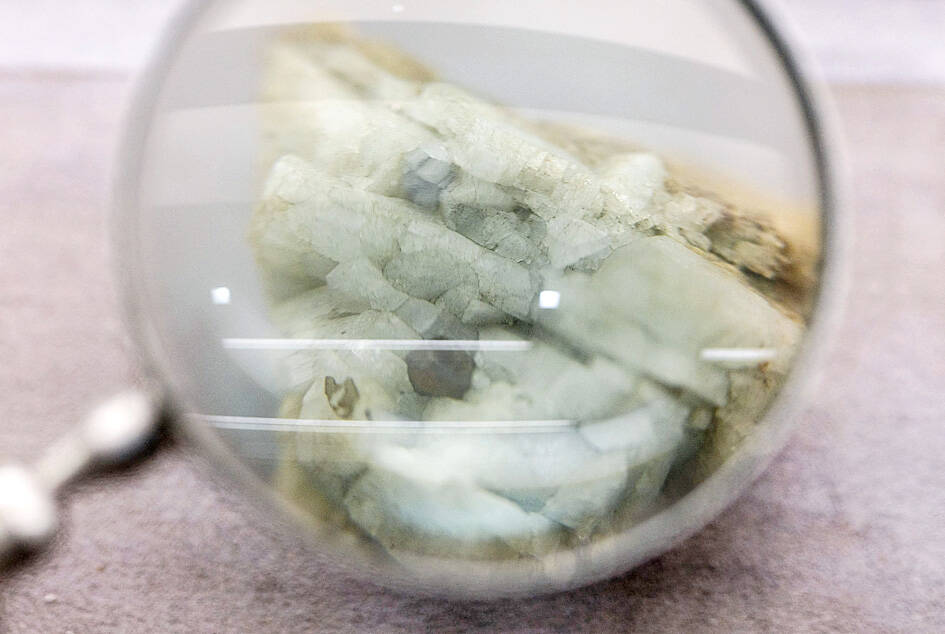
Photo: Reuters
The Treasury said in a statement that Bessent sought “to discuss solutions to secure and diversify supply chains for critical minerals, especially rare earth elements,” and expressed optimism that countries would pursue “prudent de-risking over decoupling” from China.
A US official on Sunday said that Bessent was going to urge participants to step up efforts to reduce reliance on critical minerals from China, which has imposed strict export controls on rare earths, most recently on supplies to Japan.
Japanese Minister of Finance Satsuki Katayama told reporters on Monday evening that there was “broad agreement on the need to swiftly reduce reliance on China for rare earths.”
She said she outlined short, medium and long-term policy approaches for G7 and like-minded countries to bolster non-Chinese rare earth supplies.
“These include creating markets based on standards such as respect for labor conditions and human rights, as well as deploying a range of policy tools — support from public financial institutions, tax and financial incentives, trade and tariff measures, quarantine measures and minimum price setting,” Katayama said. “I stressed the importance of committing to these measures.”
A spokesperson for China’s embassy in Washington could not be immediately reached for comment.
The participating countries and the EU account for 60 percent of global demand for critical minerals. However, China dominates the supply chain, refining between 47 and 87 percent of copper, lithium, cobalt, graphite and rare earths, the International Energy Agency said.
The minerals are essential for defense technologies, semiconductors, renewable energy components, batteries and refining processes.
Last week, China banned exports of items destined for Japan’s military that have civilian and military uses, including some critical minerals.
German Minister of Finance Lars Klingbeil said discussions at the meeting included a potential rare-earths price floor and partnerships to boost supplies, but added the talks had just begun with many unresolved issues.
He said rare earths and critical mineral supplies would be a central topic under the French presidency of the G7 this year.
However, he warned against an anti-China coalition, saying that Europe needs to move faster on its own to develop supplies of important raw materials.
“What is very important to me is that we in Europe do not sit back,” Klingbeil said. “Neither complaining nor self-pity helps us, we have to become active.”
He added that the EU needed more financing at the bloc level, pointing to a new German raw materials fund.
The EU must also move forward urgently on recycling, Klingbeil said, citing its “big potential” for reducing dependencies and broadening supply.
South Korean Minister of Finance Koo Yun-cheol said at the meeting that global value chains should be strengthened based on comparative advantage, emphasizing the importance of recycling critical minerals for resilient supply chains, its ministry said in a statement.
Koo also urged countries to pursue corporate projects-oriented cooperation, while Canada and Australia asked South Korea for technology collaboration, the ministry added.
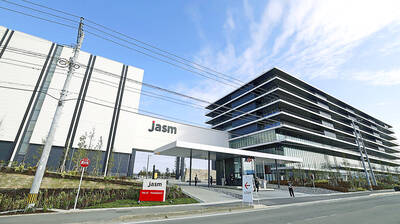
The subsidiary of Taiwan Semiconductor Manufacturing Co (TSMC, 台積電) in Kumamoto, Japan, turned a profit in the first quarter of this year, marking the first time the first fab of the unit has become profitable since mass production started at the end of 2024. According to the contract chipmaker’s financial statement released on Friday, Japan Advanced Semiconductor Manufacturing Inc (JASM), a joint venture running the fab in Kumamoto, posted NT$951 million (US$30.19 million) in profit in the January-to-March period, compared with a loss of NT$1.39 billion in the previous quarter, and a loss of NT$3.25 billion in the first quarter of
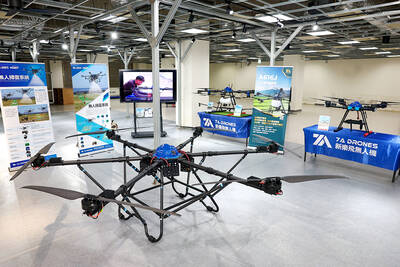
DRONE CENTRAL: Taiwan aims to become Asia’s democratic hub for drones, with most exports focused on high-quality military-grade models, an official said Taiwan’s drone industry is expected to expand significantly by 2030, producing 100,000 units per month and exporting half of them, the Ministry of Economic Affairs said yesterday. Current drone production capacity is about 15,000 units per month, but the industry can quickly scale up as demand increases, Industrial Development Administration Director-General Chiou Chyou-huey (邱求慧) told a news conference in Taipei. Taiwan’s drone output grew 2.5-fold last year to NT$12.9 billion (US$408.3 million) under a government program to develop the uncrewed vehicle sector, he said. The Executive Yuan in October last year approved plans to invest NT$44.2 billion into domestic production of uncrewed aerial
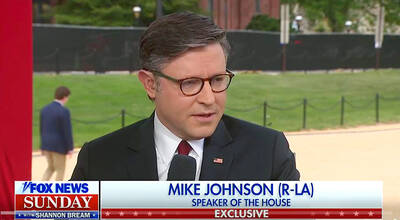
RESOLUTE BACKING: Two Republican senators are planning to introduce legislation that would impose immediate sanctions on China if it attempts to invade Taiwan US House of Representatives Speaker Mike Johnson on Sunday reaffirmed US congressional support for Taiwan, saying the US and “all freedom-loving people” have a stake in preventing China from seizing Taiwan by force. Johnson made the remarks in an interview with Fox News Sunday on US President Donald Trump’s summit with Chinese President Xi Jinping (習近平) last week. In an interview that aired on Friday on Fox News, just as Trump wrapped up a high-stakes visit to China, he said he has yet to green-light a new US$14 billion arms package to Taiwan and that it “depends on China.” “It’s a very good
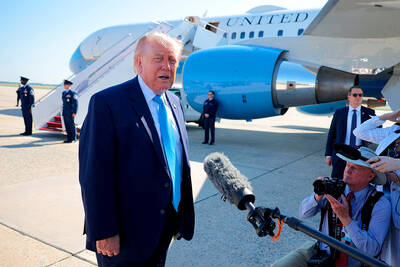
US President Donald Trump yesterday said he would speak to President William Lai (賴清德) as his administration considers whether to move ahead with a US$14 billion weapons sale to Taiwan — a potential arms deal that has drawn criticism from China. “Well, I’ll speak to him. I speak to everybody,” Trump told reporters yesterday when asked if he had any plans to call his counterpart, although he did not offer a time frame for when such a conversation could take place. Trump previously said he would speak to the person “that’s running Taiwan,” without specifying who he meant. “We have that situation very


 RSS
RSS