


Russia bombarded Ukraine with hundreds of drones and dozens of missiles in a large-scale overnight attack, which killed at least four people, officials said yesterday. For only the second time, Moscow used a new ballistic missile that it says flies at 10 times the speed of sound and is unstoppable.
The intense barrage and the launching of the nuclear-capable Oreshnik missile came days after Ukraine and its allies reported major progress toward agreeing how to defend the country from further Moscow aggression if a peace deal is struck to end Russia’s almost four-year-old invasion.
Ukrainian President Volodymyr Zelenskiy said he has made significant progress on the terms of a possible peace settlement in talks with Washington envoys, but Moscow has given no public signal it is willing to budge from its demands.
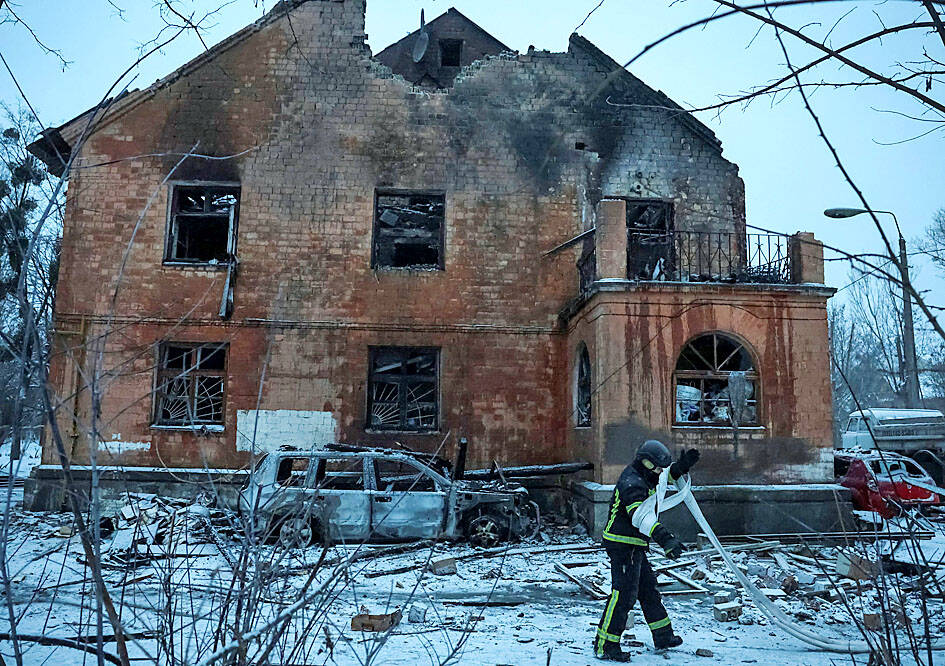
Photo: Reuters
The attack also coincides with a new chill in relations between Moscow and Washington after Russia condemned the US seizure of an oil tanker in the North Atlantic. It comes as US President Donald Trump has signaled he is on board with a hard-hitting sanctions package meant to economically cripple Moscow.
Ukrainian officials said four people were killed and at least 25 wounded in Kyiv during the overnight attack, as apartment buildings were struck.
Those killed included an emergency medical aid worker, Kyiv City Military Administration head Tymur Tkachenko said.
Four doctors and one police officer sustained injuries while responding to the ongoing attacks, authorities said.
About half of Kyiv’s apartment buildings — nearly 6,000 — were left without heating, Kyiv Mayor Vitali Klitschko said.
The water supply was also disrupted.
Municipal services restored power and heating to public facilities, including hospitals and maternity wards, using mobile boiler units, he added.
The Russian Ministry of Defense said the attack was a retaliation to what Moscow said was a Ukrainian drone strike on Russian President Vladimir Putin’s residence last month. Ukraine and US President Donald Trump have rejected the Russian claim of the attack on Putin’s residence.
Putin has previously said that the Oreshnik streaks to its target at Mach 10, “like a meteorite,” and has claimed it is immune to any missile defense system, adding that several of them used in a conventional strike could be as devastating as a nuclear attack.
Ukrainian intelligence said the missile has six warheads, each carrying six submunitions.
Moscow did not say where the Oreshnik hit, but Russian media and military bloggers said it targeted a huge underground natural gas storage facility in Ukraine’s western Lviv region.
Western military aid flows to Ukraine from a big supply hub in Poland just across the border from Lviv.
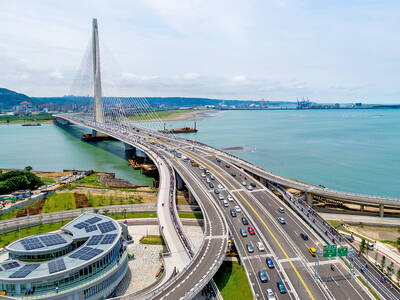
The Ministry of Transportation and Communications yesterday inaugurated the Danjiang Bridge across the Tamsui River in New Taipei City, saying that the structure would be an architectural icon and traffic artery for Taiwan. Feted as a major engineering achievement, the Danjiang Bridge is 920m long, 211m tall at the top of its pylon, and is the longest single-pylon asymmetric cable-stayed bridge in the world, the government’s Web site for the structure said. It was designed by late Iraqi-British architect Zaha Hadid. The structure, with a maximum deck of 70m, accommodates road and light rail traffic, and affords a 200m navigation channel for boats,
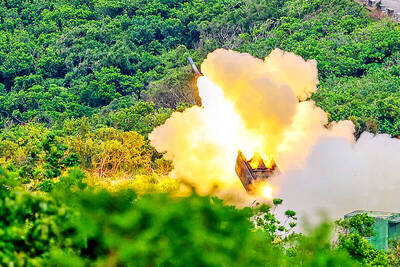
PRECISION STRIKES: The most significant reason to deploy HIMARS to outlying islands is to establish a ‘dead zone’ that the PLA would not dare enter, a source said A High Mobility Artillery Rocket System (HIMARS) would be deployed to Penghu County and Dongyin Island (東引) in Lienchiang County (Matsu) to force the Chinese military to retreat at least 100km from the coastline, a military source said yesterday. Taiwan has been procuring HIMARS and Army Tactical Missile Systems (ATACMS) from the US in batches. Once all batches have been delivered, Taiwan would possess 111 HIMARS units and 504 ATACMS, which have a range of 300km. Considering that “offense is the best defense,” the military plans to forward-deploy the systems to outlying islands such as Penghu and Dongyin so that

Taiwan Semiconductor Manufacturing Co (TSMC, 台積電), the world’s largest foundry service provider, yesterday said that global semiconductor revenue is projected to hit US$1.5 trillion in 2030, after the figure exceeds US$1 trillion this year, as artificial intelligence (AI) demand boosts consumption of token and compute power. “We are still at the beginning of the AI revolution, but we already see a significant impact across the whole semiconductor ecosystem,” TSMC deputy cochief operating officer Kevin Zhang (張曉強) said at the company’s annual technology symposium in Hsinchu City. “It is fair to say that in the past decade, smartphones and other mobile devices were

‘CLEAR MESSAGE’: The bill would set up an interagency ‘tiger team’ to review sanctions tools and other economic options to help deter any Chinese aggression toward Taiwan US Representative Young Kim has introduced a bill to deter Chinese aggression against Taiwan, calling for an interagency “tiger team” to preplan coordinated sanctions and economic measures in response to possible Chinese military or political action against Taiwan. “[Chinese President] Xi Jinping [習近平] has directed the People’s Liberation Army to be ready to invade Taiwan by 2027. China has a plan. America should have one too,” Kim said in a news release on Thursday last week. She introduced the “Deter PRC [People’s Republic of China] aggression against Taiwan act” to “ensure the US has a coordinated sanctions strategy ready should


 RSS
RSS