

The air force this morning said that the pilot of a missing F-16V jet had indicated he would eject from the aircraft before it disappeared from radar, but could not confirm whether the ejection was successful.
During a nighttime training session yesterday, air force Captain Hsin Po-yi (辛柏毅) became separated from the rest of the formation at 7:27pm after the jets entered cloud cover, air force Inspector General Chiang Yi-cheng (江義誠) told a news conference in Hualien County, citing audio recordings retrieved from the lead aircraft.

Photo courtesy of the Coast Guard Administration
After reporting that his altitude was continuing to drop, Hsin indicated at 7:28pm that he would eject from the aircraft, tail No. 6700, eight seconds before the jet's radar signal disappeared, Chiang said.
The aircraft's last recorded location was over waters about 36 nautical miles (66.6km) south of the air force's Hualien Air Base, he added.
The air force has not been able to confirm whether Hsin successfully ejected.
"So far, we have not received any signal from a survival equipment beacon, and therefore do not yet have conclusive evidence to confirm whether Captain Hsin successfully completed the ejection procedure," Chiang said.
Regarding reports that the aircraft's Modular Mission Computer malfunctioned, the air force said that no abnormalities were found in the No. 6700 aircraft over the past six months of inspections.
The air force, navy and coast guard have dispatched vessels to conduct a search-and-rescue operation. A nearby cargo ship was also contacted to assist.
Hsin had not yet been found as of this morning.
Chiang said that the operation is ongoing and would not be limited by the 72-hour golden window for rescue.
Hsin's relatives are at the Hualien base and are being kept informed of rescue operations by military councilors, he said.
Additional reporting by Wang Ching-yi

SOFT TENNIS: Yu Kai-wen and Huang Shih-yuan narrowly defeated their Japanese rivals to capture Taiwan’s first gold at the Asian Games in Nagoya Yu Kai-wen (余凱文) and Huang Shih-yuan (黃詩媛) won Taiwan’s first gold of this year’s Asian Games, defeating a Japanese duo in a nail-biter in the soft tennis mixed doubles final in Nagoya, Japan, while Johnny Sun (孫家閎) won silver in wushu and Shih Cheng-chung (石政中) won bronze in men’s kumite. Yu and Huang narrowly defeated Japan’s Toshiki Uematsu and Rena Temma 5-4 (2-4, 5-3, 4-2, 1-4, 1-4, 4-0, 1-4, 4-1, 7-5) to give Taiwan its first gold in soft tennis mixed doubles at an Asian Games since 2018. Sun secured Taiwan’s first wushu medal at this year’s game, with a combined score

CALL FOR CHANGE: They urged the UN to facilitate Taiwan’s involvement in the body, recognize its peace efforts and to work with members in preventing military conflict Representatives to the UN from five of Taiwan’s diplomatic allies sent a joint letter to UN Secretary-General Antonio Guterres on Friday, calling for the country’s inclusion in the body. Allies in the letter sent ahead of the 81st session of the UN General Assembly General Debate made three demands in support of Taiwan: inclusion, recognition and camaraderie. They implored the UN to seek an appropriate way to facilitate Taiwan’s meaningful involvement in the world governing body, saying that UN Resolution 2758, which accepted the People’s Republic of China (PRC) as a member of the UN, does not exclude Taiwan. Beijing claims that the
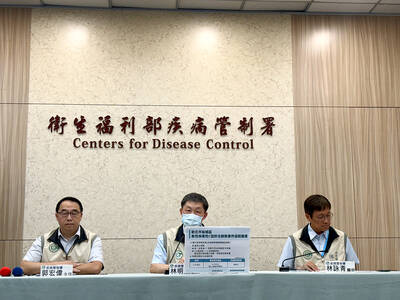
AT-RISK GROUPS: Of the accumulated 1,586 severe cases and 304 related deaths in this flu season, 65.8% were older people and 83.2% had chronic diseases, an official said The Centers for Disease Control (CDC) yesterday said that 165 severe flu cases and 30 flu-related deaths were reported last week, the highest weekly numbers in this flu season, and that cases might continue to increase, urging people to take precautions. Medical visits for flu-like illnesses increased by 1.4 percent to 141,374 last week, with 11.8 percent being emergency visits, showing that the seasonal flu is still in its epidemic period, CDC Epidemic Intelligence Center Director Guo Hung-wei (郭宏偉) said. From Tuesday last week to Monday, 165 severe flu cases and 30 flu-related deaths were confirmed, the highest weekly numbers
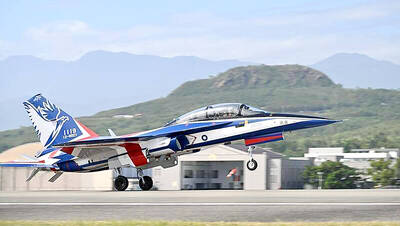
Aerospace Industrial Development Corp (AIDC, 漢翔航空工業) has finished production of the nation’s T-5 Brave Eagle (勇鷹) advanced jet trainers, with the final aircraft scheduled to be formally delivered at a ceremony on Thursday. The delivery of the trainer jets marks the end of the program, which dates back to 2017, with the first prototypes completed in 2019. Fifty-six of the 66 trainers had been delivered as of May. The Brave Eagle was developed and produced by AIDC and the National Chungshan Institute of Science and Technology. The program has provided a foundation for the development of a domestically produced next-generation primary trainer and


 RSS
RSS