


The TAIEX yesterday surged 755.23 points, or 2.57 percent, to 30,105.04, decisively breaching the 30,000-point mark on the back of investor optimism over earnings in the technology sector, early-year portfolio repositioning and supportive cues from global markets.
The advance was led by shares of semiconductor and high-end hardware makers, reflecting expectations of further gains ahead of the Lunar New Year holiday.
PGIM Inc said that market enthusiasm largely stemmed from anticipation of strong fourth-quarter earnings delivered by semiconductor giants and forecasts of more capital expenditure on advanced processes this year.
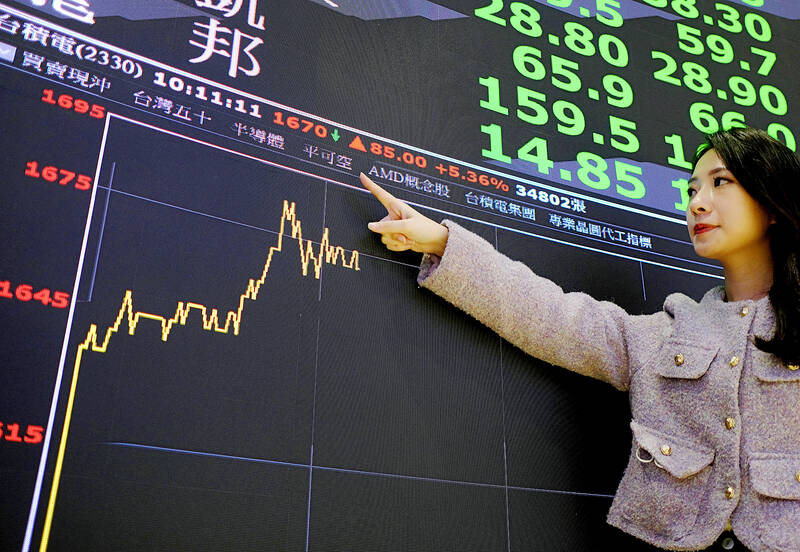
Photo: CNA
“The rally reflects optimism about sustained demand for advanced technologies and local conviction in the market, despite [a] slowdown in other sectors,” PGIM said in a note.
Taiwan Semiconductor Manufacturing Co (TSMC, 台積電), the world’s largest contract chipmaker whose clients include Nvidia Corp, Apple Inc and Intel Corp, was the primary driver of yesterday’s rise, closing 5.36 percent higher at NT$1,670, a new record.
“The strong interest in TSMC came as investors were betting the chipmaker would continue to benefit from global strong demand for its advanced processes, in particular, after its 2-nanometer process has started mass production during the current artificial intelligence boom,” Hua Nan Securities Co (華南永昌證券) analyst Kevin Su (蘇俊宏) said.
Gains in TSMC reverberated across the technology ecosystem, lifting equipment makers, IC designers and memory suppliers, amplifying overall market momentum.
MediaTek Inc (聯發科) shares rose 3.74 percent, ASE Technology Holding Co (日月光投控) shares gained 2.13 percent and United Integrated Services Co (漢唐集成) shares advanced 3.33 percent.
“With electronics stocks attracting most of the market attention, non-tech stocks largely traded in weakness,” Su said. “The silver lining was that the financial sector stayed resilient.”
Cathay Financial Holding Co (國泰金控) shares rose 1.73 percent and Fubon Financial Holding Co (富邦金控) shares added 1.67 percent.
Trading activity was notably heavy, with turnover totaling NT$765.807 billion (US$24.28 billion), the second-highest level on record after NT$782.83 billion on May 12, 2021, Taiwan Stock Exchange data showed, underscoring the eagerness of both retail and institutional investors to capitalize on early-year opportunities.
Domestic funds and proprietary traders were the main sources of buying, with proprietary traders contributing a net NT$10.75 billion. Foreign investors, by contrast, were net sellers at NT$7.64 billion, while investment trusts added a modest NT$790 million, exchange data showed.
Seasonal factors also supported the rally. Historically, Taiwan sees inflows early in the year as portfolio rebalancing and dividend expectations come into focus.
Favorable macroeconomic conditions further reinforced investor sentiment. Global equity markets, particularly US technology stocks, remained resilient, bolstering risk appetite across Asia and lending confidence to Taiwanese investors, analysts said.
With a series of potential corporate and macroeconomic catalysts on the horizon, the momentum could continue, analysts said.
Additional reporting by CNA
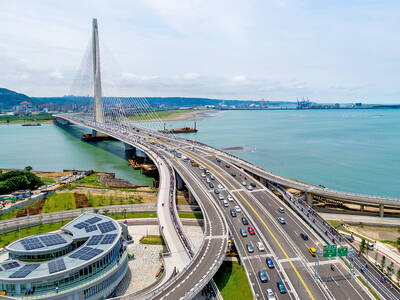
The Ministry of Transportation and Communications yesterday inaugurated the Danjiang Bridge across the Tamsui River in New Taipei City, saying that the structure would be an architectural icon and traffic artery for Taiwan. Feted as a major engineering achievement, the Danjiang Bridge is 920m long, 211m tall at the top of its pylon, and is the longest single-pylon asymmetric cable-stayed bridge in the world, the government’s Web site for the structure said. It was designed by late Iraqi-British architect Zaha Hadid. The structure, with a maximum deck of 70m, accommodates road and light rail traffic, and affords a 200m navigation channel for boats,
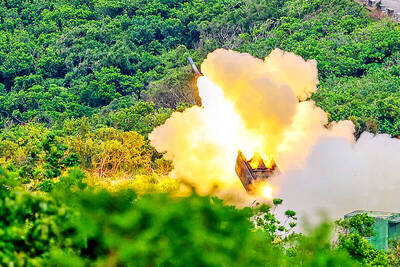
PRECISION STRIKES: The most significant reason to deploy HIMARS to outlying islands is to establish a ‘dead zone’ that the PLA would not dare enter, a source said A High Mobility Artillery Rocket System (HIMARS) would be deployed to Penghu County and Dongyin Island (東引) in Lienchiang County (Matsu) to force the Chinese military to retreat at least 100km from the coastline, a military source said yesterday. Taiwan has been procuring HIMARS and Army Tactical Missile Systems (ATACMS) from the US in batches. Once all batches have been delivered, Taiwan would possess 111 HIMARS units and 504 ATACMS, which have a range of 300km. Considering that “offense is the best defense,” the military plans to forward-deploy the systems to outlying islands such as Penghu and Dongyin so that
Taiwan Semiconductor Manufacturing Co (TSMC, 台積電), the world’s largest foundry service provider, yesterday said that global semiconductor revenue is projected to hit US$1.5 trillion in 2030, after the figure exceeds US$1 trillion this year, as artificial intelligence (AI) demand boosts consumption of token and compute power. “We are still at the beginning of the AI revolution, but we already see a significant impact across the whole semiconductor ecosystem,” TSMC deputy cochief operating officer Kevin Zhang (張曉強) said at the company’s annual technology symposium in Hsinchu City. “It is fair to say that in the past decade, smartphones and other mobile devices were

‘CLEAR MESSAGE’: The bill would set up an interagency ‘tiger team’ to review sanctions tools and other economic options to help deter any Chinese aggression toward Taiwan US Representative Young Kim has introduced a bill to deter Chinese aggression against Taiwan, calling for an interagency “tiger team” to preplan coordinated sanctions and economic measures in response to possible Chinese military or political action against Taiwan. “[Chinese President] Xi Jinping [習近平] has directed the People’s Liberation Army to be ready to invade Taiwan by 2027. China has a plan. America should have one too,” Kim said in a news release on Thursday last week. She introduced the “Deter PRC [People’s Republic of China] aggression against Taiwan act” to “ensure the US has a coordinated sanctions strategy ready should


 RSS
RSS