


Venezuelan President Nicolas Maduro was in a New York jail on Saturday, hours after US special forces seized him and flew him out of his country — which US President Donald Trump said would come under effective US control.
Trump’s announcement followed a predawn raid in which commandos grabbed Maduro and his wife while air strikes pounded sites in and around Caracas.
A US government plane carrying Maduro landed at a military base shortly after nightfall, and he was transported by helicopter to New York City, where the couple were to be arraigned on drug trafficking and weapons charges.

Photo: AFP PHOTO / X account of Rapid Response 47
The White House posted a video on social media of Maduro, handcuffed and in sandals, escorted by federal agents through a US Drug Enforcement Administration facility in New York.
“Good night, happy new year,” the 63-year-old is heard saying in English.
WHAT NEXT?
Despite the success of the risky raid, what happens next is highly uncertain.
Trump said he was “designating people” from his Cabinet to be in charge in Venezuela, but gave no further details.
In another surprise, Trump indicated US troops could be deployed, saying Washington is “not afraid of boots on the ground.”
However, he appeared to reject the possibility of the country’s opposition taking power and said he could work instead with Maduro’s vice president, Delcy Rodriguez.
One aspect that became clearer was Trump’s interest in Venezuela’s vast oil reserves.
“We’re going to have our very large United States oil companies... go in, spend billions of dollars, fix the badly broken infrastructure,” he said. “We’ll be selling large amounts of oil.”
US-backed opposition leader Maria Corina Machado, who won last year’s Nobel Peace Prize, posted on social media that “the hour of freedom has arrived.”
She called for the opposition’s 2024 election candidate, Edmundo Gonzalez Urrutia, to “immediately” assume the presidency.
Trump was surprisingly cold about expectations that Machado could become Venezuela’s new leader, saying she does not have “support or respect” there.
Instead, he touted Rodriguez, saying: “she’s essentially willing to do what we think is necessary to make Venezuela great again.”
Rodriguez poured cold water on that, demanding Maduro’s release and vowing to “defend” the country.
Late on Saturday, Venezuela’s Supreme Court ordered Rodriguez to assume presidential powers “in an acting capacity.”
Reflecting the confusion, Trump indicated US involvement is likely for the long haul.
“We’re going to stay until such time as the proper transition can take place,” he said.
REACTIONS
Venezuela’s ally China said it “strongly condemns” the US operation, and called for Maduro to be “immediately released.”
“The US’s move is in clear violation of international law, basic norms in international relations, and the purposes and principles of the UN Charter,” the Chinese Ministry of Foreign Affairs said in a statement yesterday.
Meanwhile, France warned a solution cannot “be imposed from outside.”
UN Secretary-General Antonio Guterres said he was “deeply concerned that the rules of international law have not been respected.”
At Venezuela’s request, the UN Security Council is to meet today to discuss the crisis, the Somali presidency of the council said.

Taiwan is gearing up to celebrate the New Year at events across the country, headlined by the annual countdown and Taipei 101 fireworks display at midnight. Many of the events are to be livesteamed online. See below for lineups and links: Taipei Taipei’s New Year’s Party 2026 is to begin at 7pm and run until 1am, with the theme “Sailing to the Future.” South Korean girl group KARA is headlining the concert at Taipei City Hall Plaza, with additional performances by Amber An (安心亞), Nick Chou (周湯豪), hip-hop trio Nine One One (玖壹壹), Bii (畢書盡), girl group Genblue (幻藍小熊) and more. The festivities are to

Auckland rang in 2026 with a downtown fireworks display launched from New Zealand’s tallest structure, Sky Tower, making it the first major city to greet the new year at a celebration dampened by rain, while crowds in Taipei braved the elements to watch Taipei 101’s display. South Pacific countries are the first to bid farewell to 2025. Clocks struck midnight in Auckland, with a population of 1.7 million, 18 hours before the famous ball was to drop in New York’s Times Square. The five-minute display involved 3,500 fireworks launched from the 240m Sky Tower. Smaller community events were canceled across New Zealand’s
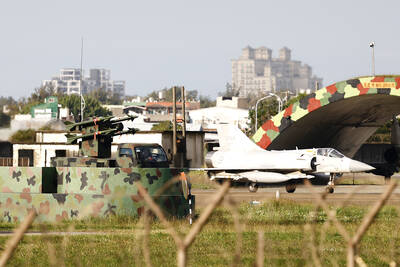
‘IRRESPONSIBLE’: Beijing’s constant disruption of the ‘status quo’ in the Taiwan Strait has damaged peace, stability and security in the Indo-Pacific region, MOFA said The Presidential Office yesterday condemned China’s launch of another military drill around Taiwan, saying such actions are a “unilateral provocation” that destabilizes regional peace and stability. China should immediately stop the irresponsible and provocative actions, Presidential Office spokeswoman Karen Kuo (郭雅慧) said, after the Chinese People’s Liberation Army (PLA) yesterday announced the start of a new round of joint exercises around Taiwan by the army, navy and air force, which it said were approaching “from different directions.” Code-named “Justice Mission 2025,” the exercises would be conducted in the Taiwan Strait and in areas north, southwest, southeast and east of Taiwan
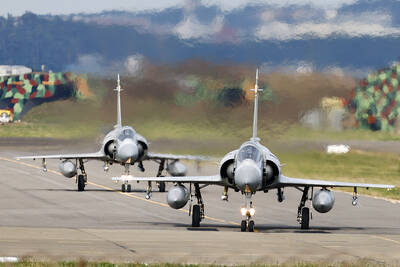
UNDER WAY: The contract for advanced sensor systems would be fulfilled in Florida, and is expected to be completed by June 2031, the Pentagon said Lockheed Martin has been given a contract involving foreign military sales to Taiwan to meet what Washington calls “an urgent operational need” of Taiwan’s air force, the Pentagon said on Wednesday. The contract has a ceiling value of US$328.5 million, with US$157.3 million in foreign military sales funds obligated at the time of award, the Pentagon said in a statement. “This contract provides for the procurement and delivery of 55 Infrared Search and Track Legion Enhanced Sensor Pods, processors, pod containers and processor containers required to meet the urgent operational need of the Taiwan air force,” it said. The contract’s work would be


 RSS
RSS