


Japan’s Cabinet yesterday approved a record defense budget plan exceeding ¥9 trillion (US$58 billion) for the coming year, aiming to fortify its strike-back capabilities and coastal defense with cruise missiles and uncrewed arsenals as tensions rise in the region.
The draft budget for fiscal 2026, beginning April, is up 9.4 percent from this year and marks the fourth year of Japan’s ongoing five-year program to double annual arms spending to 2 percent of GDP.
“It is the minimum needed as Japan faces the severest and most complex security environment in the postwar era,” Japanese Minister of Defense Shinjiro Koizumi said, stressing Tokyo’s determination to pursue military buildup and protect its people.
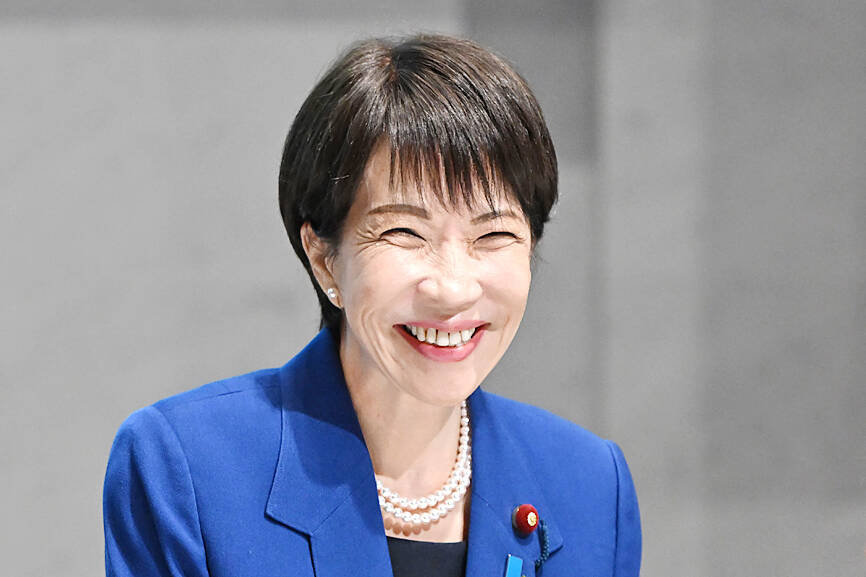
Photo: AFP
“It does not change our path as a peace-loving nation,” he said.
The increase comes as Japan faces elevated tension from China.
Japanese Prime Minister Sanae Takaichi last month said Japan’s military could get involved if China were to take action against Taiwan.
Takaichi’s government, under US pressure for a military spending increase, pledged to achieve the 2 percent target by March next year, two years earlier than planned. Japan also plans to revise its ongoing security and defense policy by December next year to further bolster its military.
Japan has been bolstering its offensive capabilities with long-range missiles to attack enemy targets from a distance, a major break from its post-World War II principle limiting the use of force to its own self-defense.
The security strategy, adopted in 2022, names China as the country’s biggest strategic challenge and calls for a more offensive role for Japan’s Self-Defense Forces under its security alliance with the US.
The new budget allocates more than ¥970 billion to bolster Japan’s “standoff” missile capability. It includes a ¥177 billion purchase of domestically developed and upgraded Type-12 surface-to-ship missiles with a range of about 1,000km.
The first batch of the Type-12 missiles would be deployed in Japan’s southwestern Kumamoto prefecture by March, a year earlier than planned, as Japan accelerates its missile buildup in the region.
In part due to Japan’s aging and declining population, and its struggles with an understaffed military, the government believes uncrewed weapons are essential.
To defend the coasts, Japan plans to spend ¥100 billion to deploy uncrewed air, sea-surface and underwater drones for surveillance and defense under a system planned for March 2028, defense ministry officials said.
For speedier deployment, Japan initially plans to rely mainly on imports, possibly from Turkey or Israel.
The Japanese defense ministry, already alarmed by China’s rapid expansion of operations in the Pacific, is to open a new office dedicated to studying operations, equipment and other necessities for Tokyo to deal with Beijing’s Pacific activity.
Chinese Ministry of Foreign Affairs spokesman Lin Jian (林劍) said the Takaichi government has “noticeably accelerated its pace of military buildup and expansion” since taking office.
“Japan is deviating from the path of peaceful development it has long claimed to uphold and is moving further and further in a dangerous direction,” Lin said.
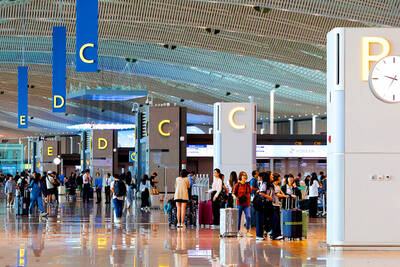
South Korea has adjusted its electronic arrival card system to no longer list Taiwan as a part of China, a move that the Ministry of Foreign Affairs said would help facilitate exchanges between the two sides. South Korea previously listed “Taiwan” as “Taiwan (China)” in the drop-down menus of its online arrival card system, where people had to fill out where they came from and their next destination. The ministry had requested South Korea make a revision and said it would change South Korea’s name on Taiwan’s online immigration system from “Republic of Korea” to “Korea (South),” should the issue not be

Tainan, Taipei and New Taipei City recorded the highest fines nationwide for illegal accommodations in the first quarter of this year, with fines issued in the three cities each exceeding NT$7 million (US$220,639), Tourism Administration data showed. Among them, Taipei had the highest number of illegal short-term rental units, with 410. There were 3,280 legally registered hotels nationwide in the first quarter, down by 14 properties, or 0.43 percent, from a year earlier, likely indicating operators exiting the market, the agency said. However, the number of unregistered properties rose to 1,174, including 314 illegal hotels and 860 illegal short-term rental
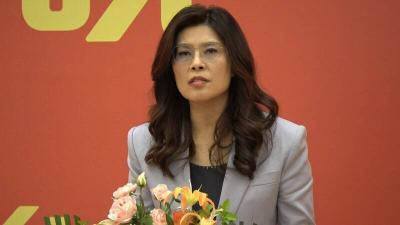
Both sides of the Taiwan Strait share a political foundation based on the “1992 consensus” and opposition to Taiwanese independence, Chinese Nationalist Party (KMT) Chairwoman Cheng Li-wun (鄭麗文) today said during her meeting with Chinese President Xi Jinping (習近平). Both sides of the Strait should plan and build institutionalized and sustainable mechanisms for dialogue and cooperation based on that foundation to make peaceful development across the Strait irreversible, she said. Peace is a shared moral value across the Strait, and both sides should move beyond political confrontation to seek institutionalized solutions to prevent war, she said. Mutually beneficial cross-strait relations are what the
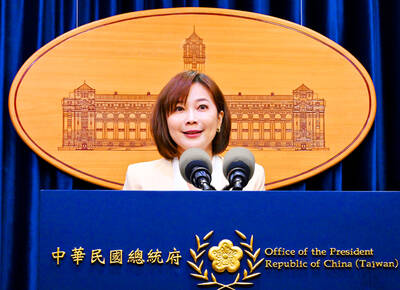
ECONOMIC COERCION: Such actions are often inconsistently applied, sometimes resumed, and sometimes just halted, the Presidential Office spokeswoman said The government backs healthy and orderly cross-strait exchanges, but such arrangements should not be made with political conditions attached and never be used as leverage for political maneuvering or partisan agendas, Presidential Office spokeswoman Karen Kuo (郭雅慧) said yesterday. Kuo made the remarks after China earlier in the day announced 10 new “incentive measures” for Taiwan, following a landmark meeting between Chinese President Xi Jinping (習近平) and Chinese Nationalist Party (KMT) Chairwoman Cheng Li-wun (鄭麗文) in Beijing on Friday. The measures, unveiled by China’s Xinhua news agency, include plans to resume individual travel by residents of Shanghai and China’s Fujian


 RSS
RSS