


Washington on Wednesday announced US$11.1 billion in potential arms sales to Taiwan, the largest-ever US weapons package to the nation.
It is the second announcement of arms sales to Taiwan by US President Donald Trump’s administration since he returned to the White House in January.
The proposed sales would cover eight items, including High Mobility Artillery Rocket Systems (HIMARS), howitzers, Javelin anti-tank missiles, Altius loitering munition drones and parts for other equipment, the Ministry of National Defense said in a statement.
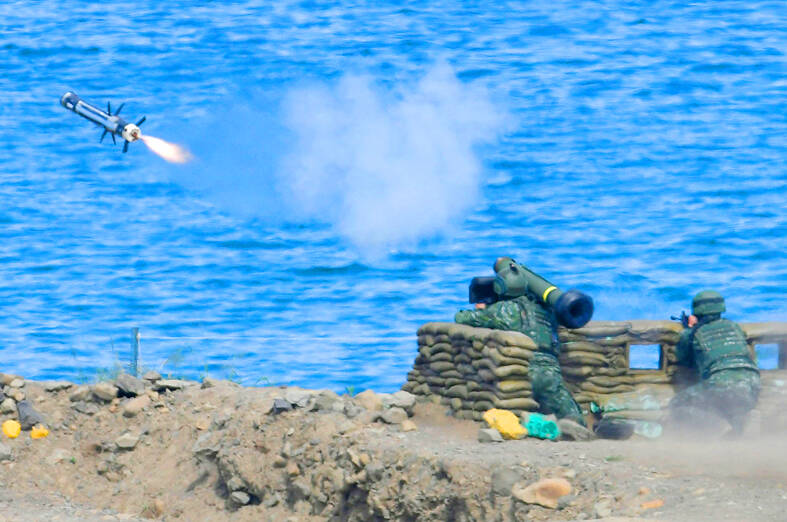
Photo: Sam Yeh, AFP
The US Defense Security Cooperation Agency said that it had delivered the required certifications notifying the US Congress of the sales, following approval by the US Department of State.
The sales serve US “national, economic and security interests by supporting the recipient’s continuing efforts to modernize its armed forces and to maintain a credible defensive capability,” the Pentagon said in a statement.
The ministry yesterday thanked Washington for its continued efforts to help Taiwan maintain its self-defense capabilities under the Taiwan Relations Act and the “six assurances.”
The packages are at the congressional notification stage, which is where the US Congress has a chance to block or alter their sale, although Taiwan has widespread cross-party support, the ministry said.
Five of the eight arms packages — the M109A7 howitzers, HIMARS rocket systems, TOW (tube-launched, optically tracked, wire-guided) 2B anti-tank missiles, anti-armor drones and FGM-148 Javelin anti-tank missiles — are covered by a NT$1.25 trillion (US$39.7 billion) special defense budget that the Executive Yuan put forward last month. The budget is pending lawmakers’ review.
The latest package also includes Harpoon missile repair follow-on support; TOW missile systems; AH-1W helicopter spare and repair parts; and Tactical Mission Network Software, the US Defense Security Cooperation Agency said.
Weapons such as the HIMARS, which have been used extensively by Ukraine against Russian forces, could play an essential role in destroying an invading Chinese force, US-Taiwan Business Council president Rupert Hammond-Chambers said.
“This bundle of congressional notifications, a record in US security assistance for Taiwan, is a response to the threat from China and the demand from Mr Trump that partners and allies do more to secure their own defense,” he said.
The announcement follows an unannounced trip by Minister of Foreign Affairs Lin Chia-lung (林佳龍) to the Washington area last week to meet with US officials, said two sources who spoke to Reuters on condition of anonymity.
Reuters was unable to determine the agenda of the meetings and the Ministry of Foreign Affairs declined to comment.
Lin in a statement yesterday thanked Washington for the proposed arms sale, saying that it demonstrates the US’ commitment to enhancing Taiwan’s self-defense capabilities, as highlighted in the latest National Security Strategy Washington released earlier this month.
Presidential Office spokeswoman Karen Kuo (郭雅慧) also expressed gratitude to the US, saying the move has again showed that Washington is implementing its security commitments to Taiwan under the Taiwan Relations Act and the “six assurances.”
Taiwan’s defense budget for next year is set to exceed 3 percent of GDP in line with NATO standards, with expectations that it would reach 5 percent by 2030, she said.
The government has also proposed a special budget to enhance defense resilience and asymmetric warfare capabilities, she said.
President William Lai (賴清德) last month announced the NT$1.25 trillion special defense budget, with the funds to be allocated from next year to 2033, saying that there was “no room for compromise on national security.”
The Democratic Progressive Party (DPP) caucus yesterday reminded lawmakers that part of the procurement list is included in the special defense budget, urging the Legislative Yuan to review it as soon as possible.
National security transcends party lines, DPP caucus chief executive Chung Chia-pin (鍾佳濱) said, adding that he hoped the ruling and opposition parties would conduct reviews in unison.
Every item in the arms package, which was not easily approved by the US, is crucial to Taiwan’s national defense security, he said.

‘NO SECURITY RISK’: The Railway Bureau reassured the public that the technicians’ activities were limited to technical guidance and did not involve sensitive systems The Railway Bureau yesterday said it had invited eight Chinese technicians to assist with an airport MRT construction project. The bureau issued the confirmation after an Internet user said Chinese nationals had entered the construction zone of Taiwan Taoyuan International Airport’s Terminal 3 project. They asked why “individuals from an enemy state” were allowed access to such a major national infrastructure project, which raised serious concerns over Taiwan’s industrial safety, sensitive systems and information security. The bureau’s Northern Region Engineering Branch Office said subcontractor Taiwan Handle Industrial Co (台灣手把工業) of the Taoyuan airport MRT’s “Contract No. CU05 Project A14 Station Civil, MEP &

A US uncrewed surface vessel (USV) encountered multiple Chinese warships during an autonomous transit of the Taiwan Strait, US defense company Seasats said in a statement on Wednesday. Seasats announced that a Lightfish USV had completed the first autonomous transit of the Taiwan Strait. Over five days, the USV traversed the entire length of the Strait while constantly monitoring surface vessel traffic, the company said. The Lightfish encountered multiple Chinese warships, one of which was a Chinese People’s Liberation Army Navy (PLAN) Type 056 corvette, it said. The Chinese vessels were operating “well within Taiwan’s exclusive economic zone without transmitting their identity via the
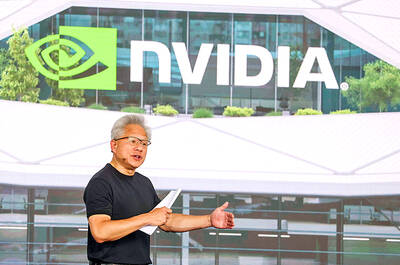
‘BOOMING’: ’ The number of partners we have here is incredible. You can see from their stock prices. They’re doing so well, they’re so happy,’ Jensen Huang said Nvidia Corp’s spending in Taiwan has ballooned to about US$150 billion a year, 10 times the US$10 billion to US$15 billion the company spent five years ago, Nvidia chief executive officer Jensen Huang (黃仁勳) said yesterday, suggesting Taiwan’s strategic importance in the global artificial intelligence (AI) supply chain. “Taiwan is the epicenter of the AI revolution. This is where the chips come, packaging comes. This is where the systems are made. This is where AI supercomputers were created,” Huang said at a meeting for the company’s employees in Beitou-Shilin Technology Park (北投士林科技園區) in Taipei, the planned site of Nvidia’s Taipei headquarters. “Taiwan
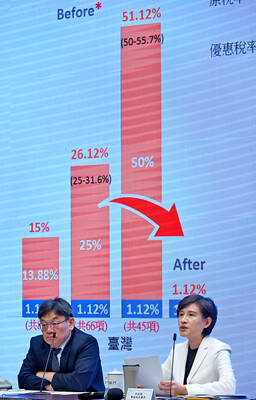
GREATER REACH? Auto parts and wood products would face tariffs of up to 15%, matching those targeting the EU, Japan and South Korea, Vice Premier said The US has announced that preferential tariff treatment for Taiwan’s non-semiconductor Section 232 goods would take effect retroactively from May 1, the Executive Yuan said yesterday. The US government yesterday posted a notice on the Federal Register’s public inspection Web site previewing tariff concessions for Taiwan under a memorandum of understanding (MOU) on Taiwan-US investment after two months of negotiations. The MOU signed on Jan. 15 stipulated three major preferential tariff arrangements: a 15 percent “reciprocal” tariff rate for Taiwan without stacking most-favored nation (MFN) rates; preferential Section 232 treatment for semiconductors and related products; and preferential Section 232 treatment for non-semiconductor


 RSS
RSS