


A batch of 42 M1A2T Abrams tanks delivered by the US in July are beginning a month-long testing program today at a northern army base, including multiple live-fire drills using the tanks’ 120mm main guns, a source familiar with the matter said yesterday.
The source said the US-made tanks were recently deployed to an army tank training ground at the Kengzikou Range (坑子口訓練場) in Hsinchu County for training sessions ahead of the testing phase.
The testing program is to begin today and focuses on evaluating the tanks’ observation and targeting systems, as well as their integration with the ammunition system, the source said.
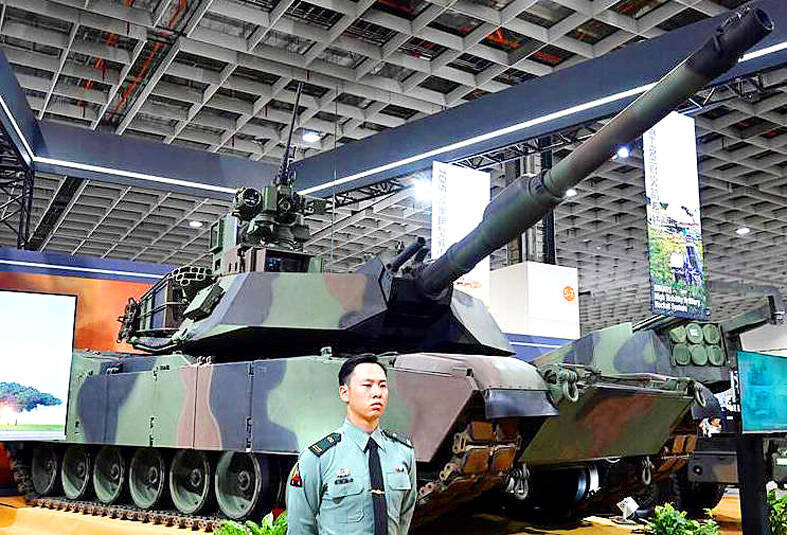
Photo: Taipei Times
Live-fire drills would include exercises involving the tanks’ 120mm main guns, with rounds fired at both stationary and moving targets, they said.
The month-long tests are expected to conclude by the end of next month, after which the tanks would enter active service with the army, they added.
The 42 Abrams tanks are the second batch of a total of 108 tanks, valued at about NT$40.5 billion (US$1.3 billion), that Taiwan purchased from the US.
The first batch of 38 Abrams tanks was delivered to Taiwan in December last year, while the remaining 28 tanks are expected to arrive early next year.
The first batch was commissioned in late October into the army’s 584th Armored Brigade in Hsinchu County after completing required training and testing.
The army operates about 1,000 tanks, including CM11 Brave Tiger and M60A3 models, both of which have been in service for more than two decades.
In addition to procuring the M1A2T tanks, the military has invested in new engines for its M60A3 tanks and upgraded their cannon fire-control systems to provide “hunter-killer” capability, allowing a tank to engage one target while tracking another.
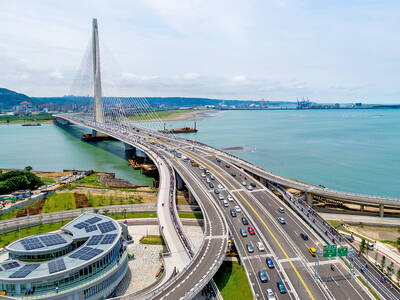
The Ministry of Transportation and Communications yesterday inaugurated the Danjiang Bridge across the Tamsui River in New Taipei City, saying that the structure would be an architectural icon and traffic artery for Taiwan. Feted as a major engineering achievement, the Danjiang Bridge is 920m long, 211m tall at the top of its pylon, and is the longest single-pylon asymmetric cable-stayed bridge in the world, the government’s Web site for the structure said. It was designed by late Iraqi-British architect Zaha Hadid. The structure, with a maximum deck of 70m, accommodates road and light rail traffic, and affords a 200m navigation channel for boats,
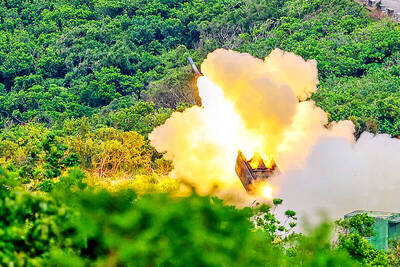
PRECISION STRIKES: The most significant reason to deploy HIMARS to outlying islands is to establish a ‘dead zone’ that the PLA would not dare enter, a source said A High Mobility Artillery Rocket System (HIMARS) would be deployed to Penghu County and Dongyin Island (東引) in Lienchiang County (Matsu) to force the Chinese military to retreat at least 100km from the coastline, a military source said yesterday. Taiwan has been procuring HIMARS and Army Tactical Missile Systems (ATACMS) from the US in batches. Once all batches have been delivered, Taiwan would possess 111 HIMARS units and 504 ATACMS, which have a range of 300km. Considering that “offense is the best defense,” the military plans to forward-deploy the systems to outlying islands such as Penghu and Dongyin so that

WHAT WAS ALL THAT FOR? Jaw Shaw-kong said that Cheng Li-wen had pushed for more drastic cuts and attacked him, just for the outcome to be nearly identical to his bill The legislature yesterday passed a supplementary budget bill to fund the purchase of separate packages of US military equipment, with the combined amount of spending capped at NT$780 billion (US$24.8 billion). The Chinese Nationalist Party (KMT) and Taiwan People’s Party (TPP) used their legislative majority to pass the bill, which runs until 2033 and has two main funding provisions. One was for NT$300 billion of arms sales already approved by the US for Taiwan on Dec. 17 last year, the other was for NT$480 billion for another arms package expected to be announced by Washington. The bill, which fell short of the NT$1.25

‘CLEAR MESSAGE’: The bill would set up an interagency ‘tiger team’ to review sanctions tools and other economic options to help deter any Chinese aggression toward Taiwan US Representative Young Kim has introduced a bill to deter Chinese aggression against Taiwan, calling for an interagency “tiger team” to preplan coordinated sanctions and economic measures in response to possible Chinese military or political action against Taiwan. “[Chinese President] Xi Jinping [習近平] has directed the People’s Liberation Army to be ready to invade Taiwan by 2027. China has a plan. America should have one too,” Kim said in a news release on Thursday last week. She introduced the “Deter PRC [People’s Republic of China] aggression against Taiwan act” to “ensure the US has a coordinated sanctions strategy ready should


 RSS
RSS