


The legislature yesterday passed amendments to suspend cuts to civil servants’ pensions, reversing a fiscal reform that aimed to reduce the government deficit.
The Chinese Nationalist Party (KMT) and the Taiwan People’s Party (TPP) caucuses together passed bills on the income substitution ratio of civil servants’ pensions after negotiations with the ruling Democratic Progressive Party (DPP) broke down.
The amendments to the Civil Servants Retirement, Discharge and Pensions Act (公務人員退休資遣撫卹法) and the Public School Employee Retirement, Discharge and Pensions Act (公立學校教職員退休資遣撫卹條例) are now headed to President William Lai’s (賴清德) desk.
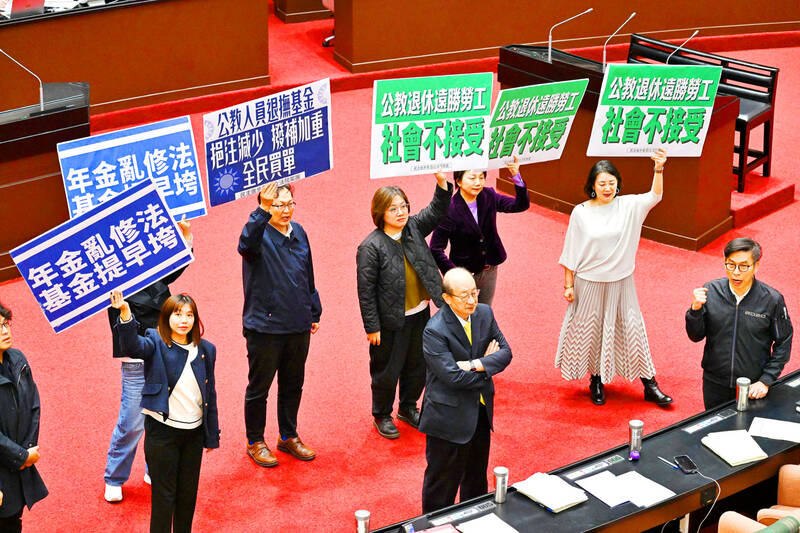
Photo: Chen Yi-kuan, Taipei Times
Retired civil servants who served for 15 years previously received a stipend equivalent to 45 percent of their income as part of the government-guaranteed pension. That was to be reduced to 30 percent over 10 years.
Those with 35 years of service previously received a stipend equivalent to 75 percent of their income, which was to be lowered to 60 percent over 10 years.
Under the amendments to two pension laws, income replacement ratios for retirees, depending on recipients' years of service (ranging from 15 to 40 years), would be restored to their 2023 levels -- 39 to 71.5 percent -- up from this year's 36 to 68.5 percent.
The KMT's proposals stipulate that the ratios be maintained at 2023 levels, reversing the 2018 reform enacted by former president Tsai Ing-wen's (蔡英文) administration, which would have gradually reduced the ratios over the course of 10 years.
Meanwhile, the revised laws require that pensions be adjusted when the cumulative growth rate of the Consumer Price Index (CPI) exceeds 5 percent.
They replace the current provision under which pensions are also reduced when prices fall by more than 5 percent.
TPP Legislator Chang Chi-kai said the bills were aimed at allowing government workers and educators to retire with dignity and economic security.
The TPP had also proposed ending the 2018 reform policy, but did not call for a return of income replacement ratios to 2023 levels.
KMT Legislator Lo Chih-chiang (羅智強) accused the government of bullying civil servants and teachers, saying that the nation’s civil service was on the verge of implosion.
The DPP has a “blood vendetta” against government employees and is guilty of “stigmatizing” these professions, he added.
Meanwhile, critics of the bills, including DPP officials and legislators, said the proposed changes were fiscally unviable.
DPP Legislator Rosalia Wu (吳思瑤) said the KMT’s and the TPP’s backing of the bills was an attempt to jack up approval among a demographic that historically voted for the pan-blue camp.
The passage of the amendments signaled a return to generational injustice, which increases the economic burden on young Taiwanese and compromises fiscal discipline, she said.
The new rules state that stipends for retired government workers and teachers who worked for 35 years cannot be less than 69 percent of their former income.
The government may not invoke a once-every-four-years automatic mechanism to adjust pension policy if the value of the consumer price index is zero or a negative figure, the rules say.

‘NO SECURITY RISK’: The Railway Bureau reassured the public that the technicians’ activities were limited to technical guidance and did not involve sensitive systems The Railway Bureau yesterday said it had invited eight Chinese technicians to assist with an airport MRT construction project. The bureau issued the confirmation after an Internet user said Chinese nationals had entered the construction zone of Taiwan Taoyuan International Airport’s Terminal 3 project. They asked why “individuals from an enemy state” were allowed access to such a major national infrastructure project, which raised serious concerns over Taiwan’s industrial safety, sensitive systems and information security. The bureau’s Northern Region Engineering Branch Office said subcontractor Taiwan Handle Industrial Co (台灣手把工業) of the Taoyuan airport MRT’s “Contract No. CU05 Project A14 Station Civil, MEP &

A US uncrewed surface vessel (USV) encountered multiple Chinese warships during an autonomous transit of the Taiwan Strait, US defense company Seasats said in a statement on Wednesday. Seasats announced that a Lightfish USV had completed the first autonomous transit of the Taiwan Strait. Over five days, the USV traversed the entire length of the Strait while constantly monitoring surface vessel traffic, the company said. The Lightfish encountered multiple Chinese warships, one of which was a Chinese People’s Liberation Army Navy (PLAN) Type 056 corvette, it said. The Chinese vessels were operating “well within Taiwan’s exclusive economic zone without transmitting their identity via the

Taiwan is still in the process of assessing the possibility of recruiting workers from Eswatini, the Ministry of Foreign Affairs said yesterday, adding that its goal is to help Eswatini upgrade its vocational training centers. If there are plans to recruit workers from Eswatini, safeguarding national security, protecting public health and ensuring the employment rights of Taiwanese would be prerequisites, Department of West Asian and African Affairs Director-General Yen Chia-liang (顏嘉良) told a news conference. Key considerations would also include filling labor shortages in specific industries, and fostering bilateral professional and technical exchanges, he said. Yen was asked about the progress of labor
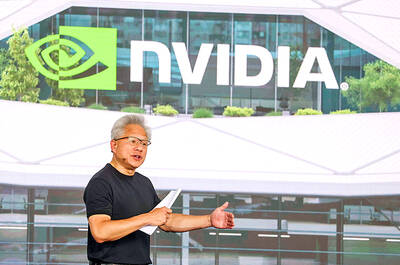
‘BOOMING’: ’ The number of partners we have here is incredible. You can see from their stock prices. They’re doing so well, they’re so happy,’ Jensen Huang said Nvidia Corp’s spending in Taiwan has ballooned to about US$150 billion a year, 10 times the US$10 billion to US$15 billion the company spent five years ago, Nvidia chief executive officer Jensen Huang (黃仁勳) said yesterday, suggesting Taiwan’s strategic importance in the global artificial intelligence (AI) supply chain. “Taiwan is the epicenter of the AI revolution. This is where the chips come, packaging comes. This is where the systems are made. This is where AI supercomputers were created,” Huang said at a meeting for the company’s employees in Beitou-Shilin Technology Park (北投士林科技園區) in Taipei, the planned site of Nvidia’s Taipei headquarters. “Taiwan


 RSS
RSS