


Australia at midnight became the first country in the world to ban social media for children under 16, blocking them from platforms including TikTok, Alphabet’s YouTube and Meta’s Instagram and Facebook.
Ten of the biggest platforms were ordered to block children or be fined up to A$49.5 million (US$33 million) under the new law, which was criticized by major technology companies and free speech campaigners, but praised by parents and child advocates.
The ban is being closely watched by other countries considering similar age-based measures as concerns mount over the effects of social media on children’s health and safety.
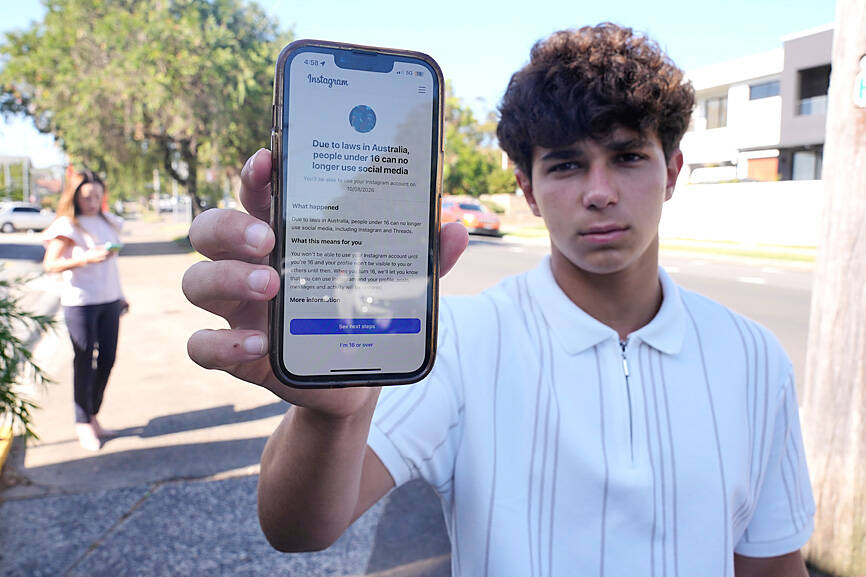
Photo: AP
“While Australia is the first to adopt such restrictions, it is unlikely to be the last,” said Tama Leaver, a professor of Internet studies at Curtin University.
“Governments around the world are watching how the power of Big Tech was successfully taken on. The social media ban in Australia ... is very much the canary in the coal mine,” she said.
The rollout closes out a year of speculation about whether a country can block children from using technology that is built into modern life, and it begins a live experiment that will be studied globally by lawmakers who want to intervene directly because they are frustrated by what they say is a tech industry that has been too slow to implement effective harm-minimization efforts.
Governments from Denmark to Malaysia — and even some states in the US, where platforms are rolling back trust and safety features — say they plan similar steps, four years after a leak of internal Meta documents showed the company knew its products contributed to body image problems and suicidal thoughts among teenagers while publicly denying the link existed.
Although the ban covers 10 platforms initially, the government has said the list would change as new products appear and young users switch to alternatives.
Of the initial 10, all but Elon Musk’s X have said they would comply using age inference — guessing a person’s age from their online activity — or age estimation, which is usually based on a selfie.
They might also check with uploaded identification documents or linked bank account details.
For the social media businesses, the implementation marks a new era of structural stagnation as user numbers flatline and time spent on platforms shrinks, studies show.
Platforms say they do not make much money showing advertisements to under-16s, but they add that the ban interrupts a pipeline of future users.
Just before the ban took effect, 86 percent of Australians aged 8 to 15 used social media, the government said.
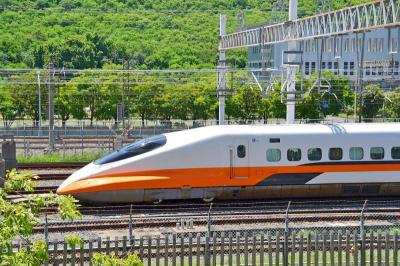
A signaling system malfunction disrupted high-speed rail (HSR) services beginning at 8am today, with trains temporarily reduced to three northbound and three southbound trains per hour as authorities conduct inspections. The malfunction occurred on a section of track in Miaoli County during pre-operation checks early this morning, forcing northbound and southbound trains to use a single track, the HSR operator said. The regular schedule has been replaced with three hourly trains offering only nonreserved seating in each direction, stopping at every station, it said, adding that business class cars would still have reserved seating. Departures from terminal stations are scheduled at the top

Taiwan is still in the process of assessing the possibility of recruiting workers from Eswatini, the Ministry of Foreign Affairs said yesterday, adding that its goal is to help Eswatini upgrade its vocational training centers. If there are plans to recruit workers from Eswatini, safeguarding national security, protecting public health and ensuring the employment rights of Taiwanese would be prerequisites, Department of West Asian and African Affairs Director-General Yen Chia-liang (顏嘉良) told a news conference. Key considerations would also include filling labor shortages in specific industries, and fostering bilateral professional and technical exchanges, he said. Yen was asked about the progress of labor
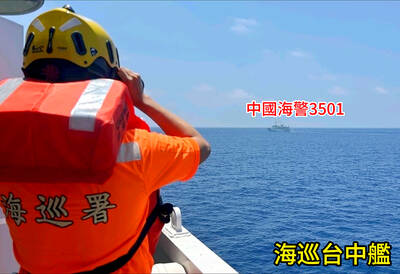
VERBOSE VESSELS: A CGA cutter and a China Coast Guard exchanged verbal barbs for more than a day in Taiwanese-controlled waters before the Chinese vessel left The Taiwanese and Chinese coast guards had a standoff near the strategically located Pratas Islands (Dongsha Islands, 東沙群島) in the north of the South China Sea, the Coast Guard Administration (CGA) said yesterday. The two sides engaged in intense radio exchanges over sovereignty claims during the 33-hour standoff. China Coast Guard vessel 3501 eventually left the restricted waters, 26.6 nautical miles (49.2km) west of the Pratas Islands, at 5pm yesterday, the CGA said. Lying approximately between southern Taiwan and Hong Kong, the Taiwan-controlled Pratas are seen by some security experts as vulnerable to Chinese attack due to their distance — more than

A US uncrewed surface vessel (USV) encountered multiple Chinese warships during an autonomous transit of the Taiwan Strait, US defense company Seasats said in a statement on Wednesday. Seasats announced that a Lightfish USV had completed the first autonomous transit of the Taiwan Strait. Over five days, the USV traversed the entire length of the Strait while constantly monitoring surface vessel traffic, the company said. The Lightfish encountered multiple Chinese warships, one of which was a Chinese People’s Liberation Army Navy (PLAN) Type 056 corvette, it said. The Chinese vessels were operating “well within Taiwan’s exclusive economic zone without transmitting their identity via the


 RSS
RSS