


Taiwan’s ranking in the Observer’s Global Artificial Intelligence (AI) Index rose from 21st last year to 16th this year, although its scores in talent, development and commercial ecosystem continued to lag.
The Observer’s Global AI Index ranked 94 countries across innovation, investment and real-world AI adoption, with the US topping this year’s list, followed by China, Singapore, the UK and South Korea. From the sixth to 15th places were France, Israel, Canada, Germany, the United Arab Emirates, Japan, Switzerland, the Netherlands, Saudi Arabia and Finland.
Taiwan’s strengths lie in government strategy, where it ranked eighth globally, and infrastructure, placing seventh, Industrial Development Administration Director-General Chiou Chyou-huey (邱求慧) wrote on social media on Friday.

Photo: Chiang Ying-ying, AP
The government’s AI-related policies and Taiwan Chip-based Industrial Innovation Program, together with Taiwan Semiconductor Manufacturing Co (TSMC, 台積電) and the hardware capabilities of the server supply chain, elevated the nation’s performance in those two indicators to a world-class level, Chiou said.
Taiwan also showed steady progress in AI-related policies and operating environment, ranking 15th, as well as in research, where it placed 18th, he said, adding that the results indicated Taiwan’s system and environment are becoming increasingly mature.
The nation lagged in three indicators: talent, development and commercial ecosystem, Chiou said.
Talent measures the availability of skilled AI practitioners, while development assesses the ability to apply AI knowledge to create new AI assets and products at a practical level, the Observer said.
Commercial ecosystem focuses on the scale and breadth of private investment in AI companies and the dynamism of the broader commercial environment, it said.
Taiwan ranked 33rd in talent, reflecting a severe shortage of advanced AI specialists in the nation, while placing 30th in commercial ecosystem indicates a lack of enterprises and start-ups capable of generating profit from AI services, Chiou said.
The nation was 27th in the development indicator, as most citizens remain users of AI tools rather than creators of the underlying technologies, he said.
The three weaknesses together form bottlenecks that prevent Taiwan from breaking into the global top 10, Chiou said.
Although hardware strength and government commitment can move the nation toward the frontier, Taiwan must still bolster its software talent and industry ecosystem if it hopes to become a leading AI nation, he added.
Pegatron Corp (和碩) chairman Tung Tzu-hsien (童子賢) yesterday said Taiwan should not be overly concerned about changes in its ranking, as the nation remains an important player in the global AI wave.
Although Taiwan only has a population of 23 million, it can still serve as an essential partner in the technology sector, particularly within the global information technology ecosystem, Tung said.
Given the nation’s important position in the global technology landscape, it is natural for people to worry about whether its ranking advances or falls, he said.
However, people should move forward with a steady mindset, rather than becoming overly concerned about rankings, he added.

NATIONAL SECURITY THREAT: An official said that Guan Guan’s comments had gone beyond the threshold of free speech, as she advocated for the destruction of the ROC China-born media influencer Guan Guan’s (關關) residency permit has been revoked for repeatedly posting pro-China content that threatens national security, the National Immigration Agency said yesterday. Guan Guan has said many controversial things in her videos posted to Douyin (抖音), including “the red flag will soon be painted all over Taiwan” and “Taiwan is an inseparable part of China,” while expressing hope for expedited “reunification.” The agency received multiple reports alleging that Guan Guan had advocated for armed reunification last year. After investigating, the agency last month issued a notice requiring her to appear and account for her actions. Guan Guan appeared as required,
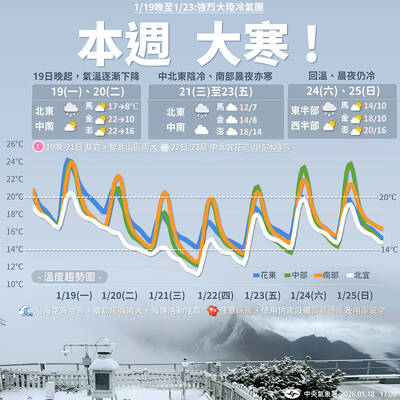
A strong cold air mass is expected to arrive tonight, bringing a change in weather and a drop in temperature, the Central Weather Administration (CWA) said. The coldest time would be early on Thursday morning, with temperatures in some areas dipping as low as 8°C, it said. Daytime highs yesterday were 22°C to 24°C in northern and eastern Taiwan, and about 25°C to 28°C in the central and southern regions, it said. However, nighttime lows would dip to about 15°C to 16°C in central and northern Taiwan as well as the northeast, and 17°C to 19°C elsewhere, it said. Tropical Storm Nokaen, currently
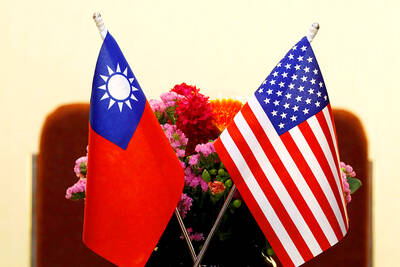
‘NATO-PLUS’: ‘Our strategic partners in the Indo-Pacific are facing increasing aggression by the Chinese Communist Party,’ US Representative Rob Wittman said The US House of Representatives on Monday released its version of the Consolidated Appropriations Act, which includes US$1.15 billion to support security cooperation with Taiwan. The omnibus act, covering US$1.2 trillion of spending, allocates US$1 billion for the Taiwan Security Cooperation Initiative, as well as US$150 million for the replacement of defense articles and reimbursement of defense services provided to Taiwan. The fund allocations were based on the US National Defense Authorization Act for fiscal 2026 that was passed by the US Congress last month and authorized up to US$1 billion to the US Defense Security Cooperation Agency in support of the
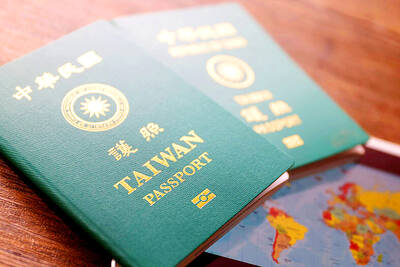
PAPERS, PLEASE: The gang exploited the high value of the passports, selling them at inflated prices to Chinese buyers, who would treat them as ‘invisibility cloaks’ The Yilan District Court has handed four members of a syndicate prison terms ranging from one year and two months to two years and two months for their involvement in a scheme to purchase Taiwanese passports and resell them abroad at a massive markup. A Chinese human smuggling syndicate purchased Taiwanese passports through local criminal networks, exploiting the passports’ visa-free travel privileges to turn a profit of more than 20 times the original price, the court said. Such criminal organizations enable people to impersonate Taiwanese when entering and exiting Taiwan and other countries, undermining social order and the credibility of the nation’s


 RSS
RSS