

The US is to work with Indo-Pacific partners to maintain peace and stability in the Taiwan Strait and the broader region, US Principal Deputy Assistant Secretary of State for East Asian and Pacific Affairs Jonathan Fritz said on Wednesday.
The US would cooperate with South Korea and other regional partners to “uphold the international law of the sea and peace and stability, whether in the Taiwan Strait, the South China Sea or elsewhere in the region,” Fritz said at the ROK-US Strategic Forum in Washington.
The alliance between the US and South Korea, as well as their extended deterrence commitments, “remain ironclad,” he added.
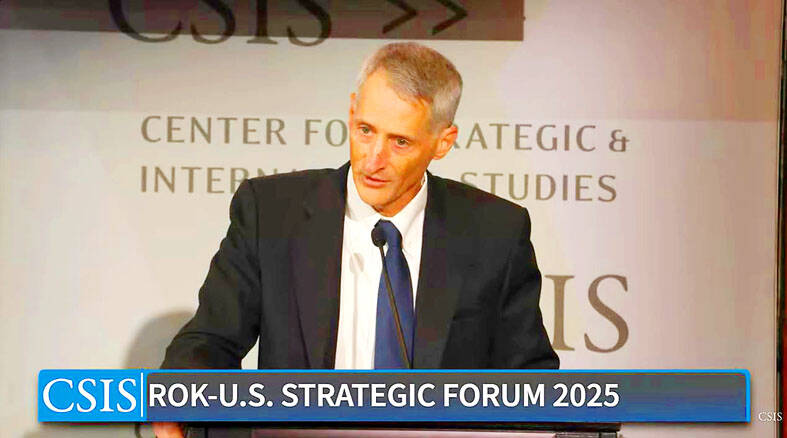
Photo: screengrab the Center for Strategic and International Studies YouTube
Victor Cha, president of the Geopolitics and Foreign Policy Department and Korea Chair at the Washington-based think tank Center for Strategic and International Studies, said that South Korea’s most important role in a potential Taiwan contingency would be to prevent a second crisis from erupting on the Korean Peninsula, which would “stretch the United States very thinly.”
Cha said that the inclusion of the Taiwan Strait issue in the joint fact sheet released after the October meeting between US President Donald Trump and South Korean President Lee Jae-myung was “very significant, given that it is a different government from the previous government.”
The statement about the law of the sea and freedom of navigation was “clearly in reference to Chinese activity in the South China Sea, as well as closer to the Korean Peninsula,” Cha said.
As for South Korea’s role in maintaining peace across the Strait, Cha said that it could at least criticize China for using economic coercion against Japan after Japanese Prime Minister Sanae Takaichi took a stance on a cross-strait issue.
He was referring to Takaichi’s recent comment that a Chinese attack on Taiwan would constitute a situation threatening Japan’s survival, a remark that prompted Beijing to issue a travel warning for Japan and suspend imports of Japanese seafood.
Lee Seong-hyon, a senior fellow at the George H.W. Bush Foundation for US-China Relations, said at the forum that Takaichi’s remark was not directed at Beijing, but rather at Washington.
“Japan wants to make sure that from Washington’s perspective, Japan is really a reliable partner,” he said.
A previous meeting between Trump and Chinese President Xi Jinping (習近平) toned down the tensions and raised the possibility of a “grand bargain” between the two superpowers, prompting “a fear of abandonment” in smaller countries, Lee said.
“Interestingly, US allies are showing strategic clarity,” even as Washington is approaching Beijing with strategic ambiguity, he said.
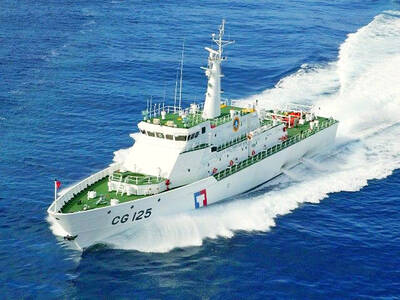
GEOPOLITICAL SIGNIFICANCE: The CGA’s nonmilitary role makes it a tool to avert diplomatic issues, an official said, while confirming the donation of a ship to Manila Coast Guard Administration (CGA) ships are scheduled to sail to the Philippines bearing the words “Taiwan Coast Guard” in a high-profile visit in October next year, the first such visit by a Taiwanese maritime law enforcement vessel to the Southeast Asian nation, the agency said yesterday. The CGA also confirmed that it had donated one of its decommissioned patrol vessels to the Philippines in a rare transfer of a retired ship to a nondiplomatic ally. The Republic of China (ROC) Navy last made such a visit in 1974, shortly before the Philippines switched diplomatic recognition to the People’s Republic of China in

‘GLOBAL WARNING’: The infiltration is not just a local problem, as Beijing has been deploying the same tactics worldwide against Western democracies, a report said Between 50,000 and 100,000 Chinese spies are operating in Taiwan, far more than the National Security Bureau’s previous estimate of 5,000, German journalist and author Jurgen Kremb said on Monday. Kremb presented his research, titled “The War of Spies: How China’s Intelligence Services Are Infiltrating Taiwan — and What Europe Must Learn from It,” at a joint event held by the Taiwan offices of the Friedrich Naumann Foundation and the European Values Center for Security Policy. The report was published in June in the Ministry of Justice Investigation Bureau’s Prospect & Exploration Monthly (展望與探索月刊). By spies, he said he was referring to informants,

PRICE STABILIZATION: The Ministry of Economic Affairs has urged the legislature to support the Cabinet’s supplementary budget for state-owned energy companies State-owned oil supplier CPC Corp, Taiwan (CPC, 台灣中油) on Saturday announced that it would raise domestic gasoline prices by NT$0.7 (US$0.02) per liter and diesel prices by NT$0.6 per liter this week after international crude oil prices rose above US$100 per barrel last week. Formosa Petrochemical Corp (台塑石化) yesterday said that it matched CPC’s price adjustments for this week. The decisions end a six-week period during which CPC and Formosa kept fuel prices in Taiwan unchanged. Retail gasoline prices this week would rise to NT$31.2, NT$32.7 and NT$34.7 per liter for 92, 95 and 98-octane unleaded gasoline respectively at CPC
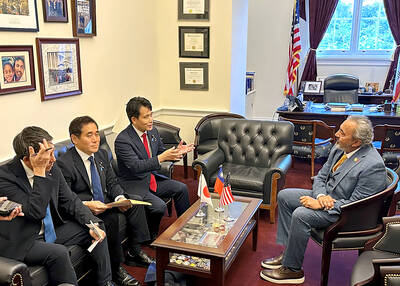
WASHINGTON MEETING: Japan’s Hirofumi Takinami said participants rejected the idea that the US should limit its defensive perimeter to the Second Island Chain US and Japanese lawmakers agree that the US must defend the First Island Chain, including Taiwan, and should not fall back to the Second Island Chain, while “a Taiwan contingency is a Japan contingency and therefore a US-Japan alliance contingency,” media reported after a meeting between officials of the two nations in Washington on Tuesday. A delegation of Japanese lawmakers from the Liberal Democratic Party met with US Senator Thom Tillis, co-chair of the Senate Taiwan Caucus, and US Representative Ami Bera, co-chair of the US Congressional Taiwan caucus, to discuss issues concerning East Asia and the Taiwan Strait. The Japanese and


 RSS
RSS