


President William Lai (賴清德) in a US media interview said that Taiwan is “working side by side” with other democracies to deter a Chinese invasion, and “robust preparations are the best way to avoid war and achieve peace.”
Speaking in a prerecorded video interview, which aired on Wednesday at the New York Times’ DealBook Summit, Lai said that “peace is priceless and war has no winners.”
“While we aspire to peace, we cannot harbor illusions about it,” Lai told interviewer Andrew Ross Sorkin in his first foreign media interview since he announced a US$40 billion special defense budget on Wednesday last week.
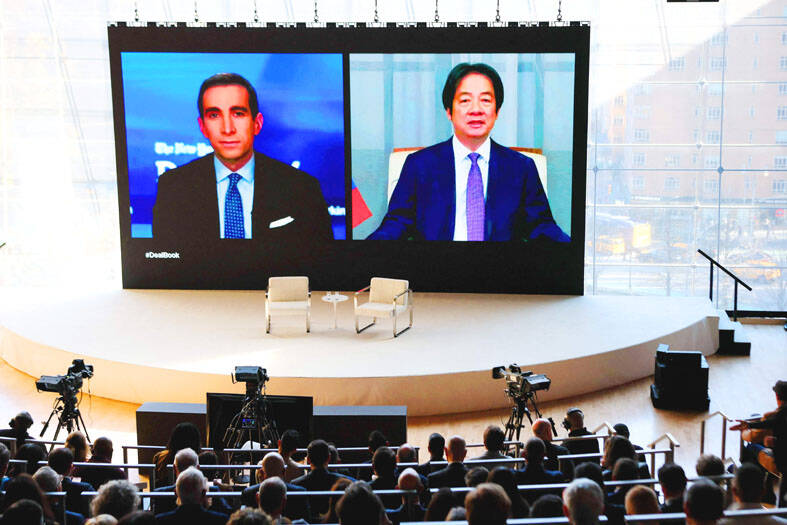
Photo: AFP
“Peace must be secured through strength. This is why we are increasing our defense budget and strengthening our national defense capabilities, while also cutting back our economic dependence on China,” Lai added.
The president was one of more than a dozen interviewees at the Times’ event, which also featured conversations with US Secretary of the Treasury Scott Bessent, BlackRock CEO Larry Fink, General Motors CEO Mary Barra and California Governor Gavin Newsom.
In the Lai interview, which lasted about 10 minutes, Sorkin asked about China’s goal of being capable of “taking Taiwan by force by 2027” and what Lai thought China’s current timeline could be.
“Whatever timeline China’s People’s Liberation Army may have, Taiwan’s fundamental principle is that we must be ready first,” he said, before expressing gratitude to the international community for their support of Taiwan.
Sorkin then asked how confident Lai felt about US President Donald Trump’s support for Taiwan.
“Our relationship truly is rock solid,” Lai said of the long-standing relationship between the two countries, adding that US cooperation with Taiwan has expanded since Trump assumed office.
On the Russia-Ukraine war, Lai said Taiwan stands with Ukrainians, and he hopes “this irrational and illegitimate war will be over as soon as possible so that the Ukrainian people will no longer have to suffer.”
“However, in ending this war, we also hope that Ukraine’s national dignity and the well-being of its people will be respected and future conflict will be prevented,” Lai said.
Sorkin, a financial columnist for the New York Times and coanchor of CNBC’s business news show Squawk Box, turned the interview to the topic of semiconductors.
Noting the Trump administration’s desire to manufacture “40 to 50 percent of all semiconductors in the next couple of years,” Sorkin asked whether Lai was concerned about Taiwan potentially becoming “less valuable” to the US.
Lai said that “semiconductors are a global ecosystem” and that he hopes Taiwan can “support the reindustrialization of the US” through investments in the country.
Taiwan Semiconductor Manufacturing Co (台積電) and other Taiwanese chip firms invest in the US, Japan, Europe or “wherever they believe it is needed,” Lai said.
On the question of whether Trump’s 40 to 50 percent domestic semiconductor manufacturing goal was realistic or not, Lai said that would depend on the US government’s ability to facilitate land, water and electricity, workforce and talent development, and investment incentives.
Later in the interview, Lai said that Taiwan’s decision in about 2000 not to relocate its most advanced manufacturing to China was correct.
He also urged Chinese President Xi Jinping (習近平) to focus on China’s economic and not “territorial expansion.”
Taiwan’s economy is forecast to grow 7.37 percent this year, “while international financial institutions estimate China’s growth to be only a little above 4 percent,” he said.
“China’s economy is indeed struggling,” Lai added. “We sincerely hope that as China faces economic pressures, President Xi Jinping will focus not on territorial expansion, but on improving the well-being of the Chinese people.”
He also called on leaders around the world to work together to “take steps to prevent AI [artificial intelligence] from becoming a bubble,” so that the industry can drive long-term global growth.
Additional reporting by Reuters

SILENCING CRITICS: In addition to blocking Taiwan, China aimed to prevent rights activists from speaking out against authoritarian states, a Cabinet department said The Ministry of Foreign Affairs (MOFA) yesterday condemned transnational repression by Beijing after RightsCon, a major digital human rights conference scheduled to be held in Zambia this week, was abruptly canceled due to Chinese pressure over Taiwanese participation. This year’s RightsCon, the world’s largest conference discussing issues “at the intersection of human rights and technology,” was scheduled to take place from tomorrow to Friday in Lusaka, and expected to draw 2,600 in-person attendees from 150 countries, along with 1,100 online participants. However, organizers were forced to cancel the event due to behind-the-scenes pressure from China, the ministry said, expressing its “strongest condemnation”
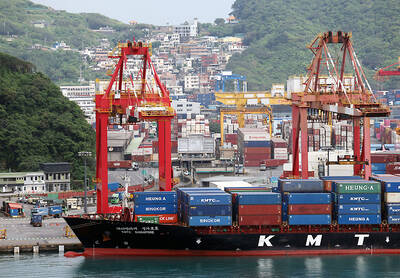
Taiwan’s economy grew far faster than expected in the first quarter, as booming demand for artificial intelligence (AI) applications drove a surge in exports, spilling over into investment and consumption, the Directorate-General of Budget, Accounting and Statistics (DGBAS) said yesterday. GDP growth was 13.69 percent year-on-year during the January-to-March period, beating the DGBAS’ February forecast by 2.23 percentage points and marking the most robust growth in nearly four decades, DGBAS senior official Chiang Hsin-yi (江心怡) told a news conference in Taipei. The result was powered by exports, which remain the backbone of Taiwan’s economy, Chiang said. Outbound shipments jumped 51.12 percent year-on-year to
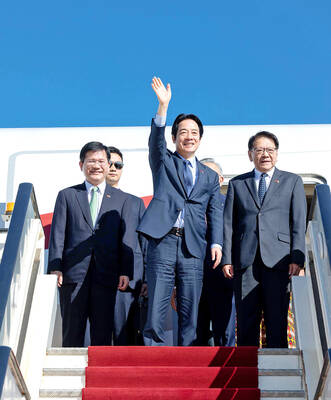
DELAYED BUT DETERMINED: The president’s visit highlights Taiwan’s right to international engagement amid regional pressure from China President Willaim Lai (賴清德) yesterday arrived in Eswatini, more than a week after his planned visit to Taiwan’s sole African ally was suspended because of revoked overflight permits. “The visit, originally scheduled for April 22, was postponed due to unforeseen external factors,” Lai wrote on social media. “After several days of careful arrangements by our diplomatic and national security teams, we successfully arrived today.” Lai said he looked forward to further deepening Taiwan-Eswatini relations through closer cooperation in the economy, agriculture, culture and education, as well as advancing the nation’s international partnerships. The president was initially scheduled to arrive in time to celebrate
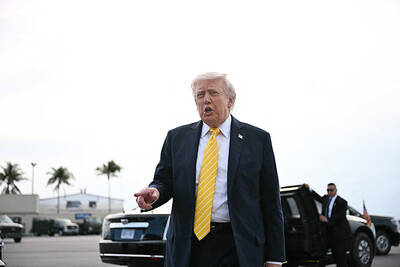
Iran’s Islamic Revolutionary Guard Corp (IRGC) yesterday said the US faced a choice between an “impossible” military operation or a “bad deal” with Tehran, after US President Donald Trump disparaged Iran’s latest peace proposal. Negotiations between the two countries have been deadlocked since a ceasefire came into effect on April 8, with only one round of direct peace talks held so far. Iran’s Tasnim and Fars news agencies reported that Tehran had submitted a 14-point proposal to mediator Pakistan, but Trump was quick to cast doubt on it. “I will soon be reviewing the plan that Iran has just sent to us, but


 RSS
RSS