


Taiwanese prosecutors charged Tokyo Electron Ltd for failing to prevent staff from allegedly stealing Taiwan Semiconductor Manufacturing Co (TSMC, 台積電) trade secrets, escalating a dispute involving two Asian linchpins of a chip industry increasingly vital to national and economic security.
Prosecutors indicted the Japanese company on four counts of contravening the Trade Secrets Act (營業秘密法) and the National Security Act (國家安全法), they said in a statement yesterday. They’re asking a local court to rule in favor of their request for Tokyo Electron pay a fine of up to NT$120 million (US$3.8 million) for failing in its duty to prevent the alleged theft.
“Tokyo Electron has not done its best to carry out preventive measures,” prosecutors said. They did not accuse the Japanese firm of utilizing TSMC’s proprietary data.
Photo: Kiyoshi Ota, Bloomberg
The indictment follows the August charging of three people — including a former TSMC and Tokyo Electron employee — for allegedly conspiring to steal intellectual property from Taiwan’s largest and most important company.
TSMC, chipmaker to Apple Inc and Nvidia Corp, reported the alleged theft to the authorities this year, triggering a probe that’s cast a spotlight on the sensitive nature of chipmaking technology.
Taiwan makes the bulk of the world’s most advanced semiconductors and its companies have regularly been targeted for their intellectual property by entities with ties to Beijing, which is pushing hard to develop its own chip capabilities.
Last month, prosecutors searched the homes of a former TSMC executive who joined Intel Corp, after the Taiwanese firm accused him of potentially transferring intellectual property. The US company has rejected those allegations.
Tokyo Electron said it’s still trying to verify the details of the announcement from the Taiwanese authorities. TSMC didn’t immediately respond to a request for comment outside normal business hours.
The dispute has also put lower-profile Tokyo Electron — a maker of equipment for TSMC and other manufacturers — under unusual scrutiny.
Taiwan is seeking jail terms for the individuals indicted, citing a threat to national security. Among those was the former employee, identified by the surname Chen, who allegedly tried to gain access to TSMC’s confidential data while at Tokyo Electron. According to prosecutors, the ex-employee convinced former TSMC co-workers to share proprietary technology.
Tokyo Electron previously said it had fired an employee at a Taiwan unit in connection with the case, and is cooperating with the investigation. It has stressed a firm policy against wrongdoing by its staff and reiterated it had seen no evidence that sensitive data was leaked to a third party.
Alongside Applied Materials Inc and Lam Research Corp, Tokyo Electron plays a crucial supporting role to chipmakers including TSMC, Samsung Electronics Co and Intel, making machines that coat, etch, process and clean silicon wafers to create semiconductors.
Prosecutors had accused Chen of trying to steal technology to help improve the Japanese company’s etching equipment, and win TSMC’s certification for use in cutting-edge 2-nanometer chipmaking processes. They also said the three people who were indicted intended to use TSMC’s proprietary technology overseas.

‘NO SECURITY RISK’: The Railway Bureau reassured the public that the technicians’ activities were limited to technical guidance and did not involve sensitive systems The Railway Bureau yesterday said it had invited eight Chinese technicians to assist with an airport MRT construction project. The bureau issued the confirmation after an Internet user said Chinese nationals had entered the construction zone of Taiwan Taoyuan International Airport’s Terminal 3 project. They asked why “individuals from an enemy state” were allowed access to such a major national infrastructure project, which raised serious concerns over Taiwan’s industrial safety, sensitive systems and information security. The bureau’s Northern Region Engineering Branch Office said subcontractor Taiwan Handle Industrial Co (台灣手把工業) of the Taoyuan airport MRT’s “Contract No. CU05 Project A14 Station Civil, MEP &

A US uncrewed surface vessel (USV) encountered multiple Chinese warships during an autonomous transit of the Taiwan Strait, US defense company Seasats said in a statement on Wednesday. Seasats announced that a Lightfish USV had completed the first autonomous transit of the Taiwan Strait. Over five days, the USV traversed the entire length of the Strait while constantly monitoring surface vessel traffic, the company said. The Lightfish encountered multiple Chinese warships, one of which was a Chinese People’s Liberation Army Navy (PLAN) Type 056 corvette, it said. The Chinese vessels were operating “well within Taiwan’s exclusive economic zone without transmitting their identity via the
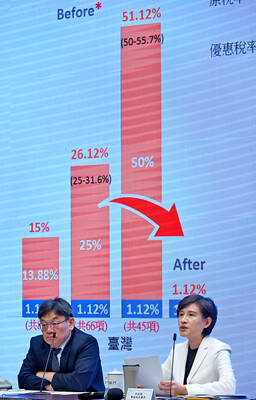
GREATER REACH? Auto parts and wood products would face tariffs of up to 15%, matching those targeting the EU, Japan and South Korea, Vice Premier said The US has announced that preferential tariff treatment for Taiwan’s non-semiconductor Section 232 goods would take effect retroactively from May 1, the Executive Yuan said yesterday. The US government yesterday posted a notice on the Federal Register’s public inspection Web site previewing tariff concessions for Taiwan under a memorandum of understanding (MOU) on Taiwan-US investment after two months of negotiations. The MOU signed on Jan. 15 stipulated three major preferential tariff arrangements: a 15 percent “reciprocal” tariff rate for Taiwan without stacking most-favored nation (MFN) rates; preferential Section 232 treatment for semiconductors and related products; and preferential Section 232 treatment for non-semiconductor

The National Chungshan Institute of Science and Technology yesterday showcased its locally developed variants of the Vision 60 robotic patrol dog, which it plans to deploy on the nation’s outlying territories in the South China Sea. The variants were produced under the Joint Lab project — created by the institute and domestic companies — and assembled with domestically produced motors, lenses and artificial intelligence (AI) systems alongside licensed tech from the US, Missile and Rocket Systems Research Division deputy director Jen Kuo-kang (任國光) told the media event at a military base in Taipei’s Dazhi (大直) area. Taiwan has built up its strengths


 RSS
RSS