


Opposition lawmakers yesterday blocked a bill authorizing a special defense budget of NT$1.25 trillion (US$39.8 billion) from being placed on the agenda for Friday’s Legislative Yuan plenary session as they urged President William Lai (賴清德) to appear before the legislature and answer questions about the proposed budget first.
Lai on Wednesday last week announced the NT$1.25 trillion supplementary budget to underscore the nation’s determination to defend itself, saying that China’s goal is to “prepare for the military unification with Taiwan by 2027.”
The Executive Yuan on Thursday last week passed the draft act for the NT$1.25 trillion in government spending for major weapons purchases over eight years, from next year to 2033.

Photo: Tu Chien-jung, Taipei Times
During a meeting of the legislature’s Procedure Committee yesterday, the Chinese Nationalist Party (KMT) proposed postponing consideration of the bill, a move that was supported by the Taiwan People’s Party (TPP).
KMT caucus whip Fu Kun-chi (傅?萁) said the KMT caucus fully supports national defense and military procurement to protect the nation, and defend free and democratic Taiwan, but the Ministry of National Defense had not explicitly stated that the Chinese Communist Party would have the capability to take Taiwan by force by 2027 in any of its defense budgets across the past three fiscal years, including this fiscal year.
Lai had neither briefed the legislature nor informed the public, but made the announcement through an op-ed in an international newspaper, Fu said.
The government has not stated what equipment or platforms are being purchased before attempting to ram a draft defense budget through the Procedure Committee, he said, adding that this was akin to demanding a blank check while the public remains in the dark.
The president must appear before the legislature to clarify the defense budget to the public before a decision can be made, he said.
TPP Chairman Huang Kuo-chang (黃國昌) said that the public absolutely supports measures to increase the nation’s self-defense capabilities, but with budgets running to more than NT$1 trillion and the lackluster results of defense procurements, Lai must provide guarantees that the special budget would translate into a direct increase in Taiwan’s combat readiness.
The Democratic Progressive Party’s (DPP) efforts to legitimize its demands to boost the defense budget, while smearing the opposition’s right to oversight, as well as allowing the president to “threaten” the public with the imminent subjugation of the country, are the greatest dangers facing Taiwan, he added.
Huang agreed that the president should appear before the legislature and the TPP wished to ask the president many questions, as it had received only two A4 pages of information on the proposed budget.
Meanwhile, DPP lawmakers went to the committee meeting armed with protest placards.
DPP caucus secretary-general Chen Pei-yu (陳培瑜) said the opposition parties must make known to the public why they are blocking the special defense budget.
The president has made it very clear that his appearance at the legislature is open for discussion as long as the process is in line with standing regulations and procedures, Chen said, but the opposition parties were unwilling to discuss the issue in detail.
DPP Legislator Fan Yun (范雲) said the opposition’s demands were an excuse to hide behind their true intention to oppose the defense budget.
DPP spokesman Justin Wu (吳崢) said that Lai was willing to brief the legislature, but the opposition’s insistence that each legislator be allowed to question the president is unconstitutional.
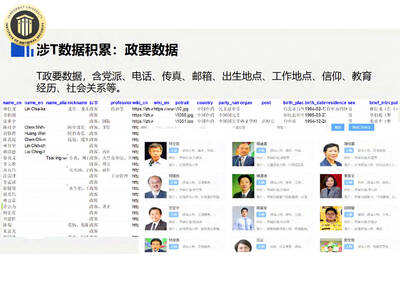
NETWORK-MAPPING PROJECT: The database contains 170 detailed files of Taiwanese politicians and about 23 million records of household registration data in Taiwan China has developed a network-mapping project targeting political figures and parties in Taiwan to monitor public opinion during elections and to craft tailored influence campaigns aimed at dividing Taiwanese society, according to documents leaked by Chinese technology firm GoLaxy (中科天璣). The documents, collected by Taipei-based Doublethink Lab, showed a database was specifically created to gather detailed information on Taiwanese political figures, including their political affiliations, job histories, birthplaces, residences, education, religion and a brief biography about them. Several notable Taiwanese politicians are in the database, including President William Lai (賴清德), former president Tsai Ing-wen (蔡英文), Minister of Foreign Affairs Lin Chia-lung (林佳龍),
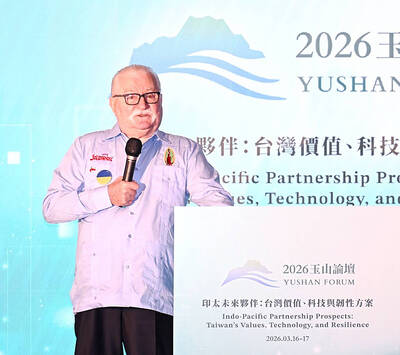
RECOGNITION: Former Fijian prime minister Mahendra Chaudhry said that Taiwan’s New Southbound Policy serves as a stabilizing force in the Indo-Pacific region Taiwan can lead the unification of the Chinese people, Nobel Peace Prize laureate and former Polish president Lech Walesa said in Taipei yesterday, adding that as the world order is changing, peaceful discussion would find good solutions, and that the use of force and coercion would always fail. Walesa made the remarks during his keynote address at a luncheon of the Yushan Forum in Taipei, titled “Indo-Pacific Partnership Prospects: Taiwan’s Values, Technology and Resilience,” organized by the Taiwan-Asia Exchange Foundation with the Ministry of Foreign Affairs. Walesa said that he had been at the forefront of a big peaceful revolution and “if
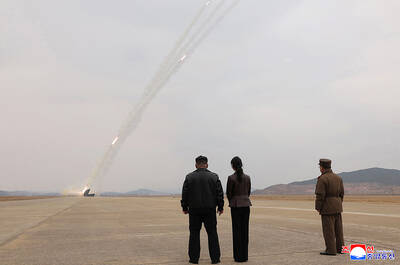
North Korea tested nuclear-capable rocket launchers, state media reported yesterday, a day after Seoul detected the launch of about 10 ballistic missiles. The test comes after South Korean and US forces launched their springtime military drills, due to run until Thursday. North Korean leader Kim Jong-un on Saturday oversaw the testing of the multiple rocket launcher system (MRLS), the Korean Central News Agency (KCNA) said. The test involved 12 600mm-caliber ultra-precision multiple rocket launchers and two artillery companies, it said. Kim said the drill gave Pyongyang’s enemies, within the 420km striking range, a sense of “uneasiness” and “a deep understanding
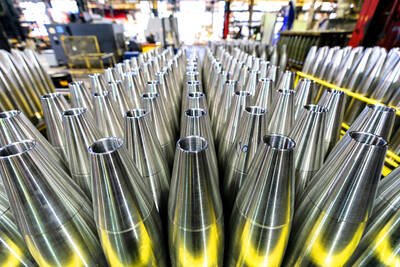
UPGRADED MISSILE: The Chungshan Institute of Science and Technology is reportedly to conduct a live-fire test of the Hsiung Feng III anti-ship missile on Thursday next week The US Army is planning to build new facilities to boost explosives production and strengthen its supply chain, a move aimed at addressing munitions shortages and supporting obligations to partners including Taiwan, Ukraine and Israel, Defense News reported. The army has issued a sources sought notice for a proposed Center of Excellence at the Blue Grass Army Depot in Kentucky, the report said. The facility would serve as a hub within the US industrial base for the production of key military explosives, including research department explosives (RDX) and high melting explosives (HMX), while also supporting research and development of next-generation materials. The proposed


 RSS
RSS