


President William Lai (賴清德) yesterday announced a NT$1.25 trillion (US$39.9 billion) special defense budget, which includes funding for a “Taiwan dome” air defense system with high-level detection and interception capabilities.
The funds would be allocated over eight years from next year to 2033, he told a news conference at the Presidential Office in Taipei.
Lai has previously pledged to increase defense spending to 5 percent of GDP as part of an ongoing strategy amid China’s threats of invasion.
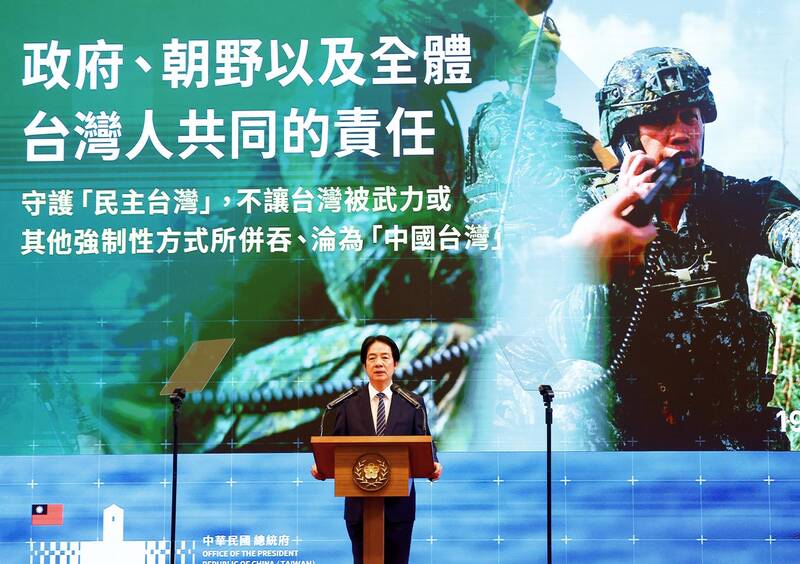
Photo: CNA
“China’s threats to Taiwan and the Indo-Pacific region are escalating,” Lai said yesterday. “Recently, various types of military intrusions, as well as maritime gray zone and disinformation campaigns have been occurring in Japan, the Philippines and in the Taiwan Strait, causing deep unease and distress to all parties in the region.”
“Taiwan, as the most important and most critical part of the first island chain, must demonstrate its determination and take on a greater responsibility in self-defense,” he said.
As Taiwan faces calls from Washington to spend more on its own defense, mirroring US pressure on Europe, it plans to increase in its defense budget to 3.32 percent of GDP next year, allocating NT$949.5 billion, topping 3 percent of GDP for the first time since 2009.
Lai in August said that he hoped for a boost in defense spending to 5 percent of GDP by 2030.
US President Donald Trump has said that Taiwan should raise its defense spending to as much as 10 percent of GDP.
China has ramped up military and political pressure over the past five years to assert territorial claims.
History has proven that trying to compromise in the face of aggression brings nothing but “enslavement,” Lai said, adding: “There is no room for compromise on national security.”
“National sovereignty, and the core values of freedom and democracy are the very foundation of our nation,” he said.
Lai, who first announced the new spending plan of US$40 billion in an op-ed in the Washington Post on Tuesday, said that Taiwan was showing its determination to defend itself.
“It is a struggle between defending democratic Taiwan and refusing to submit to become ‘China’s Taiwan,’” rather than merely an ideological struggle or a dispute over “unification versus independence,” he said.
“My message is clear: Taiwan’s dedication to peace and stability is unwavering,” Lai said. “No country will be more determined in safeguarding Taiwan’s future.”
The government would focus on finding ways to increase its defense against Beijing’s “psychological warfare” as China attempts to “weaken our unity,” Lai said.
Mitigation efforts would include monitoring Chinese interference attempts during major events, including elections, and increasing public awareness of Beijing’s tactics, Lai said.
Special budgets supplement regular annual spending plans, providing funding for emergencies or projects that require years to complete.
Taiwan has previously used such funds to buy weapons systems, including fighter jets and missiles.
Minister of National Defense Wellington Koo (顧立雄) said that NT$1.25 trillion is an upper limit for the special budget.
The funds would be used to buy precision-strike missiles, as well as go toward joint development with and procurement from the US of equipment and systems, Koo said.
Lai in October announced that Taiwan would accelerate development of a comprehensive air defense system, dubbed T-Dome, that is expected to integrate domestically made and US-made weapons.
The special budget proposal is likely to face obstacles after Lai’s Cabinet formally proposes it, given that it requires the approval of the legislature, which is controlled by the opposition.
Lai also commented on a feud between China and Japan, which started when Japanese Prime Minister Sanae Takaichi said that a hypothetical Chinese attack on Taiwan could trigger Japanese military action.
Lai said that Takaichi’s comments appeared to be focused largely on stability in the region.
“We hope China can understand that each country in the Indo-Pacific region has a responsibility to its peace and stability,” he said. “We hope that China, as a major power in the region, would also demonstrate the responsibilities of a major power. Instead, it has continued to raise threats and attacks toward neighboring countries. This is not the way a responsible major power acts.”

‘NO SECURITY RISK’: The Railway Bureau reassured the public that the technicians’ activities were limited to technical guidance and did not involve sensitive systems The Railway Bureau yesterday said it had invited eight Chinese technicians to assist with an airport MRT construction project. The bureau issued the confirmation after an Internet user said Chinese nationals had entered the construction zone of Taiwan Taoyuan International Airport’s Terminal 3 project. They asked why “individuals from an enemy state” were allowed access to such a major national infrastructure project, which raised serious concerns over Taiwan’s industrial safety, sensitive systems and information security. The bureau’s Northern Region Engineering Branch Office said subcontractor Taiwan Handle Industrial Co (台灣手把工業) of the Taoyuan airport MRT’s “Contract No. CU05 Project A14 Station Civil, MEP &

A US uncrewed surface vessel (USV) encountered multiple Chinese warships during an autonomous transit of the Taiwan Strait, US defense company Seasats said in a statement on Wednesday. Seasats announced that a Lightfish USV had completed the first autonomous transit of the Taiwan Strait. Over five days, the USV traversed the entire length of the Strait while constantly monitoring surface vessel traffic, the company said. The Lightfish encountered multiple Chinese warships, one of which was a Chinese People’s Liberation Army Navy (PLAN) Type 056 corvette, it said. The Chinese vessels were operating “well within Taiwan’s exclusive economic zone without transmitting their identity via the
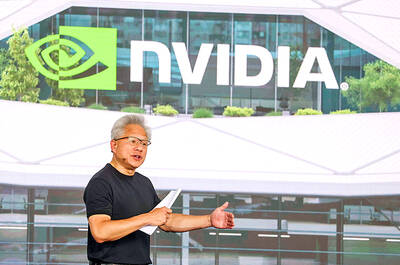
‘BOOMING’: ’ The number of partners we have here is incredible. You can see from their stock prices. They’re doing so well, they’re so happy,’ Jensen Huang said Nvidia Corp’s spending in Taiwan has ballooned to about US$150 billion a year, 10 times the US$10 billion to US$15 billion the company spent five years ago, Nvidia chief executive officer Jensen Huang (黃仁勳) said yesterday, suggesting Taiwan’s strategic importance in the global artificial intelligence (AI) supply chain. “Taiwan is the epicenter of the AI revolution. This is where the chips come, packaging comes. This is where the systems are made. This is where AI supercomputers were created,” Huang said at a meeting for the company’s employees in Beitou-Shilin Technology Park (北投士林科技園區) in Taipei, the planned site of Nvidia’s Taipei headquarters. “Taiwan
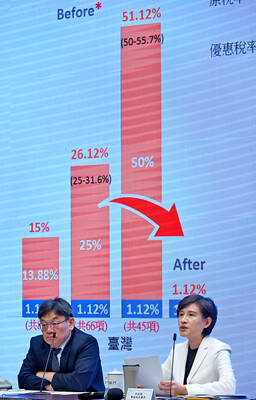
GREATER REACH? Auto parts and wood products would face tariffs of up to 15%, matching those targeting the EU, Japan and South Korea, Vice Premier said The US has announced that preferential tariff treatment for Taiwan’s non-semiconductor Section 232 goods would take effect retroactively from May 1, the Executive Yuan said yesterday. The US government yesterday posted a notice on the Federal Register’s public inspection Web site previewing tariff concessions for Taiwan under a memorandum of understanding (MOU) on Taiwan-US investment after two months of negotiations. The MOU signed on Jan. 15 stipulated three major preferential tariff arrangements: a 15 percent “reciprocal” tariff rate for Taiwan without stacking most-favored nation (MFN) rates; preferential Section 232 treatment for semiconductors and related products; and preferential Section 232 treatment for non-semiconductor


 RSS
RSS