


Nations sealed a modest agreement at the UN Climate Change Conference (COP30) in the Brazilian Amazon on Saturday as many countries swallowed weaker terms on a fossil fuel phase-out to preserve unity.
Nearly 200 countries approved the deal by consensus after two weeks of exhaustive negotiations on the fringes of the rainforest, with the notable absence of the US, as President Donald Trump shunned the talks.
Applause rang out as the gavel was brought down in steamy Belem, capping a dramatic summit that witnessed raucous protests, a damaging fire and massive street marches.
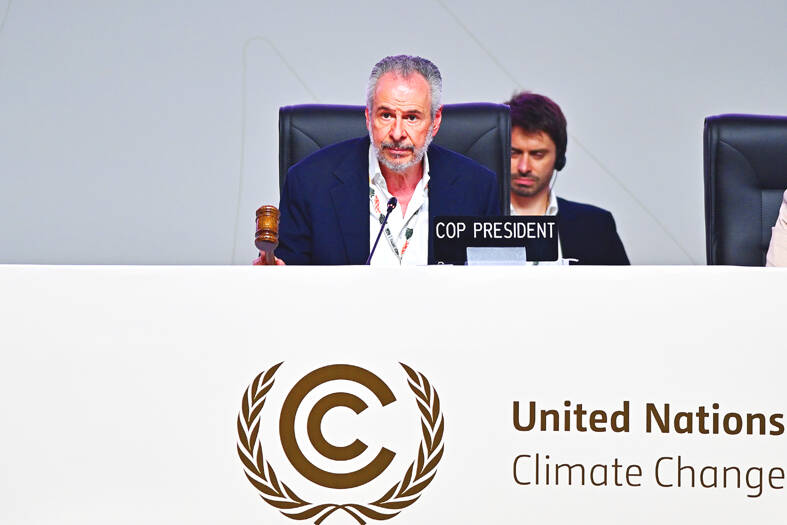
Photo: EPA
Brazilian President Luiz Inacio Lula da Silva, who staked political capital on the success of COP30, said the pact was proof that a fractured world could still unite in crisis.
“The international community faced a choice: to continue or to give up. We chose the first option,” Lula said in South Africa, where he was attending a G20 summit. “Multilateralism won.”
There was less euphoria in Belem, where defeated European ministers admitted they only took the watered-down deal to keep the entire process from imploding.
“We’re not going to hide the fact that we would have preferred to have more,” EU Commissioner for Climate, Net Zero and Clean Growth Wopke Hoekstra said.
“I know it’s a bit intangible, but there is huge value in doing stuff together,” he said.
The head of China’s delegation, Li Gao (李高), said that the summit would go down as a success.
“We achieved this success in a very difficult situation, so it shows that the international community would like to show solidarity and make joint efforts to address climate change,” Li said.
India hailed a “meaningful” deal in a statement read on behalf of major emerging markets Brazil, South Africa, India and China.
The Alliance of Small Island States — a bloc of 39 of the world’s most climate-imperiled nations — said the deal was “imperfect, but necessary progress” for a global body that operates by consensus.
Dozens of countries had threatened to walk away from the talks without an exit strategy from oil, gas and coal — instead, the deal points to a previous pact on fossil fuels, without explicitly using those words.
“We know some of you had greater ambitions for some of the issues at hand,” said COP30 president Andre Correa do Lago, who offered to create a voluntary “roadmap” away from fossil fuels as a consolation.
Colombia “does not accept” the deal, said President Gustavo Petro, whose country is hosting a world-first summit on a fossil fuel phase-out in April next year.
The roadmap idea picked up pace after an early endorsement from Lula, but ran into predictable opposition from oil giants like Saudi Arabia, coal producer India, and others.
“President Lula set the bar high in calling for roadmaps to end fossil fuels and deforestation, but a divided multilateral landscape was unable to hurdle it,” Carolina Pasquali from Greenpeace Brazil said.
Brazil sought to manage expectations of landing a major deal given the state of geopolitics and a hostile US.
Even so, optimism took root that Brazil — a champion of developing nations and home to the world’s biggest rainforest — could pull something out of the bag.
In a coup for developing countries, the world agreed to “at least triple” by 2035 money for poorer nations to adapt to climate change.
However, this was the bare minimum, one negotiator from Bangladesh said, vowing the “fight will continue.”
Raju Pandit, a negotiator from Nepal, said the summit “had not met the expectations of climate vulnerable countries.”

SILENCING CRITICS: In addition to blocking Taiwan, China aimed to prevent rights activists from speaking out against authoritarian states, a Cabinet department said The Ministry of Foreign Affairs (MOFA) yesterday condemned transnational repression by Beijing after RightsCon, a major digital human rights conference scheduled to be held in Zambia this week, was abruptly canceled due to Chinese pressure over Taiwanese participation. This year’s RightsCon, the world’s largest conference discussing issues “at the intersection of human rights and technology,” was scheduled to take place from tomorrow to Friday in Lusaka, and expected to draw 2,600 in-person attendees from 150 countries, along with 1,100 online participants. However, organizers were forced to cancel the event due to behind-the-scenes pressure from China, the ministry said, expressing its “strongest condemnation”
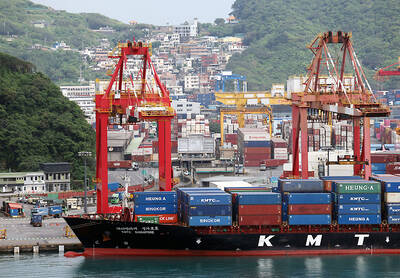
Taiwan’s economy grew far faster than expected in the first quarter, as booming demand for artificial intelligence (AI) applications drove a surge in exports, spilling over into investment and consumption, the Directorate-General of Budget, Accounting and Statistics (DGBAS) said yesterday. GDP growth was 13.69 percent year-on-year during the January-to-March period, beating the DGBAS’ February forecast by 2.23 percentage points and marking the most robust growth in nearly four decades, DGBAS senior official Chiang Hsin-yi (江心怡) told a news conference in Taipei. The result was powered by exports, which remain the backbone of Taiwan’s economy, Chiang said. Outbound shipments jumped 51.12 percent year-on-year to
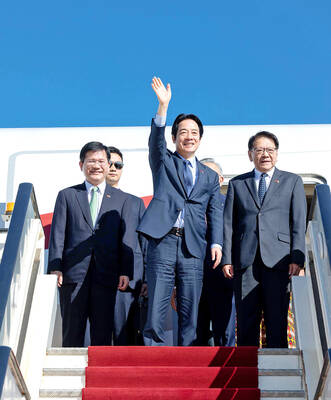
DELAYED BUT DETERMINED: The president’s visit highlights Taiwan’s right to international engagement amid regional pressure from China President Willaim Lai (賴清德) yesterday arrived in Eswatini, more than a week after his planned visit to Taiwan’s sole African ally was suspended because of revoked overflight permits. “The visit, originally scheduled for April 22, was postponed due to unforeseen external factors,” Lai wrote on social media. “After several days of careful arrangements by our diplomatic and national security teams, we successfully arrived today.” Lai said he looked forward to further deepening Taiwan-Eswatini relations through closer cooperation in the economy, agriculture, culture and education, as well as advancing the nation’s international partnerships. The president was initially scheduled to arrive in time to celebrate
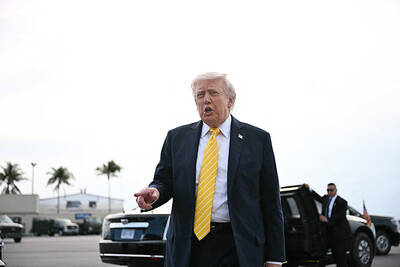
Iran’s Islamic Revolutionary Guard Corp (IRGC) yesterday said the US faced a choice between an “impossible” military operation or a “bad deal” with Tehran, after US President Donald Trump disparaged Iran’s latest peace proposal. Negotiations between the two countries have been deadlocked since a ceasefire came into effect on April 8, with only one round of direct peace talks held so far. Iran’s Tasnim and Fars news agencies reported that Tehran had submitted a 14-point proposal to mediator Pakistan, but Trump was quick to cast doubt on it. “I will soon be reviewing the plan that Iran has just sent to us, but


 RSS
RSS