


A Philippine court yesterday convicted a former mayor, who officials say is a Chinese national, of human trafficking charges for helping establish an illegal online gaming complex in a northern province where hundreds of Chinese and other foreign nationals were forced to conduct scams.
The Pasig Regional Trial Court in Metropolitan Manila sentenced Alice Guo (郭華萍) to life in prison with seven other Filipino and Chinese co-accused, and ordered them each to pay a 2 million pesos (US$33,856) fine and compensate several trafficking victims, who filed the complaints.
Guo denied all allegations against her and says she is a Filipino citizen.

Photo: AFP
Philippine authorities allege that Guo is a Chinese national named Guo Huaping, who faked Filipino citizenship to run for mayor of Bamban in northern Tarlac province, where she ran a sprawling illegal scam compound near the town hall.
The complex — which included office buildings, luxury villas and a large swimming pool — was raided in March last year after a Vietnamese worker escaped and called the police.
More than 700 Filipinos, Taiwanese, Chinese, Vietnamese, Malaysians, Indonesians and Rwandans were found on site, along with documents allegedly showing that Guo was president of a company that owned the compound.
“They used the parcels of land and buildings to house the trafficked workers and to force them to work as scammers,” the court said in its decision.
Last year, Philippine President Ferdinand Marcos Jr ordered a ban on hundreds of mostly Chinese-run online gaming operations, which proliferated under the administration of former Philippine president Rodrigo Duterte. Marcos accused the gaming operations of crimes including financial scams, human trafficking, torture, kidnapping and murder.
“The conviction of Alice Guo, also known as Guo Huaping, is a victory against corruption, human trafficking, cybercrime and many other transnational crimes,” Philippine Senator Risa Hontiveros said. “But it is far from over.”
Hontiveros led televised Senate inquiries last year that exposed online scam operations in the Philippines, along with Guo’s alleged criminal involvement.
Philippine security officials and Hontiveros have said the scam centers operated by Guo and other Chinese nationals might have also been used for espionage by China, which has had increasingly fierce territorial conflicts with the Philippines in the South China Sea and has strongly opposed the presence of US forces in the country.
“We will continue to demand accountability from every government agency that failed in their duties, and we will continue to investigate the full extent of Chinese intelligence operations in our country,” Hontiveros said. “And to all others who enabled Alice Guo’s criminal empire: The Philippines is not a playground for exploitation, infiltration and espionage.”
Guo has not been charged with espionage and she denies any connection to spying.
Bamban is located kilometers from a Philippine air force base, where US forces have been allowed to maintain a rotating presence with their aircraft and weapons under a 2014 defense pact.
Additional reporting by AFP

A signaling system malfunction disrupted high-speed rail (HSR) services beginning at 8am today, with trains temporarily reduced to three northbound and three southbound trains per hour as authorities conduct inspections. The malfunction occurred on a section of track in Miaoli County during pre-operation checks early this morning, forcing northbound and southbound trains to use a single track, the HSR operator said. The regular schedule has been replaced with three hourly trains offering only nonreserved seating in each direction, stopping at every station, it said, adding that business class cars would still have reserved seating. Departures from terminal stations are scheduled at the top

DRONE CENTRAL: Taiwan aims to become Asia’s democratic hub for drones, with most exports focused on high-quality military-grade models, an official said Taiwan’s drone industry is expected to expand significantly by 2030, producing 100,000 units per month and exporting half of them, the Ministry of Economic Affairs said yesterday. Current drone production capacity is about 15,000 units per month, but the industry can quickly scale up as demand increases, Industrial Development Administration Director-General Chiou Chyou-huey (邱求慧) told a news conference in Taipei. Taiwan’s drone output grew 2.5-fold last year to NT$12.9 billion (US$408.3 million) under a government program to develop the uncrewed vehicle sector, he said. The Executive Yuan in October last year approved plans to invest NT$44.2 billion into domestic production of uncrewed aerial

VERBOSE VESSELS: A CGA cutter and a China Coast Guard exchanged verbal barbs for more than a day in Taiwanese-controlled waters before the Chinese vessel left The Taiwanese and Chinese coast guards had a standoff near the strategically located Pratas Islands (Dongsha Islands, 東沙群島) in the north of the South China Sea, the Coast Guard Administration (CGA) said yesterday. The two sides engaged in intense radio exchanges over sovereignty claims during the 33-hour standoff. China Coast Guard vessel 3501 eventually left the restricted waters, 26.6 nautical miles (49.2km) west of the Pratas Islands, at 5pm yesterday, the CGA said. Lying approximately between southern Taiwan and Hong Kong, the Taiwan-controlled Pratas are seen by some security experts as vulnerable to Chinese attack due to their distance — more than
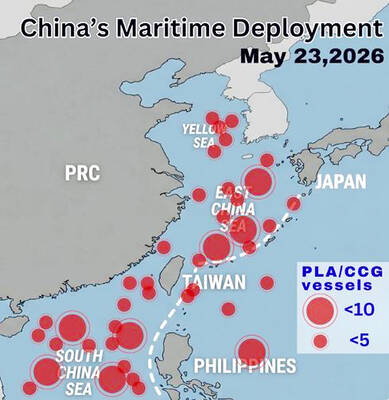
WARNING: China should stop engaging in actions that undermine regional peace and stability, as it would only build resentment among people across the Strait, the CGA said China has deployed more than 100 navy, coast guard and other vessels in waters from the Yellow Sea to the South China Sea and the western Pacific since US President Donald Trump and Chinese President Xi Jinping (習近平) met in Beijing, National Security Council Secretary-General Joseph Wu (吳釗燮) said yesterday. “In this part of the world, #China is the one & only PROBLEM wrecking the #StatusQuo & threatening regional peace & stability,” Wu wrote on X. In a separate post, he said Beijing was coercing Taiwan’s maritime domain, calling it illegal and provocative, after the Coast Guard Administration (CGA) expelled a


 RSS
RSS