


Russia launched a major missile and drone barrage on Kyiv yesterday, reportedly killing six people as of press time last night, starting fires and scattering debris across the city, Ukrainian authorities said.
Emergency crews responded to multiple strikes during the night, Kyiv military administration head Tymur Tkachenko said.
Russia used at least 430 drones and 18 missiles in the attack that left gaping holes in some city buildings, Ukrainian President Volodymyr Zelenskiy said.

Photo: AP
Friday’s assault, which also targeted Odesa in the south and Kharkiv in the northeast, was mostly aimed at Kyiv, where drones and missiles smashed into high-rise apartment blocks, Zelenskiy said.
It was “a specially calculated attack to cause as much harm as possible to people and civilians,” he wrote on Telegram.
Moscow denies targeting civilian areas, with the Russian Ministry of Defense saying it carried out an overnight strike on Ukraine’s “military-industrial and energy facilities.”
Ukrainian officials scoffed at those claims, showing repeated damage to homes and public buildings.
The attack was the biggest on Kyiv in almost three weeks. Most recent Russian aerial attacks have aimed at electricity infrastructure around the country ahead of the bitter winter months.
Ukraine used its US-made Patriot air defense systems to repel the attack and shot down 14 missiles, Zelenskiy said.
In the Odesa region, Russian drones struck a busy street in Chornomorsk, killing two people and injuring seven others, regional military administration chief Oleh Kiper said.
City authorities warned that power and water outages are possible.
Eight of the capital’s 10 districts reported damage. Emergency crews fought fires in apartment blocks, debris from explosions was strewn across yards and cars parked in the streets were set ablaze.
In the wider Kyiv region, Russian strikes damaged critical infrastructure and private homes, injuring at least one civilian, regional military administration head Mykola Kalashnyk said.
The Russian Ministry of Defense yesterday said its air defense forces shot down 216 Ukrainian drones overnight over a number of Russian regions, including the annexed Crimea.
It did not mention missiles.
The Russian defense ministry accused Ukraine of hitting civilian facilities and claimed the overnight strike on Kyiv came in response to that.
More than 60 Ukrainian drones were intercepted over the southern Krasnodar region, 45 drones were destroyed over the Saratov region while another 19 were shot down over Crimea, it said.
PROVOCATIVE: Chinese Deputy Ambassador to the UN Sun Lei accused Japan of sending military vessels to deliberately provoke tensions in the Taiwan Strait China denounced remarks by Japan and the EU about the South China Sea at a UN Security Council meeting on Monday, and accused Tokyo of provocative behavior in the Taiwan Strait and planning military expansion. Ayano Kunimitsu, a Japanese vice foreign minister, told the Council meeting on maritime security that Tokyo was seriously concerned about the situation in the East China and South China seas, and reiterated Japan’s opposition to any attempt to change the “status quo” by force, and obstruction of freedom of navigation and overflight. Stavros Lambrinidis, head of the EU delegation to the UN, also highlighted South China Sea
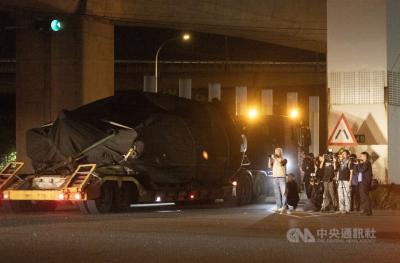
The final batch of 28 M1A2T Abrams tanks purchased from the US arrived at Taipei Port last night and were transported to the Armor Training Command in Hsinchu County’s Hukou Township (湖口), completing the military’s multi-year procurement of 108 of the tanks. Starting at 12:10am today, reporters observed more than a dozen civilian flatbed trailers departing from Taipei Port, each carrying an M1A2T tank covered with black waterproof tarps. Escorted by military vehicles, the convoy traveled via the West Coast Expressway to the Armor Training Command, with police implementing traffic control. The army operates about 1,000 tanks, including CM-11 Brave Tiger
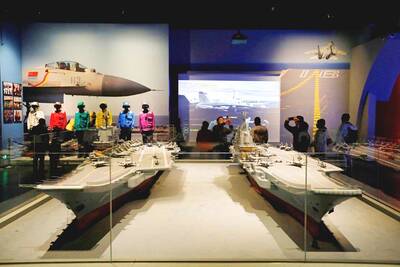
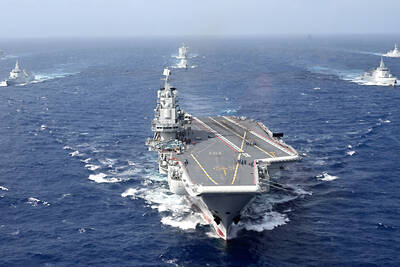
China on Wednesday teased in a video an aircraft carrier that could be its fourth, and the first using nuclear power, while making an allusion to Taiwan and vowing to further build up its islands, as it looks to boost maritime power, secure resources and bolster territorial claims. The video, issued on the eve of the 77th founding anniversary of the Chinese People’s Liberation Army Navy, featured fictional officers with names that are homophones of three commissioned aircraft carriers, the Liaoning (遼寧), Shandong (山東) and Fujian (福建). Titled Into the Deep, it showed a 19-year-old named “Hejian” (何劍) joining the group, sparking

Taiwan Semiconductor Manufacturing Co (TSMC, 台積電), the world’s largest contract chipmaker, said it expects its 2-nanometer (2nm) chip capacity to grow at a compound annual rate of 70 percent from this year to 2028. The projection comes as five fabs begin volume production of 2-nanometer chips this year — two in Hsinchu and three in Kaohsiung — TSMC senior vice president and deputy cochief operating officer Cliff Hou (侯永清) said at the company’s annual technology symposium in Silicon Valley, California, last week. Output in the first year of 2-nanometer production, which began in the fourth quarter of last year, is expected to


 RSS
RSS