


US airlines yesterday were scrambling to rejig schedules and fielding a flood of customer queries after the US ordered flight cuts at some of the nation’s busiest airports, the latest travel disruption from the prolonged government shutdown.
US Secretary of Transportation Sean Duffy on Wednesday said that he would order steep cuts, citing air traffic control safety risks from the government shutdown.
The shutdown, now the longest in US history, has forced 13,000 air traffic controllers and 50,000 security screeners to work without pay.
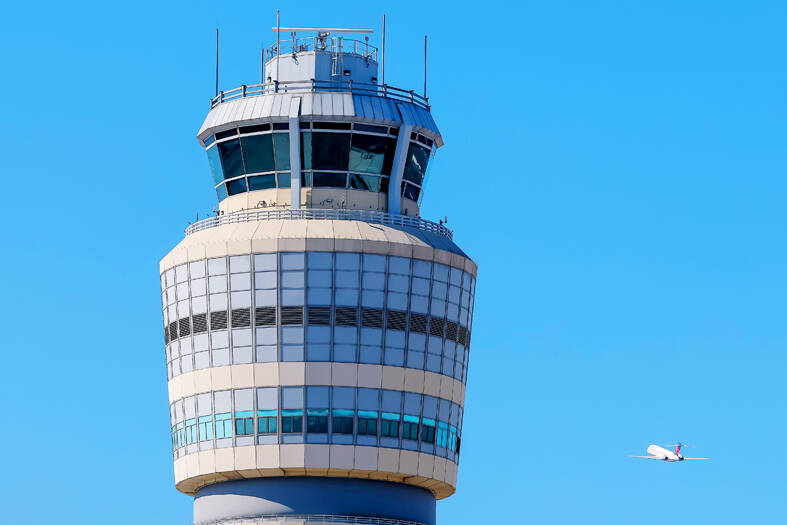
Photo: EPA
Staffing shortages have already caused tens of thousands of flight delays nationwide, with airlines estimating that at least 3.2 million travelers have been affected.
Industry sources said the first round of reductions, cutting about 4 percent of scheduled flights, would take effect as soon as today.
The cuts would rise to 5 percent tomorrow, 6 percent on Sunday and reach as much as 10 percent by next week if the shutdown persists.
“This is a fluid situation, but we believe the impact is more manageable than headlines imply,” TD Cowen’s Tom Fitzgerald said, adding that the timing of the shutdown’s end remains the key swing factor.
Unless the government reopens, the drastic plan threatens to throw holiday plans into chaos for millions of Americans traveling for Thanksgiving, marking one of the most visible ripple effects yet from the record-long government shutdown.
“They [the airlines might] have some flexibility on prices, but if this shutdown goes on much longer, then that should have a negative effect overall,” Trade Nation senior market analyst David Morrison said.
Airlines including United Airlines, American Airlines and Southwest were inundated with passenger queries on social media platforms such as X, as flyers sought clarity on travel plans.
“Please, you and your fellow airlines — for Thanksgiving week — issue all cancellations at least a week in advance,” one X user urged in response to United’s post outlining flight reductions. “Don’t make people wait to find out if they can fly home for the holiday.”
The US Federal Aviation Administration is expected to formally issue the order for flight reductions later in the day.
The move aims to ease pressure on controllers, with the agency short about 3,500 staff and many working mandatory overtime and six-day weeks even before the shutdown.
Still, carriers stressed they would try to minimize disruption for customers and rebooking efforts were under way.
United CEO Scott Kirby said the airline would target its cuts on regional flying and non-hub domestic routes, and the carrier expects to rebook many affected travelers.

‘NO SECURITY RISK’: The Railway Bureau reassured the public that the technicians’ activities were limited to technical guidance and did not involve sensitive systems The Railway Bureau yesterday said it had invited eight Chinese technicians to assist with an airport MRT construction project. The bureau issued the confirmation after an Internet user said Chinese nationals had entered the construction zone of Taiwan Taoyuan International Airport’s Terminal 3 project. They asked why “individuals from an enemy state” were allowed access to such a major national infrastructure project, which raised serious concerns over Taiwan’s industrial safety, sensitive systems and information security. The bureau’s Northern Region Engineering Branch Office said subcontractor Taiwan Handle Industrial Co (台灣手把工業) of the Taoyuan airport MRT’s “Contract No. CU05 Project A14 Station Civil, MEP &

A US uncrewed surface vessel (USV) encountered multiple Chinese warships during an autonomous transit of the Taiwan Strait, US defense company Seasats said in a statement on Wednesday. Seasats announced that a Lightfish USV had completed the first autonomous transit of the Taiwan Strait. Over five days, the USV traversed the entire length of the Strait while constantly monitoring surface vessel traffic, the company said. The Lightfish encountered multiple Chinese warships, one of which was a Chinese People’s Liberation Army Navy (PLAN) Type 056 corvette, it said. The Chinese vessels were operating “well within Taiwan’s exclusive economic zone without transmitting their identity via the

‘BOOMING’: ’ The number of partners we have here is incredible. You can see from their stock prices. They’re doing so well, they’re so happy,’ Jensen Huang said Nvidia Corp’s spending in Taiwan has ballooned to about US$150 billion a year, 10 times the US$10 billion to US$15 billion the company spent five years ago, Nvidia chief executive officer Jensen Huang (黃仁勳) said yesterday, suggesting Taiwan’s strategic importance in the global artificial intelligence (AI) supply chain. “Taiwan is the epicenter of the AI revolution. This is where the chips come, packaging comes. This is where the systems are made. This is where AI supercomputers were created,” Huang said at a meeting for the company’s employees in Beitou-Shilin Technology Park (北投士林科技園區) in Taipei, the planned site of Nvidia’s Taipei headquarters. “Taiwan
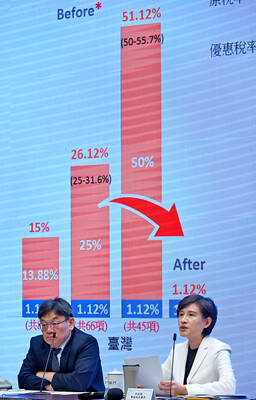
GREATER REACH? Auto parts and wood products would face tariffs of up to 15%, matching those targeting the EU, Japan and South Korea, Vice Premier said The US has announced that preferential tariff treatment for Taiwan’s non-semiconductor Section 232 goods would take effect retroactively from May 1, the Executive Yuan said yesterday. The US government yesterday posted a notice on the Federal Register’s public inspection Web site previewing tariff concessions for Taiwan under a memorandum of understanding (MOU) on Taiwan-US investment after two months of negotiations. The MOU signed on Jan. 15 stipulated three major preferential tariff arrangements: a 15 percent “reciprocal” tariff rate for Taiwan without stacking most-favored nation (MFN) rates; preferential Section 232 treatment for semiconductors and related products; and preferential Section 232 treatment for non-semiconductor


 RSS
RSS