


Taiwan is to lift a nationwide ban on live pig transport at noon today, with slaughter, pig auctions and carcass transport to resume at midnight tomorrow, the Ministry of Agriculture (MOA) announced yesterday, as the nation is close to eliminating its first local outbreak of African swine (ASF) fever.
Officials found no evidence pointing to the spread of the disease outside of the hog farm in Taichung’s Wuci District (梧棲) where the first case was reported on Oct. 21, Minister of Agriculture Chen Junne-jih (陳駿季) said.
Shipments of live pigs to and pork sales from meatpacking plants would resume at midday today and midnight tomorrow respectively, following recommendations by experts, Chen told a news conference in Taipei.
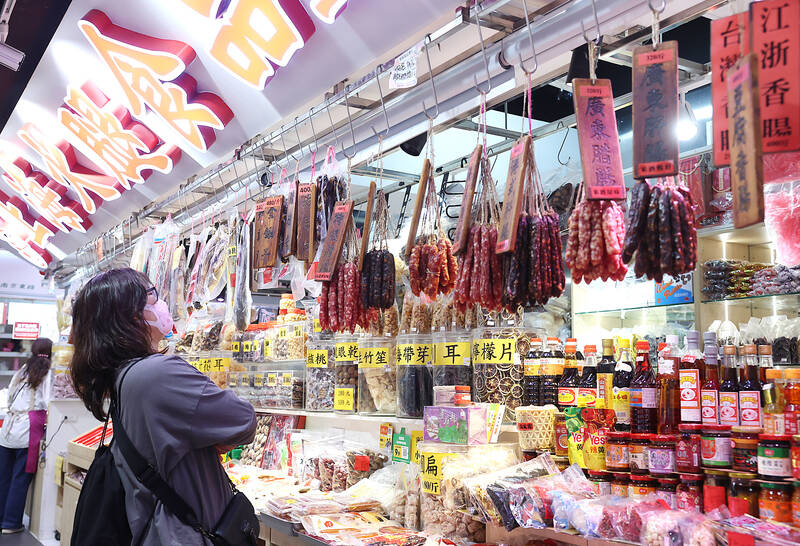
Photo: CNA
Lin Nien-nong (林念農), head of the Animal Health Inspection Division of the Animal and Plant Health Inspection Agency, added that to ensure a smooth reopening, 53 meat markets and slaughterhouses nationwide yesterday began large-scale disinfections under the supervision of slaughterhouse hygiene inspectors.
Pork stalls must complete disinfection before markets reopen tomorrow, while the Ministry of Economic Affairs would oversee local governments’ implementation of sterilization guidelines, and the MOA and the Ministry of Health and Welfare would supervise the cleaning of carcass transport vehicles, Lin said.
The MOA would tomorrow begin reviewing subsidy applications for financial losses incurred during the outbreak, Chen added.
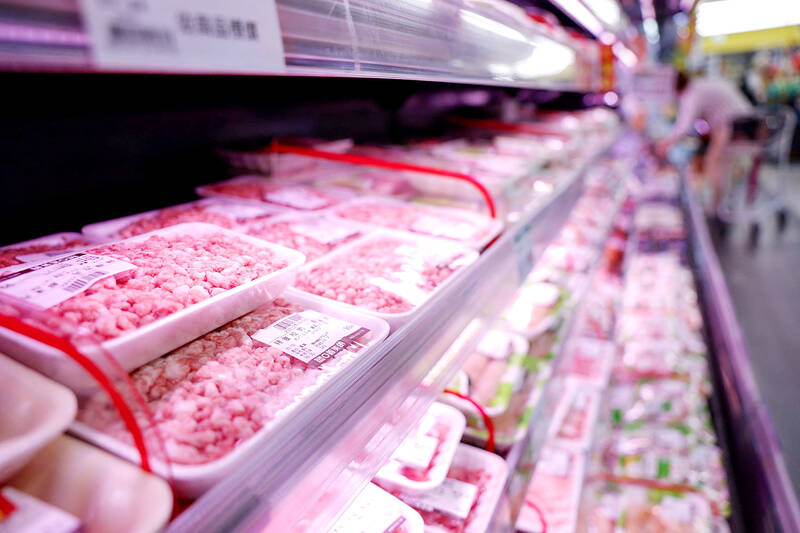
Photo: Ann Wang, Reuters
A ban on using kitchen waste to feed pigs would remain in place until the government is satisfied with the enactment of new regulations and measures aimed at ensuring waste is properly sterilized, he said.
The MOA’s investigations revealed that improperly sanitized kitchen waste was the cause of the outbreak, he said.
Fresh pork or pork that has been chilled or frozen after slaughter and offal would return to wet markets as soon as tomorrow evening and Saturday respectively, while consumers at other retail outlets would have to wait longer for the products to become available again, officials said.
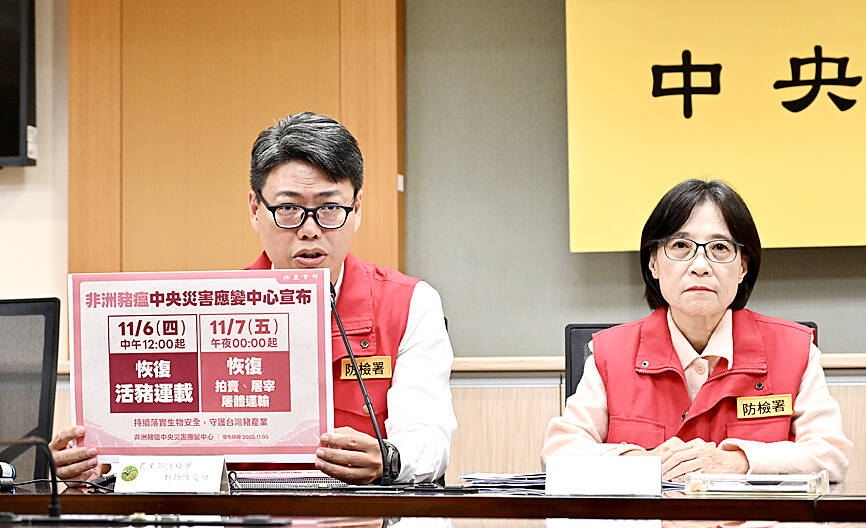
Photo: Lo Pei-de, Taipei Times
The Central Emergency Operations Center for African Swine Fever said the farm in Taichung, where the initial case was reported, remains under a lockdown after testing positive for traces of the ASF virus.
The military has taken over sterilization operations at the site from the Taichung City Government, which has twice tried and failed to accomplish the task, the center said.
Inspectors yesterday morning took samples from the farm to test for the virus, and expect results to be available today, it said.
Citing the World Organisation for Animal Health regulations, the center said that Taiwan must have no ASF cases for three months after the last reported incident before its ASF-free status can be restored.
The nation must establish additional sanitation measures to qualify to regain the status, including raising “sentinel” pigs in pens in areas known to be contaminated previously, it said.
Sentinel pigs act as early-warning detection to determine if a site is still contaminated with ASF.
Additional reporting by CNA

A signaling system malfunction disrupted high-speed rail (HSR) services beginning at 8am today, with trains temporarily reduced to three northbound and three southbound trains per hour as authorities conduct inspections. The malfunction occurred on a section of track in Miaoli County during pre-operation checks early this morning, forcing northbound and southbound trains to use a single track, the HSR operator said. The regular schedule has been replaced with three hourly trains offering only nonreserved seating in each direction, stopping at every station, it said, adding that business class cars would still have reserved seating. Departures from terminal stations are scheduled at the top

DRONE CENTRAL: Taiwan aims to become Asia’s democratic hub for drones, with most exports focused on high-quality military-grade models, an official said Taiwan’s drone industry is expected to expand significantly by 2030, producing 100,000 units per month and exporting half of them, the Ministry of Economic Affairs said yesterday. Current drone production capacity is about 15,000 units per month, but the industry can quickly scale up as demand increases, Industrial Development Administration Director-General Chiou Chyou-huey (邱求慧) told a news conference in Taipei. Taiwan’s drone output grew 2.5-fold last year to NT$12.9 billion (US$408.3 million) under a government program to develop the uncrewed vehicle sector, he said. The Executive Yuan in October last year approved plans to invest NT$44.2 billion into domestic production of uncrewed aerial

VERBOSE VESSELS: A CGA cutter and a China Coast Guard exchanged verbal barbs for more than a day in Taiwanese-controlled waters before the Chinese vessel left The Taiwanese and Chinese coast guards had a standoff near the strategically located Pratas Islands (Dongsha Islands, 東沙群島) in the north of the South China Sea, the Coast Guard Administration (CGA) said yesterday. The two sides engaged in intense radio exchanges over sovereignty claims during the 33-hour standoff. China Coast Guard vessel 3501 eventually left the restricted waters, 26.6 nautical miles (49.2km) west of the Pratas Islands, at 5pm yesterday, the CGA said. Lying approximately between southern Taiwan and Hong Kong, the Taiwan-controlled Pratas are seen by some security experts as vulnerable to Chinese attack due to their distance — more than
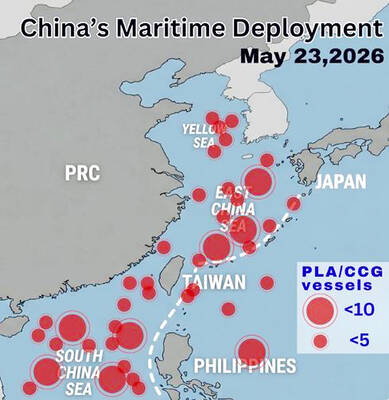
WARNING: China should stop engaging in actions that undermine regional peace and stability, as it would only build resentment among people across the Strait, the CGA said China has deployed more than 100 navy, coast guard and other vessels in waters from the Yellow Sea to the South China Sea and the western Pacific since US President Donald Trump and Chinese President Xi Jinping (習近平) met in Beijing, National Security Council Secretary-General Joseph Wu (吳釗燮) said yesterday. “In this part of the world, #China is the one & only PROBLEM wrecking the #StatusQuo & threatening regional peace & stability,” Wu wrote on X. In a separate post, he said Beijing was coercing Taiwan’s maritime domain, calling it illegal and provocative, after the Coast Guard Administration (CGA) expelled a


 RSS
RSS