

The government should step up its efforts to reduce carbon and adapt to climate developments to enhance climate justice and resilience in Taiwan, environmental activists said at a rally in Taipei yesterday.
The groups estimated that more than 1,000 people attended the March for Climate, which had a band playing as people issued a call for “resilience to protect the Earth.”
Mom Loves Taiwan Association secretary-general Huang Pin-han (黃品涵) said that more than 100 civic groups took part in the event, with their main demands being to promote sustainable development, intergenerational justice, climate democracy, national security and respect for diversity.
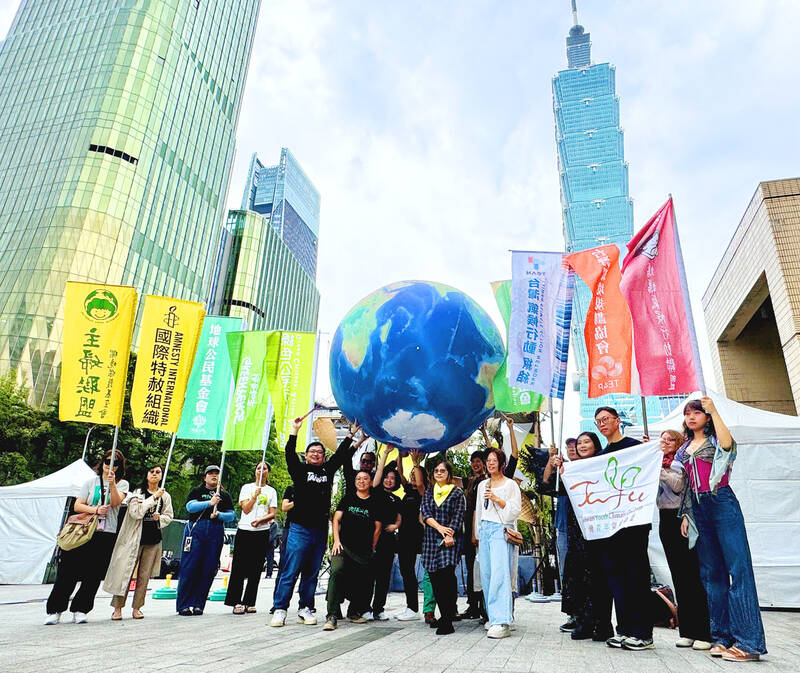
Photo: Huang Yi-ching, Taipei Times
Citing UN data, Taiwan Climate Action Network Research Center director Chao Chia-wei (趙家緯) said that global carbon reduction would fall short of Paris Agreement targets, as reduction pledges collectively amount to only 17 percent of carbon cut by 2035 compared with the 2019 baseline year.
The government should set a more ambitious target by shifting from 38 percent to 52 percent of carbon cut by 2035, otherwise Taiwan might not achieve net zero emissions by 2050, Chao said.
Environmental Rights Foundation executive director Tu Yu-wen (涂又文) said climate issues are intertwined with the right to life, so climate action and policies should not be oriented around economic development.
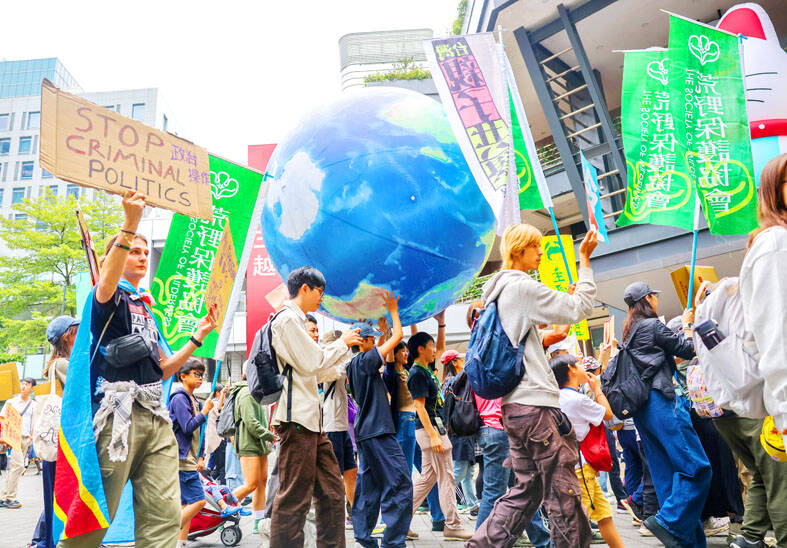
Photo: CNA
Voices from minorities and local communities should be heard and considered, Tu said, calling on the government to uphold procedural justice to encourage public participation in local climate issues.
Tsai Ming-chieh (蔡明潔), counselor of Wanders Lodge — a non-profit organization dedicated to assisting homeless people — said she and her coworkers marched mainly to be a voice for the homeless, many of whom work as sign holders or leaflet distributors on Taiwan’s streets.
“We hope to raise awareness that economically disadvantaged groups such as homeless people are bearing the brunt of climate change,” Tsai said.
Homeless people are usually outdoors all day, but they dare not rest in the shade on hot days with their employers watching, she said, adding that they often face heatstroke and exhaustion.
Given the tough, physical nature of their work, they tend to use plastic water bottles rather than their own reusable bottles, as plastic bottles are lighter, she said, adding that even the extra cost of buying their own bottle cuts into their daily wage of NT$800.
Mandatory heat-related leave might deprive them of income, so the government should require employers to provide them with cooling devices and drinking water, she added.
Former Central Weather Administration director-general Cheng Ming-dean (鄭明典) said that climate change is accelerating faster than expected, and many scientists say that global warming is unlikely to be limited to 1.5°C above pre-industrial times, despite the goals of the Paris Agreement.
The ocean can stabilize the climate and warms more slowly than air, but ocean temperatures are rising and would be difficult to lower, Cheng said.
“Climate change affects everyone differently,” he said, adding that the public should respect different values and perspectives when they debate climate issues.
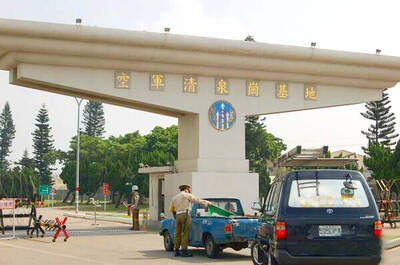
An unauthorized drone intrusion over Ching Chuan Kang Air Base (清泉崗基地) at Taichung International Airport on Tuesday night forced the temporary closure of the base, diverting eight fighter jets and delaying a commercial flight, authorities said. Air Force Command Headquarters said that clear weather had allowed for scheduled night training exercises, but after a drone was spotted entering the airspace, the control tower declared an emergency closure of the airport, forcing eight Indigenous Defense Fighter jets in the air to divert and land at Hsinchu Air Base (新竹基地). Taichung airport director Chang Jui-shu (張瑞澍) said the airspace intrusion lasted from 7:37pm to
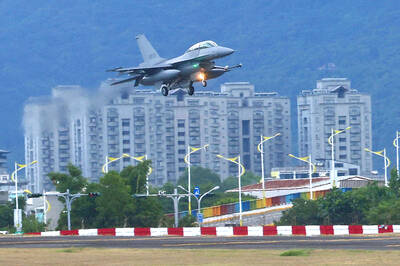
The air force plans to build 26 more hardened aircraft shelters as the number of F-16Vs stationed along Taiwan’s east coast is expected to reach 120 when the final shipment of 66 jets procured from the US arrives. The incoming jets would be stationed at Chihhang Air Base in Taitung County, augmenting the F-16V Block 20s operated by the 5th Tactical Fighter Wing in Hualien County, officials said yesterday. The air force plans to allocate more than NT$6.88 billion (US$218.1 million) from next year to 2031 to build the shelters in Hualien and Taitung as part of the implementation of a “one
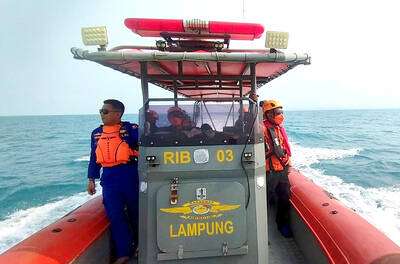
Indonesian rescuers searched for eight people who went missing at sea while heading to a volcanic island to report on an eruption there, officials said yesterday. Anak Krakatau initially erupted for about 25 hours over the weekend, and it has since continued to erupt intermittently with explosions ejecting lava, ash and incandescent volcanic material from the crater, the Indonesian Geology Agency said in a statement. A speedboat carrying five photojournalists, two crew members and a route guide lost contact after leaving Carita, a coastal town in Banten Province, for the volcanic island, Banten Province Search and Rescue Office Chief Al Amrad said. He

NO LIMITS: More legislation expanding Beijing’s control over the movement of people, money and information raises risks for Taiwanese travelers and businesses, officials said China is set to implement several laws in the coming months that expand the definition of national security, creating greater risks for Taiwanese traveling to or doing business in China, Taiwanese officials said yesterday. Beijing’s Ethnic Unity and Progress Promotion Law took effect on July 1, while a draft “Internet Information Service Management Measures” finished its public consultation on Aug. 2, but has yet to be adopted. China’s Regulations of the State Council on Exit and Entry Administration are to take effect on Tuesday next week, while amendments to its National Defense Mobilization Law and the Ministry of Public Security’s Measures


 RSS
RSS