

The legislature’s Economics Committee yesterday passed a preliminary review of amendments to seven laws to protect critical underwater infrastructure that would apply the same penalties for damaging water and natural gas pipelines to damaging submarine cables.
People convicted of intentionally damaging submarine water pipelines, natural gas pipelines or undersea power cables would face up to seven years in prison, the proposed changes say.
They would also allow the confiscation of vessels used to commit the crime.
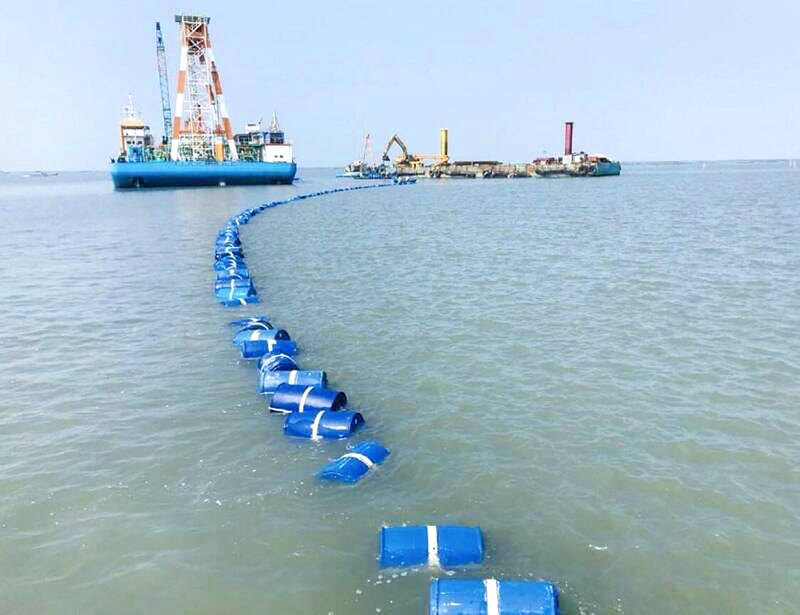
Photo courtesy of Taiwan Power Co
The Executive Yuan last month advanced amendments to seven acts: the Telecommunications Management Act (電信管理法), the Electricity Act (電業法), the Natural Gas Enterprise Act (天然氣事業法), the Water Supply Act (自來水法), the Meteorological Act (氣象法), the Commercial Port Act (商港法) and the Shipping Act (船舶法).
The proposed changes follow a spate of undersea cable disruptions around Taiwan.
In April, prosecutors for the first time charged a Chinese ship captain with intentionally damaging undersea cables off Taiwan in February.
The Legislative Yuan’s Research Bureau in March published a report urging the government to stipulate a specific law to manage the installation and protection of undersea cables, which should also be in step with similar international laws.
The Economics Committee yesterday discussed bills concerning Article 71-1 of the Electricity Act, Article 55-1 of the Natural Gas Enterprise Act and Article 97-1 of the Water Supply Act.
It passed a preliminary review of articles, which say that those who threaten the normal functioning of natural gas unloading and storage equipment, undersea water supply pipelines or undersea power cables through theft, destruction or other illegal means would face a prison sentence of one to seven years and a maximum fine of NT$10 million (US$325,574), while negligence would be punishable by up to six months in prison, detention or a maximum fine of NT$2 million.
A resolution was also passed to ask the Ministry of the Interior to publicly release maps of the undersea cables and pipelines, and to cooperate with other agencies to increase public awareness before the amendments are passed, and to prevent offenders from claiming ignorance, which would aid enforcement and prosecution, the committee said.
Additional reporting by Reuters, Chen Chih-yu and Shelley Shan
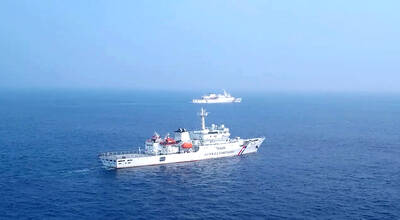
PATROL PARTNERS: The ‘Chiayi’ and the ‘Penghu’ departed for a two-day joint patrol of Palau’s exclusive economic zone, the CGA’s second diplomatic visit to the country The Coast Guard Administration (CGA) set a record for its southernmost deployment of a coast guard vessel as the vessels Chiayi and the Penghu reached Palau’s Pulo Anna Island on Saturday in a cooperative exercise between the two countries. The island, about 217 nautical miles (401km) southwest of Koror in the Palauan state of Sonsorol and 1,220 nautical miles from Taiwan’s southernmost point, Oluanpi (鵝鑾鼻), is the furthest south a CGA vessel has sailed. The two vessels are in Palau for the coast guard’s second diplomatic visit to the country. They docked at Malakal Harbor on Tuesday last week. The coast guard

The government is monitoring online rumors that a pneumonic plague outbreak has spread from Russia into China, and it might enhance quarantine measures, Premier Cho Jung-tai (卓榮泰) said yesterday. During a legislative meeting, Democratic Progressive Party Legislator Wang Ting-yu (王定宇) said that rumors had circulated that the disease had spread across several Chinese provinces. He asked Cho whether the government was prepared to prevent the disease spreading to Taiwan, given the volume of traffic between the two sides, and how concerned the government was about the alleged outbreak. The Ministry of Health and Welfare had implemented border quarantine measures after briefing the Executive
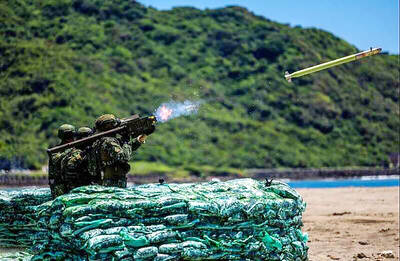
BATCH 1: The military has plans to assign the weapons to the army to defend Taiwan proper, as well as outlying islands and the navy for the Marine Corps, the official said Taiwan is to receive 500 Stinger missiles and 178 launchers from the US by the end of the year, the first batch under a planned two-stage acquisition totaling 2,621 missiles and 763 launchers, a defense official said yesterday on condition of anonymity. The portable missiles would play a vital role in the nation’s air defense capabilities, the source said. The army plans to deploy 2,235 missiles and 657 launchers to defend Taiwan proper and outlying islands, they said, citing military documents. The navy is allotted 295 missiles and 85 launchers to arm the Marine Corps and some surface vessels that lack air defense
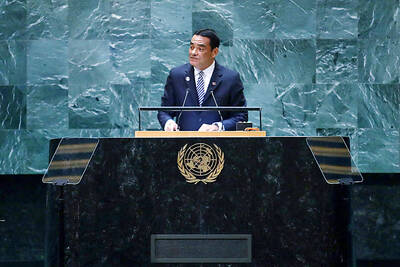
RIGHT TO DIPLOMACY: Under the UN Charter, every state has the right to conduct foreign policy free from external pressure, Belize said in a statement Belize and Paraguay on Monday condemned Beijing sanctions over their countries’ ties with Taiwan, saying China’s actions create unnecessary tensions. Earlier on Monday, Beijing announced sanctions against Paraguayan Minister of Information and Communication Technologies Gustavo Villate and Belizean Minister of Foreign Affairs Francis Fonseca. The Paraguayan Ministry of Foreign Affairs said it rejected the sanctions, writing on X that they created unnecessary friction. It added that it reaffirmed its support for Taiwan and its commitment to democratic values and principles. Villate told the Spanish-language Paraguayan daily ABC Color the sanctions were “predictable” and linked them to several cooperation projects between Taiwan and Paraguay. The projects


 RSS
RSS