


Passengers of the first direct flight between India and China in five years touched down yesterday, after Asia’s giants lifted a long-term air travel suspension as they cautiously rebuild relations.
IndiGo Flight 6E1703 from Kolkata touched down in the southern Chinese city of Guangzhou shortly before 4am, officially resuming nonstop air links that had been suspended since 2020 due to the COVID-19 pandemic and subsequent geopolitical tensions.
The neighbors and world’s two most populous nations remain strategic rivals competing for regional influence, but ties have eased gradually since a deadly Himalayan border clash in 2020.
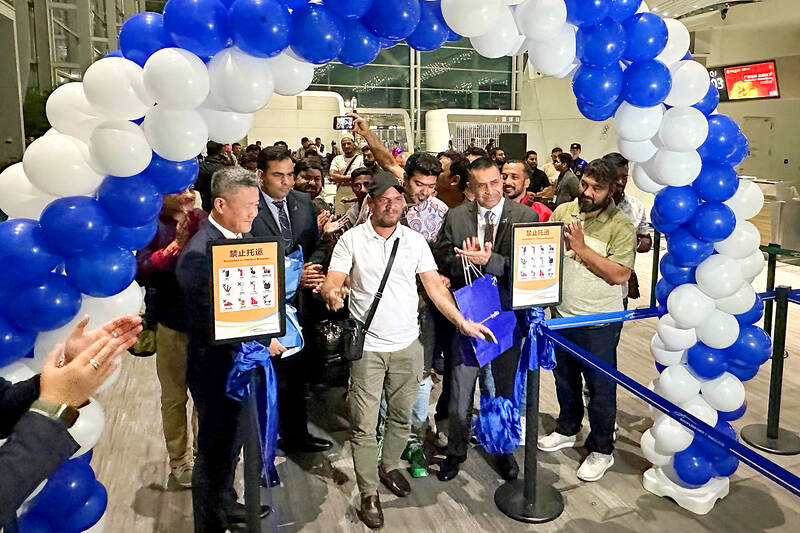
Photo: AFP
The Indian government said the resumption of flights would boost “people-to-people contact” and aid the gradual normalization of bilateral exchanges.
Passengers aboard the first flight — among them many Indians in search of cross-border business opportunities — spoke at Guangzhou airport about the convenience of the resumed links.
“It was such a smooth and easy, lovable trip,” said Rashika Mintri, a 44-year-old interior designer from Kolkata.
“I could come again and again,” she said.
Warming relations with Beijing come as India’s ties with key trade partner Washington falter, following US President Donald Trump’s order imposing punishing 50 percent tariffs.
Trump’s aides have accused India of fueling Russia’s war in Ukraine by buying Moscow’s oil.
There are already regular flights between India and Hong Kong, while additional services from the capital New Delhi to Shanghai and Guangzhou are to begin next month.
Abhijit Mukherjee, the captain of the flight yesterday, said that without the new nonstop flights, passengers would need to travel through other airports, such as Bangkok or Singapore.
“It adds up,” the 55-year-old pilot said of the transfers.
The direct flight he had just completed was “very smooth,” he said, holding a bouquet of flowers presented to him upon arrival.
India’s eastern port city of Kolkata has centuries-old ties with China dating back to British rule, when Chinese migrants arrived as traders. Indo-Chinese fusion food remains a beloved staple of the city’s culinary identity.
“It’s great news for people like us, who have relatives in China,” said Chen Khoi Kui, a civil society leader in Kolkata’s Chinatown district of Tangra. “Air connectivity will boost trade, tourism and business travel.”
India runs a significant trade deficit with Beijing, relying heavily on Chinese raw materials for industrial and export growth.
The thaw between New Delhi and Beijing followed meetings between their leaders in Russia last year and in China in August.
The resumption of direct flights is a “first step” in repairing ties, said passenger Athar Ali, a 33-year-old businessman from India, as he waited to check in for IndiGo’s flight returning the aircraft to Kolkata.
Earlier this month, soldiers on each side exchanged gifts of candy on the Hindu festival of Diwali as a gesture of goodwill.
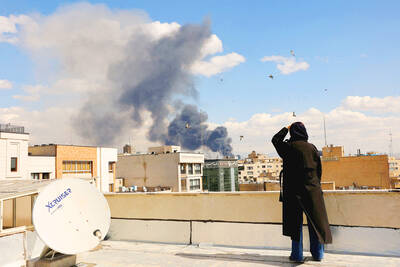
CHAOS: Iranians took to the streets playing celebratory music after reports of Khamenei’s death on Saturday, while mourners also gathered in Tehran yesterday Iranian Supreme Leader Ayatollah Ali Khamenei was killed in a major attack on Iran launched by Israel and the US, throwing the future of the Islamic republic into doubt and raising the risk of regional instability. Iranian state television and the state-run IRNA news agency announced the 86-year-old’s death early yesterday. US President Donald Trump said it gave Iranians their “greatest chance” to “take back” their country. The announcements came after a joint US and Israeli aerial bombardment that targeted Iranian military and governmental sites. Trump said the “heavy and pinpoint bombing” would continue through the week or as long
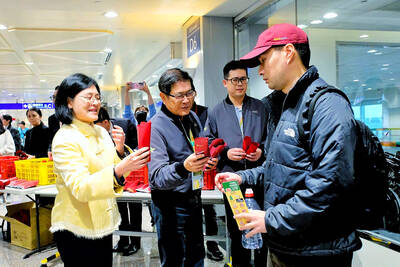
An Emirates flight from Dubai arrived at Taiwan Taoyuan International Airport yesterday afternoon, the first service of the airline since the US and Israel launched strikes against Iran on Saturday. Flight EK366 took off from the United Arab Emirates (UAE) at 3:51am yesterday and landed at 4:02pm before taxiing to the airport’s D6 gate at Terminal 2 at 4:08pm, data from the airport and FlightAware, a global flight tracking site, showed. Of the 501 passengers on the flight, 275 were Taiwanese, including 96 group tour travelers, the data showed. Tourism Administration Deputy Director-General Huang He-ting (黃荷婷) greeted Taiwanese passengers at the airport and
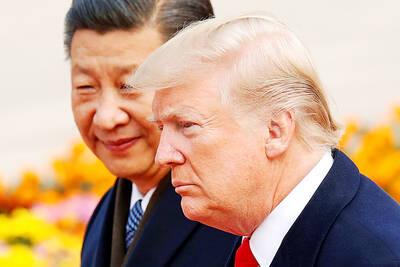
TRUST: The KMT said it respected the US’ timing and considerations, and hoped it would continue to honor its commitments to helping Taiwan bolster its defenses and deterrence US President Donald Trump is delaying a multibillion-dollar arms sale to Taiwan to ensure his visit to Beijing is successful, a New York Times report said. The weapons sales package has stalled in the US Department of State, the report said, citing US officials it did not identify. The White House has told agencies not to push forward ahead of Trump’s meeting with Chinese President Xi Jinping (習近平), it said. The two last month held a phone call to discuss trade and geopolitical flashpoints ahead of the summit. Xi raised the Taiwan issue and urged the US to handle arms sales to
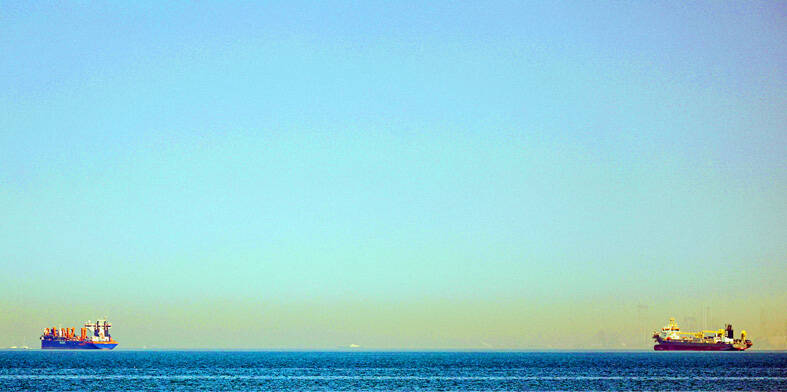
State-run CPC Corp, Taiwan (CPC, 台灣中油) yesterday said that it had confirmed on Saturday night with its liquefied natural gas (LNG) and crude oil suppliers that shipments are proceeding as scheduled and that domestic supplies remain unaffected. The CPC yesterday announced the gasoline and diesel prices will rise by NT$0.2 and NT$0.4 per liter, respectively, starting Monday, citing Middle East tensions and blizzards in the eastern United States. CPC also iterated it has been reducing the proportion of crude oil imports from the Middle East and diversifying its supply sources in the past few years in response to geopolitical risks, expanding


 RSS
RSS