


The nation’s armed forces would comprehensively enhance their combat capabilities, President William Lai (賴清德) said yesterday aboard the navy’s Tsoying (左營) destroyer, just hours after the conclusion of the military’s annual Hai Chiang (海強, “Sea Strong”) live-fire exercise near Taiwan proper.
Lai was accompanied by Minister of National Defense Wellington Koo (顧立雄), Navy Commander Admiral Tang Hua (唐華), Surface Combatant Group 62.1 Commander Rear Admiral Wei Chien-chung (魏建中), and other senior defense officials and military officers.
Lai attended a briefing on the drills before inspecting the Tsoying’s combat information center, foredeck, helicopter hangar, and air defense systems and drones, then gave a speech to the naval service personnel.
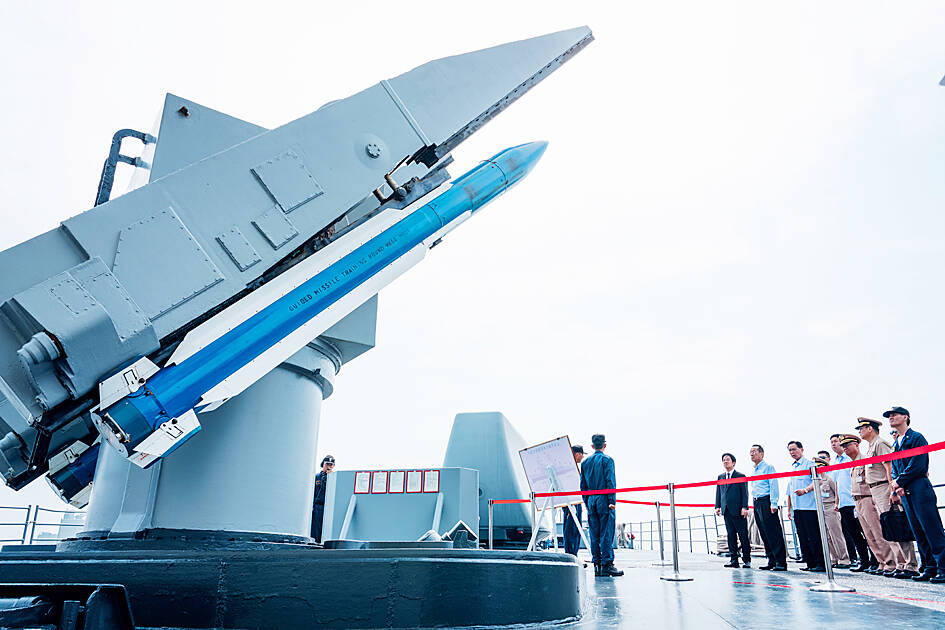
Photo courtesy of the Presidential Office
The five-day drill tested the fleet’s readiness for potential conflict with China, including joint interception, damage control, formational maneuvers, aerial replenishment and live-fire missions, the Ministry of National Defense said.
Warships in Surface Combatant Group 62.1 deployed Sikorsky S-70C anti-submarine helicopters, Albatross surveillance drones made by the Chungshan Institute of Science and Technology, naval mines, 5-inch guns, 40mm cannons and Chaparral missiles, a video released by the Presidential Office showed.
Lai thanked the naval service members on the ship, saying the Hai Chiang exercise is vital for bolstering the military’s capacity to counter a Chinese blockade and recover from combat damage in wartime.
Naval personnel who took part in the drills should take pride that they have performed superbly as befits the navy’s highest standards of professionalism, skill and diligence, he added.
Surface Combatant Group 62.1 has long served as the guardian of Taiwan’s territorial waters and maritime security, Lai said, adding that he hoped the unit would continue to uphold its tradition of honor, discipline and prowess in battle.
The armed forces must enhance their asymmetric capabilities and innovative defense technologies to counter the long-term threat posed by China and its increasing use of “gray zone” tactics, he said.
The military should prioritize the deployment of precision-guided weapons, uncrewed systems, applied artificial intelligence and other measures to bolster the nation’s defensive resilience, he added.
The armed forces must embrace new training, thinking, equipment and technology by integrating emerging capabilities and techniques to achieve a comprehensive transformation of military power, he said.
Such objectives can only be realized through a whole-of-society effort and a firm commitment within the military to implement necessary reforms across all levels of command, Lai said.
Separately, Koo is expected to brief lawmakers on the progress of the Hai Kun (海鯤), Taiwan’s first domestically built defense submarine, on Monday and Thursday, the Legislative Yuan’s agenda showed.
Koo’s scheduled sessions follow the navy’s confirmation that the prototype submarine has encountered technical problems affecting its diesel-electric propulsion system and operational firmware.
That prevented the Hai Kun from completing key components of its sea acceptance tests — including diving and torpedo-firing trials originally slated for last month — and could lead to significant delays in CSBC Corp’s (台船公司) delivery of the vessel to the navy, which was initially planned for next month.

The National Chungshan Institute of Science and Technology yesterday showcased its locally developed variants of the Vision 60 robotic patrol dog, which it plans to deploy on the nation’s outlying territories in the South China Sea. The variants were produced under the Joint Lab project — created by the institute and domestic companies — and assembled with domestically produced motors, lenses and artificial intelligence (AI) systems alongside licensed tech from the US, Missile and Rocket Systems Research Division deputy director Jen Kuo-kang (任國光) told the media event at a military base in Taipei’s Dazhi (大直) area. Taiwan has built up its strengths

RIGHT DIRECTION: Taiwan’s efforts to prevent forced labor include a proposal to ‘fully prohibit’ employers from withholding workers’ documents, an official said Taiwan is to establish a mechanism to restrict imports of goods linked to forced labor, the Executive Yuan said yesterday, after the US proposed imposing additional tariffs on Taiwanese goods over labor concerns. “The Ministry of Labor and the Ministry of Economic Affairs are to establish an interministerial review procedure,” Executive Yuan spokesperson Michelle Lee (李慧芝) said at a news briefing in Taipei. “The government is to use the Foreign Trade Act [貿易法] as the legal basis to restrict imports of goods produced with forced labor” and bring its supply chain governance more in line with international standards on human rights, resilience

NOT IMMEDIATE: Taiwan has a chance to appeal the proposed 10 percent tariff before it starts, while other countries face a 12.5 percent tariff from the trade office Taiwan is among 60 economies determined by the US to have failed to impose or enforce a ban on the importation of goods produced with forced labor, according to a notice released on Tuesday by the Office of the US Trade Representative (USTR), which proposed imposing an additional 10 percent or more tariff on them. The USTR in a statement said that following an investigation, it had determined under Section 301 of the Trade Act of 1974 that the failure of the 60 economies to impose and effectively enforce a prohibition on the importation of goods produced with forced labor is

TIT-FOR-TAT: The US allegedly revoked the visa of a Chinese national working at Xinhua News Agency in the US in response to Beijing’s expulsion of Vivian Wang The Presidential Office yesterday condemned China for expelling a New York Times correspondent from Beijing following the newspaper’s interview with President William Lai (賴清德), saying the move highlighted Beijing’s suppression of press freedom and its threat to international news media. Taiwan has noted a series of recent incidents in which Beijing used similar tactics to “threaten and pressure international media outlets and journalists,” Presidential Office spokeswoman Karen Kuo (郭雅慧) said in a statement. “This concerns not only press freedom and freedom of expression, but also the safety of journalists, and Taiwan and relevant partners are paying close attention to the situation,” she


 RSS
RSS