


The US on Monday said that it stood by its Philippine ally and emphasized their mutual defense treaty after vessels from China and the Philippines clashed amid heightened tensions in the disputed South China Sea.
Earlier, the Chinese Ministry of Foreign Affairs urged Manila not to challenge Beijing’s efforts to “safeguard its territorial sovereignty and maritime rights and interests” after Sunday’s incident in the Spratly Islands (Nansha Islands, 南沙群島), in which the Philippines said China deployed a water cannon and rammed a Philippine vessel.
US Department of State spokesman Tommy Pigott condemned China’s “ramming and water cannoning” of a Philippine vessel and said Washington stood with its ally “as they confront China’s dangerous actions which undermine regional stability.”
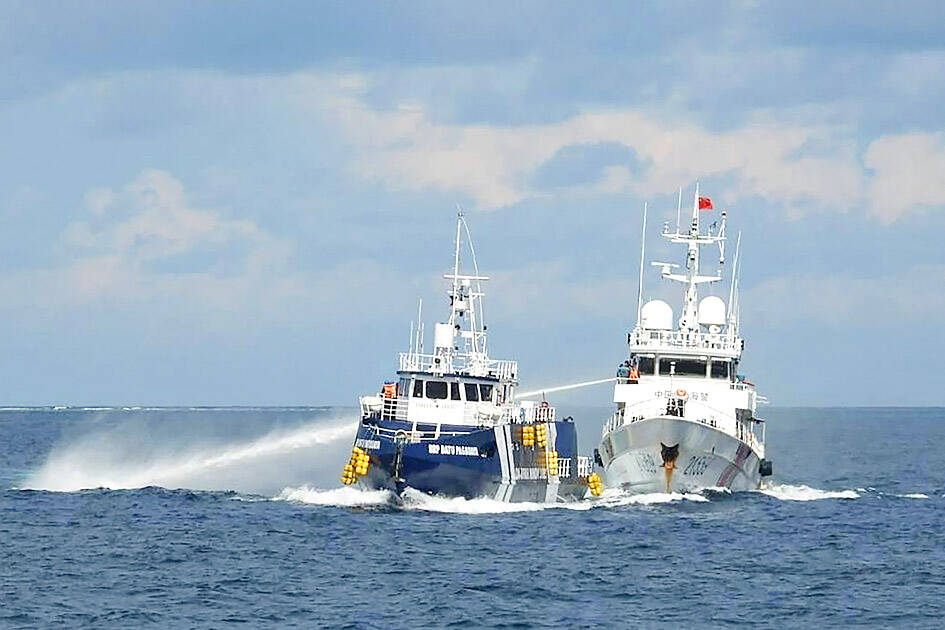
Photo: AFP / Philippine Coast Guard
Pigott in a statement reaffirmed that Article IV of the 1951 US Philippines Mutual Defense Treaty “extends to armed attacks on Philippine armed forces, public vessels or aircraft — including those of its Coast Guard — anywhere in the South China Sea.”
China and the Philippines have traded accusations over the confrontation near Sandy Cay (Tiexian Reef, 鐵線礁), a coral reef in the Spratly Islands.
The two nations have confronted each other repeatedly in the South China Sea, a strategic trade route that facilitates more than US$3 trillion of annual ship-borne commerce, and which China claims most of.
Tensions have heightened and Chinese Ministry of Foreign Affairs spokesman Lin Jian (林劍) told a regular news briefing that the Philippines should immediately stop “violations and provocations.”
The US state department said: “China’s sweeping territorial and maritime claims in the South China Sea and its increasingly coercive actions to advance them at the expense of its neighbors continue to undermine regional stability and fly in the face of its prior commitments to resolve disputes peacefully.”
Two senior US senators last year called for a list of options developed by the Pentagon and state department to support the Philippines against Beijing in the South China Sea, saying that limiting responses to verbal assurances of the applicability of Article IV undermines the credibility and value of those commitments.
In Taipei, Ministry of Foreign Affairs spokesman Hsiao Kuang-wei (蕭光偉) yesterday expressed grave concern over China’s behavior, saying it seriously affects regional peace and stability, adding that it opposed any action by China that escalates tensions, endangers personal safety, or harms the peaceful and stable “status quo” in the South China Sea.
The ministry called for a peaceful solution through multilateral dialogue and a dispute resolution mechanism, he said.
Taiwan, together with like-minded countries, would continue to pay attention to the situation in the South China Sea, and commit to maintaining regional security and stability, he added.
Additional reporting by Lee I-chia

A signaling system malfunction disrupted high-speed rail (HSR) services beginning at 8am today, with trains temporarily reduced to three northbound and three southbound trains per hour as authorities conduct inspections. The malfunction occurred on a section of track in Miaoli County during pre-operation checks early this morning, forcing northbound and southbound trains to use a single track, the HSR operator said. The regular schedule has been replaced with three hourly trains offering only nonreserved seating in each direction, stopping at every station, it said, adding that business class cars would still have reserved seating. Departures from terminal stations are scheduled at the top

Taiwan is still in the process of assessing the possibility of recruiting workers from Eswatini, the Ministry of Foreign Affairs said yesterday, adding that its goal is to help Eswatini upgrade its vocational training centers. If there are plans to recruit workers from Eswatini, safeguarding national security, protecting public health and ensuring the employment rights of Taiwanese would be prerequisites, Department of West Asian and African Affairs Director-General Yen Chia-liang (顏嘉良) told a news conference. Key considerations would also include filling labor shortages in specific industries, and fostering bilateral professional and technical exchanges, he said. Yen was asked about the progress of labor

VERBOSE VESSELS: A CGA cutter and a China Coast Guard exchanged verbal barbs for more than a day in Taiwanese-controlled waters before the Chinese vessel left The Taiwanese and Chinese coast guards had a standoff near the strategically located Pratas Islands (Dongsha Islands, 東沙群島) in the north of the South China Sea, the Coast Guard Administration (CGA) said yesterday. The two sides engaged in intense radio exchanges over sovereignty claims during the 33-hour standoff. China Coast Guard vessel 3501 eventually left the restricted waters, 26.6 nautical miles (49.2km) west of the Pratas Islands, at 5pm yesterday, the CGA said. Lying approximately between southern Taiwan and Hong Kong, the Taiwan-controlled Pratas are seen by some security experts as vulnerable to Chinese attack due to their distance — more than

A US uncrewed surface vessel (USV) encountered multiple Chinese warships during an autonomous transit of the Taiwan Strait, US defense company Seasats said in a statement on Wednesday. Seasats announced that a Lightfish USV had completed the first autonomous transit of the Taiwan Strait. Over five days, the USV traversed the entire length of the Strait while constantly monitoring surface vessel traffic, the company said. The Lightfish encountered multiple Chinese warships, one of which was a Chinese People’s Liberation Army Navy (PLAN) Type 056 corvette, it said. The Chinese vessels were operating “well within Taiwan’s exclusive economic zone without transmitting their identity via the


 RSS
RSS