

The Philippines said a Chinese ship deliberately rammed one of its government vessels in the disputed South China Sea yesterday, although Beijing blamed Manila for the incident.
The Philippines said a Chinese coast guard ship yesterday fired its water cannon at the BRP Datu Pagbuaya, a vessel belonging to the Philippine Bureau of Fisheries and Aquatic Resources.
“Just three minutes later... the same [Chinese] vessel deliberately rammed the stern” of the Philippine boat, “causing minor structural damage, but no injuries to the crew,” the Philippine Coast Guard said.
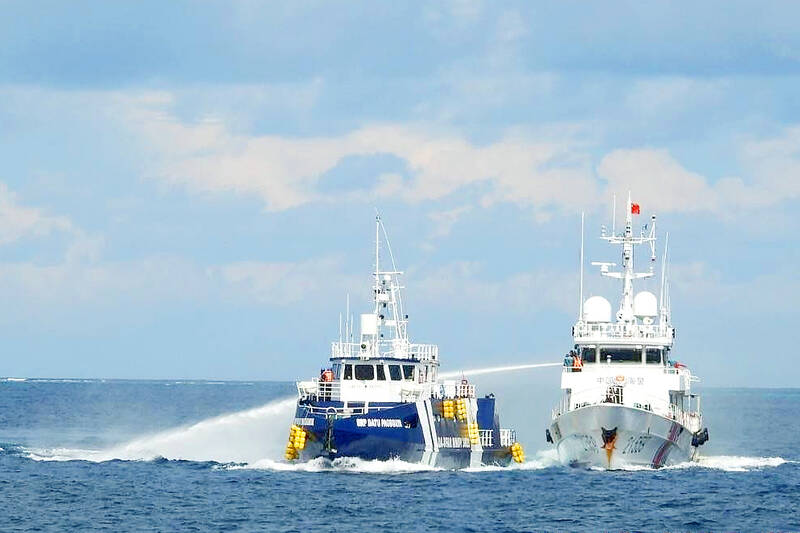
Photo: Philippine Coast Guard via AP
The incident took place near Thitu Island (Jhongye Island, 中業島), part of the Spratly Islands (Nansha Islands, 南沙群島), it said.
The Philippine National Maritime Council condemned the incident and vowed to pursue “appropriate diplomatic action to convey its strong objections to the aggressive and illegal actions of China.”
Philippine Department of Foreign Affairs spokeswoman Angelica Escalona said that a diplomatic protest would be filed over the incident.
China’s coast guard said the incident occurred after a Philippine vessel entered waters near Sandy Cay, “ignored repeated stern warnings from the Chinese side and dangerously approached” the Chinese ship.
“Full responsibility lies with the Philippine side,” China Coast Guard spokesman Liu Dejun (劉德軍) said.
Photos and videos released by the Philippine Coast Guard showed a China Coast Guard vessel which had its water cannon activated, shadowing a Philippine ship.
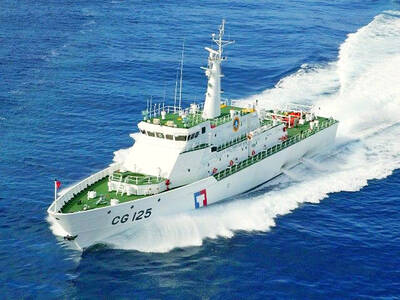
GEOPOLITICAL SIGNIFICANCE: The CGA’s nonmilitary role makes it a tool to avert diplomatic issues, an official said, while confirming the donation of a ship to Manila Coast Guard Administration (CGA) ships are scheduled to sail to the Philippines bearing the words “Taiwan Coast Guard” in a high-profile visit in October next year, the first such visit by a Taiwanese maritime law enforcement vessel to the Southeast Asian nation, the agency said yesterday. The CGA also confirmed that it had donated one of its decommissioned patrol vessels to the Philippines in a rare transfer of a retired ship to a nondiplomatic ally. The Republic of China (ROC) Navy last made such a visit in 1974, shortly before the Philippines switched diplomatic recognition to the People’s Republic of China in

‘GLOBAL WARNING’: The infiltration is not just a local problem, as Beijing has been deploying the same tactics worldwide against Western democracies, a report said Between 50,000 and 100,000 Chinese spies are operating in Taiwan, far more than the National Security Bureau’s previous estimate of 5,000, German journalist and author Jurgen Kremb said on Monday. Kremb presented his research, titled “The War of Spies: How China’s Intelligence Services Are Infiltrating Taiwan — and What Europe Must Learn from It,” at a joint event held by the Taiwan offices of the Friedrich Naumann Foundation and the European Values Center for Security Policy. The report was published in June in the Ministry of Justice Investigation Bureau’s Prospect & Exploration Monthly (展望與探索月刊). By spies, he said he was referring to informants,

PRICE STABILIZATION: The Ministry of Economic Affairs has urged the legislature to support the Cabinet’s supplementary budget for state-owned energy companies State-owned oil supplier CPC Corp, Taiwan (CPC, 台灣中油) on Saturday announced that it would raise domestic gasoline prices by NT$0.7 (US$0.02) per liter and diesel prices by NT$0.6 per liter this week after international crude oil prices rose above US$100 per barrel last week. Formosa Petrochemical Corp (台塑石化) yesterday said that it matched CPC’s price adjustments for this week. The decisions end a six-week period during which CPC and Formosa kept fuel prices in Taiwan unchanged. Retail gasoline prices this week would rise to NT$31.2, NT$32.7 and NT$34.7 per liter for 92, 95 and 98-octane unleaded gasoline respectively at CPC
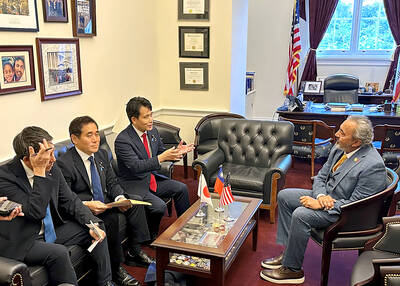
WASHINGTON MEETING: Japan’s Hirofumi Takinami said participants rejected the idea that the US should limit its defensive perimeter to the Second Island Chain US and Japanese lawmakers agree that the US must defend the First Island Chain, including Taiwan, and should not fall back to the Second Island Chain, while “a Taiwan contingency is a Japan contingency and therefore a US-Japan alliance contingency,” media reported after a meeting between officials of the two nations in Washington on Tuesday. A delegation of Japanese lawmakers from the Liberal Democratic Party met with US Senator Thom Tillis, co-chair of the Senate Taiwan Caucus, and US Representative Ami Bera, co-chair of the US Congressional Taiwan caucus, to discuss issues concerning East Asia and the Taiwan Strait. The Japanese and


 RSS
RSS