


Czech billionaire and former prime minister Andrej Babis vowed loyalty to Europe as he met with the Czech president to start talks on a new government yesterday, a day after his movement topped a national vote.
Final results showed that Babis’ ANO (Yes) party won 34.5 percent of the vote on Friday and Saturday, earning 80 seats in the 200-member parliament of the EU and NATO member of 10.9 million people.
Babis said he would seek backing for his government from the far-right Freedom and Direct Democracy (SPD) movement, which earned 7.8 percent for 15 seats, and right-wing newcomers, the Motorists, with 6.8 percent and 13 seats.
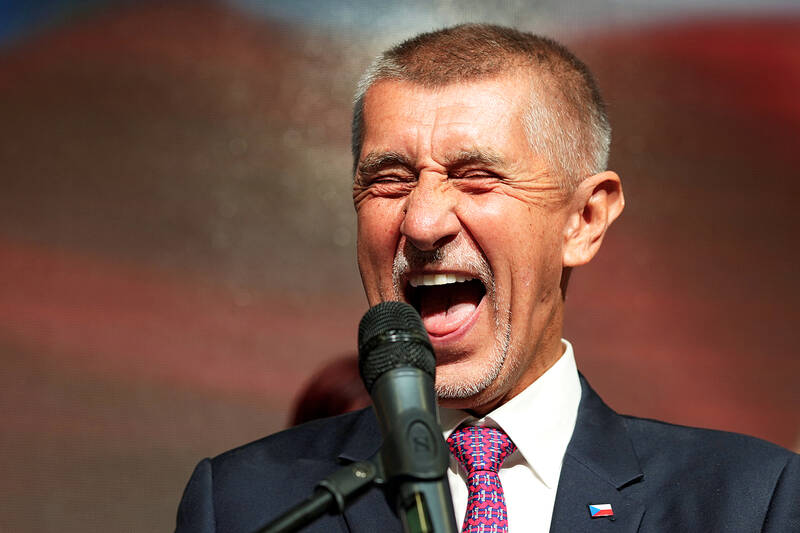
Photo: AP
A self-proclaimed [US President Donald] “Trumpist,” Babis won over voters with pledges of welfare and halting military aid to Ukraine, which made pundits worry the country might shift toward EU skeptics Slovakia and Hungary if he takes over.
“We have discussed the election result and our image in NATO and the EU. I keep seeing negative information ... and I think it’s not fair,” Babis told reporters after meeting with Czech President Petr Pavel.
The 71-year-old, Slovak-born Babis stressed he was pro-European and wanted “Europe to work well.”
However, a day before the vote, Babis said the Czech Republic should help Ukraine through the EU, not directly as up to now.
“Every year, we send 2.5 billion euros in the budget to Brussels, and of course Brussels is helping Ukraine, and the new proposal for the new budget includes a large sum for Ukraine. So, I think we are there,” Babis said.
In Taipei, the Ministry of Foreign Affairs yesterday said the Czech Republic’s smooth and peaceful elections show the maturity of its democracy, congratulating the nation.
As democratic allies, Taiwan and the Czech Republic have deepened their cooperation in the trade, technology, education, culture and public health sectors over the past few years as their bilaterial ties have flourished, the ministry said.
The Czech parliament has long demonstrated bipartisan support of Taiwan, passing several pro-Taiwan resolutions that show its friendliness toward Taiwan, it said.
Taiwan looks forward to deepening its cooperation with the Czech parliament across various fields, and jointly promoting peace, stability and prosperity in Europe and the Indo-Pacific region, it said.
Additional reporting by Huang Chin-hsuan

South Korea has adjusted its electronic arrival card system to no longer list Taiwan as a part of China, a move that the Ministry of Foreign Affairs said would help facilitate exchanges between the two sides. South Korea previously listed “Taiwan” as “Taiwan (China)” in the drop-down menus of its online arrival card system, where people had to fill out where they came from and their next destination. The ministry had requested South Korea make a revision and said it would change South Korea’s name on Taiwan’s online immigration system from “Republic of Korea” to “Korea (South),” should the issue not be

Tainan, Taipei and New Taipei City recorded the highest fines nationwide for illegal accommodations in the first quarter of this year, with fines issued in the three cities each exceeding NT$7 million (US$220,639), Tourism Administration data showed. Among them, Taipei had the highest number of illegal short-term rental units, with 410. There were 3,280 legally registered hotels nationwide in the first quarter, down by 14 properties, or 0.43 percent, from a year earlier, likely indicating operators exiting the market, the agency said. However, the number of unregistered properties rose to 1,174, including 314 illegal hotels and 860 illegal short-term rental
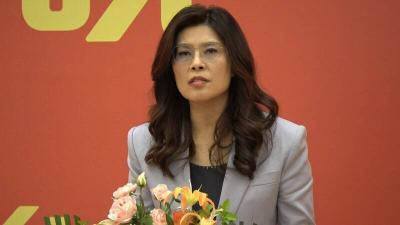
Both sides of the Taiwan Strait share a political foundation based on the “1992 consensus” and opposition to Taiwanese independence, Chinese Nationalist Party (KMT) Chairwoman Cheng Li-wun (鄭麗文) today said during her meeting with Chinese President Xi Jinping (習近平). Both sides of the Strait should plan and build institutionalized and sustainable mechanisms for dialogue and cooperation based on that foundation to make peaceful development across the Strait irreversible, she said. Peace is a shared moral value across the Strait, and both sides should move beyond political confrontation to seek institutionalized solutions to prevent war, she said. Mutually beneficial cross-strait relations are what the

ECONOMIC COERCION: Such actions are often inconsistently applied, sometimes resumed, and sometimes just halted, the Presidential Office spokeswoman said The government backs healthy and orderly cross-strait exchanges, but such arrangements should not be made with political conditions attached and never be used as leverage for political maneuvering or partisan agendas, Presidential Office spokeswoman Karen Kuo (郭雅慧) said yesterday. Kuo made the remarks after China earlier in the day announced 10 new “incentive measures” for Taiwan, following a landmark meeting between Chinese President Xi Jinping (習近平) and Chinese Nationalist Party (KMT) Chairwoman Cheng Li-wun (鄭麗文) in Beijing on Friday. The measures, unveiled by China’s Xinhua news agency, include plans to resume individual travel by residents of Shanghai and China’s Fujian


 RSS
RSS