

The government is aiming for NT$20 billion (US$657.57 million) to support disaster recovery and reconstruction following flooding in Hualien County, Premier Cho Jung-tai (卓榮泰) said yesterday.
“I hope that the caucuses across the Legislative Yuan would quickly support the proposal,” Cho said.
The new funding — to be added to a special bill to deliver aid following a typhoon and flooding in central Taiwan in July — would fund rebuilding in Hualien, where rain from Super Typhoon Ragasa caused a barrier lake on the Mataian River (馬太鞍溪) to breach, flooding Guangfu Township (光復).
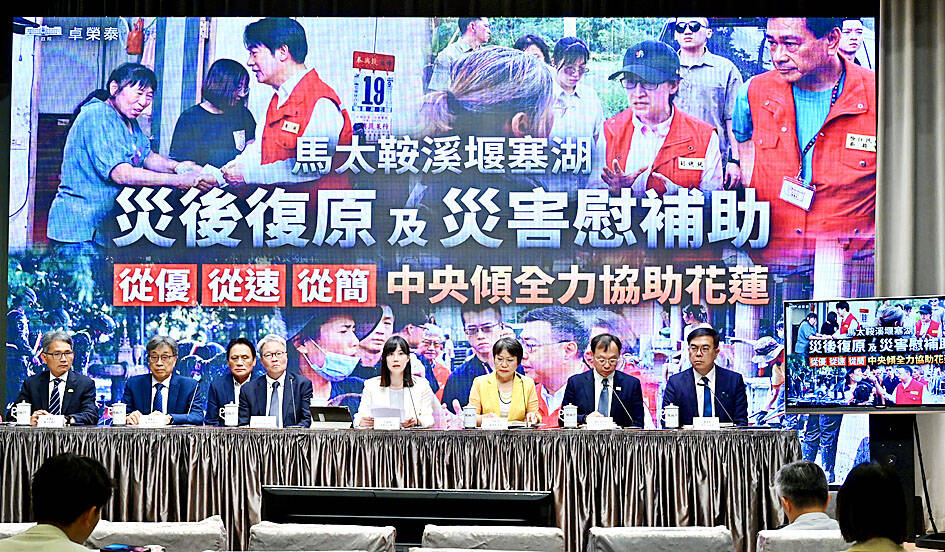
Photo: George Tsorng, Taipei Times
The death toll from Ragasa is 18, while six people are missing and 139 were injured, the Central Emergency Operations Center said yesterday.
The funds would not replace aid for areas already affected by Typhoon Danas, which made landfall on the central west coast of Taiwan at the beginning of July, Cho said.
Executive Yuan spokeswoman Michelle Lee (李慧芝) said that the proposed additions to the special bill designate all of Hualien County as a disaster area.
The government would continue to focus on rescue and restoration efforts, with a multiphase plan aimed at saving lives, aiding reconstruction, removing mud and debris, and restoring local transportation in Hualien, Cho said.
Families of those killed would receive NT$1 million, while those seriously injured would receive NT$250,000, he said.
The government would provide aid of NT$50,000 to NT$100,000 per household, with an additional NT$50,000 subsidy to help remove mud and debris, he added.
Taiwan Power Co (台電) and Taiwan Water Corp (台灣自來水) would waive electricity and water bills for last month and this month for households affected by the flooding in Guangfu, he said.
The government is also planning rent subsidies, temporary lodging, agricultural disaster relief, and assistance for businesses, he said.
The Ministry of Health and Welfare is providing medical treatment and prescription refills without a National Health Insurance card, medicine delivery, a three-month waiver of co-payments and a six-month waiver of health insurance premiums, he said.
Twenty-five measures with a budget of NT$2.5 billion are in the central government’s plan for the additions to the special act, targeting indigenous people, farmers, businesses and others affected in Hualien, the Cabinet said.
Public Construction Commission Chairman Derek Chen (陳金德), who heads the disaster relief and reconstruction efforts following Typhoon Danas, is to lead a cross-departmental team to the worst-hit areas in Hualien to set up a one-stop service platform on Tuesday next week, it said.
The platform would accept applications for financial aid, promote the relief measures and provide consultations for applicants, it said.
The Executive Yuan on Aug. 7 approved a draft of the special bill and the Legislative Yuan passed it on Aug. 15, increasing the maximum budget to NT$60 billion from NT$56 billion.
The Executive Yuan passed a special budgetary bill on Aug. 21 — covering regions in Taichung, Tainan, Kaohsiung and Chiayi cities, as well as Chiayi, Pingtung, Changhua, Yunlin and Nantou counties affected by severe weather in July — and the Legislative Yuan authorized the full NT$60 billion in a third reading on Aug. 29.

SOFT TENNIS: Yu Kai-wen and Huang Shih-yuan narrowly defeated their Japanese rivals to capture Taiwan’s first gold at the Asian Games in Nagoya Yu Kai-wen (余凱文) and Huang Shih-yuan (黃詩媛) won Taiwan’s first gold of this year’s Asian Games, defeating a Japanese duo in a nail-biter in the soft tennis mixed doubles final in Nagoya, Japan, while Johnny Sun (孫家閎) won silver in wushu and Shih Cheng-chung (石政中) won bronze in men’s kumite. Yu and Huang narrowly defeated Japan’s Toshiki Uematsu and Rena Temma 5-4 (2-4, 5-3, 4-2, 1-4, 1-4, 4-0, 1-4, 4-1, 7-5) to give Taiwan its first gold in soft tennis mixed doubles at an Asian Games since 2018. Sun secured Taiwan’s first wushu medal at this year’s game, with a combined score
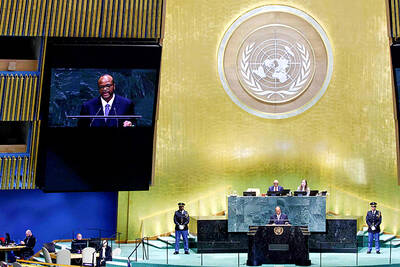
UNITY: Lai thanked the nations who spoke up for Taiwan, saying that democracies must stand together to face global authoritarian expansion Taiwan yesterday thanked eight European and Indo-Pacific countries for opposing unilateral changes to the “status quo” in the Taiwan Strait in a joint statement earlier this week, as well as three of Taiwan’s allies for speaking up for the nation’s participation in the UN at the body’s General Assembly in New York. Minister of Foreign Affairs Lin Chia-lung (林佳龍) welcomed the support and expressed his appreciation for the countries’ stance, the Ministry of Foreign Affairs said in a statement. Foreign ministers and senior representatives of Australia, France, Germany, Japan, New Zealand, Poland, South Korea and the UK issued a statement on Tuesday
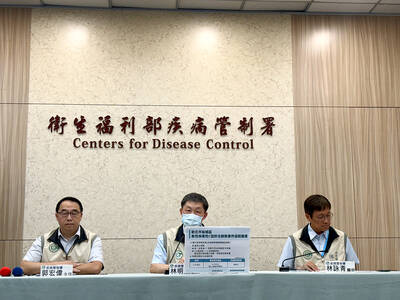
AT-RISK GROUPS: Of the accumulated 1,586 severe cases and 304 related deaths in this flu season, 65.8% were older people and 83.2% had chronic diseases, an official said The Centers for Disease Control (CDC) yesterday said that 165 severe flu cases and 30 flu-related deaths were reported last week, the highest weekly numbers in this flu season, and that cases might continue to increase, urging people to take precautions. Medical visits for flu-like illnesses increased by 1.4 percent to 141,374 last week, with 11.8 percent being emergency visits, showing that the seasonal flu is still in its epidemic period, CDC Epidemic Intelligence Center Director Guo Hung-wei (郭宏偉) said. From Tuesday last week to Monday, 165 severe flu cases and 30 flu-related deaths were confirmed, the highest weekly numbers
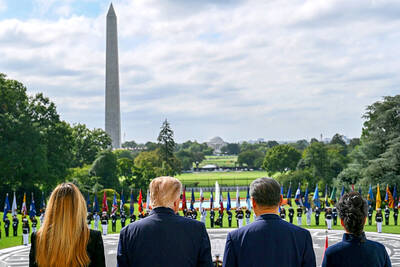
FACTS DISTORTION: The MAC rejected Xi’s remarks that the US and ‘China’ fought side-by-side during WWII, saying the ROC was Washington’s true ally during the war Taiwan yesterday denounced Chinese President Xi Jinping’s (習近平) comments to US President Donald Trump on the nation’s future, after Xi appeared to push Trump for a subtle change in stance that could erode US support for Taiwan. Xi told Trump in Washington on Thursday that he hoped the US would adhere to the “correct position” of opposing Taiwanese independence, according to a Chinese readout of the talks. That would be a tougher version of Washington’s long-standing formulation that it does not “support” independence. There was no immediate White House readout of the exchange. Xi’s remarks represent “the consistent Chinese approach of distorting facts


 RSS
RSS