


At least 14 people have been confirmed dead after floodwaters from the Mataian River (馬太鞍溪) barrier lake burst into Hualien County’s Guangfu Township (光復) on Tuesday, government officials said yesterday, after Super Typhoon Ragasa pounded Taiwan with torrential rain.
The lake in eastern Hualien — formed by a series of landslides that created a natural dam wall — burst, washing away a bridge and sweeping into Guangfu with a trail of thick sludge and mud.
“It was like a volcano erupting... The muddy floodwaters came roaring straight into the first floor of my house,” said Hsu Cheng-hsiung, 55, a neighborhood leader of Guangfu.
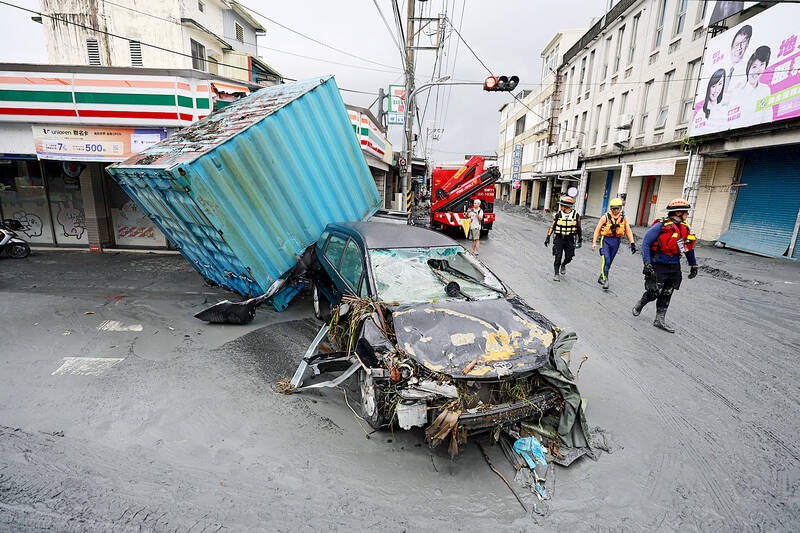
Photo: Ritchie B. Tongo, EPA
More than half of Guangfu’s 8,450 people sought safety on higher floors of their homes or on higher ground yesterday morning. The streets were caked in thick gray mud after the flood hit, with fallen trees blocking the way.
Wrecked cars and scooters lay by the roadside or piled on top of each other by the flood waters, and some metal gates and roofs of homes were destroyed, with furniture scattered along the streets.
Residents said the mud was too much to clear by themselves with more help for the cleanup expected today.

Photo: CNA
“I was very scared... About 500m in front of me, the stream suddenly swelled into a flood,” a 54-year-old relief volunteer surnamed Shih (施) said at a makeshift shelter. “I heard police broadcasting on the street: ‘The water is coming, run.’”
Residents were ordered to evacuate amid fears that the barrier lake would overflow again or burst, a day after the initial breach.
Local broadcasts at about 11:30am instructed residents to halt cleanup work and head toward Rueisuei Township (瑞穗) for safety.
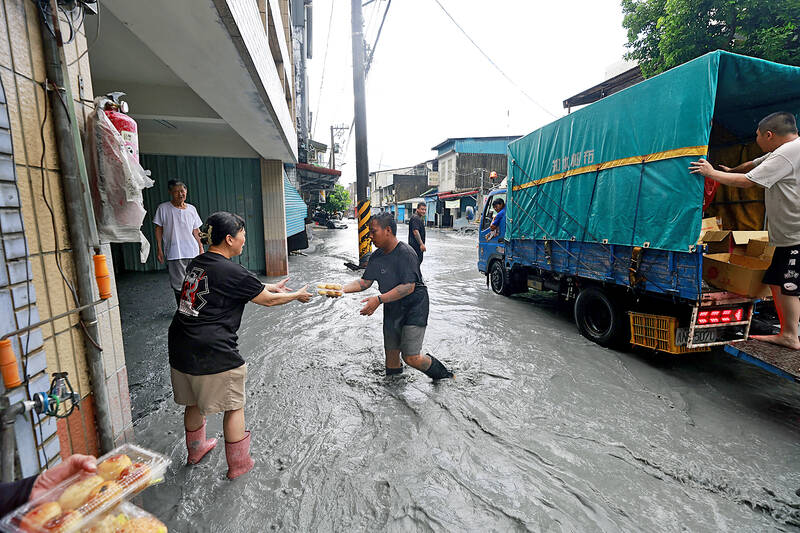
Photo: Ritchie B. Tongo, EPA
Authorities said the confirmation of a new overflow was pending, but that precautionary measures were necessary due to heavy rains.
As of 5pm yesterday, there were a total of 17 deaths and 32 injured across the country, the Central Emergency Operation Center said.
The death toll at 10:30pm was again fixed and dropped to 14, while the number of missing also fell from 152 to 46, as rescuers established contact with more than 100 people who were previously unreachable, and were going door-to-door to check on the remaining 46 residents, the National Fire Agency said.
“Seventeen people remain missing after the Mataian River barrier lake burst. We must ... seize the time for rescue,” Minister of the Interior Liu Shyh-fang (劉世芳) told a government briefing.
Premier Cho Jung-tai (卓榮泰) visited the area yesterday, pledging to provide assistance to those affected.
He said the authorities should find out why “evacuation orders were not carried out in the affected area,” which led to the casualties, and ordered representatives of central government agencies to stay in Hualien to support relief efforts.
Across Taiwan, nearly 8,400 people were evacuated due to Super Typhoon Ragasa.
In areas around the barrier lake, 3,285 people were evacuated and about 1,200 were staying in shelters, the fire agency said.
The Central Weather Administration said rainfall in Guangfu had eased, but warned that eastern and southeastern Taiwan could still see heavy showers or localized downpours.
Saturated mountain soil remained prone to landslides, rockfalls and debris flows, it said.
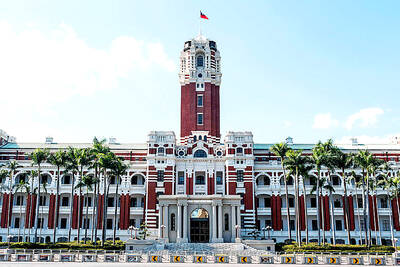
SECURITY: Taipei presses the US for arms supplies, saying the arms sales are not only a reflection of the US security commitment to Taiwan but also serve as a mutual deterrent against regional threats Taiwan is committed to preserving the cross-strait “status quo” and contributing to regional peace and stability, the Presidential Office said yesterday. “It is an undeniable fact that the Republic of China is a sovereign and independent democratic nation,” Presidential Office spokeswoman Karen Kuo (郭雅慧) reiterated, adding that Beijing has no right to claim sovereignty over Taiwan. The statements came after US President Donald Trump warned against Taiwanese independence. Trump wrapped up a state visit to Beijing on Friday, during which Chinese President Xi Jinping (習近平) had pressed him not to support Taiwan. Taiwan depends heavily on US security backing to deter China from carrying

The subsidiary of Taiwan Semiconductor Manufacturing Co (TSMC, 台積電) in Kumamoto, Japan, turned a profit in the first quarter of this year, marking the first time the first fab of the unit has become profitable since mass production started at the end of 2024. According to the contract chipmaker’s financial statement released on Friday, Japan Advanced Semiconductor Manufacturing Inc (JASM), a joint venture running the fab in Kumamoto, posted NT$951 million (US$30.19 million) in profit in the January-to-March period, compared with a loss of NT$1.39 billion in the previous quarter, and a loss of NT$3.25 billion in the first quarter of

RESOLUTE BACKING: Two Republican senators are planning to introduce legislation that would impose immediate sanctions on China if it attempts to invade Taiwan US House of Representatives Speaker Mike Johnson on Sunday reaffirmed US congressional support for Taiwan, saying the US and “all freedom-loving people” have a stake in preventing China from seizing Taiwan by force. Johnson made the remarks in an interview with Fox News Sunday on US President Donald Trump’s summit with Chinese President Xi Jinping (習近平) last week. In an interview that aired on Friday on Fox News, just as Trump wrapped up a high-stakes visit to China, he said he has yet to green-light a new US$14 billion arms package to Taiwan and that it “depends on China.” “It’s a very good
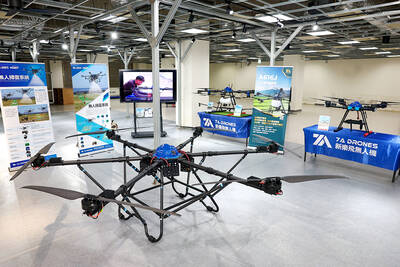
DRONE CENTRAL: Taiwan aims to become Asia’s democratic hub for drones, with most exports focused on high-quality military-grade models, an official said Taiwan’s drone industry is expected to expand significantly by 2030, producing 100,000 units per month and exporting half of them, the Ministry of Economic Affairs said yesterday. Current drone production capacity is about 15,000 units per month, but the industry can quickly scale up as demand increases, Industrial Development Administration Director-General Chiou Chyou-huey (邱求慧) told a news conference in Taipei. Taiwan’s drone output grew 2.5-fold last year to NT$12.9 billion (US$408.3 million) under a government program to develop the uncrewed vehicle sector, he said. The Executive Yuan in October last year approved plans to invest NT$44.2 billion into domestic production of uncrewed aerial


 RSS
RSS