


The leader of a US congressional delegation to China yesterday warned of the “risk of a misunderstanding” between the two countries’ militaries as advances in defense technology move at breakneck speed.
US Representative Adam Smith, the most senior Democrat on the US House of Representatives Armed Services Committee, told journalists in Beijing that China needs to talk more about its military with other global powers “for basic de-confliction.”
“We’ve seen this with our ships, our planes, their ships, their planes coming entirely too close to one another,” he told a news conference at the US embassy. “We need to have a better conversation about de-conflicting those things.”
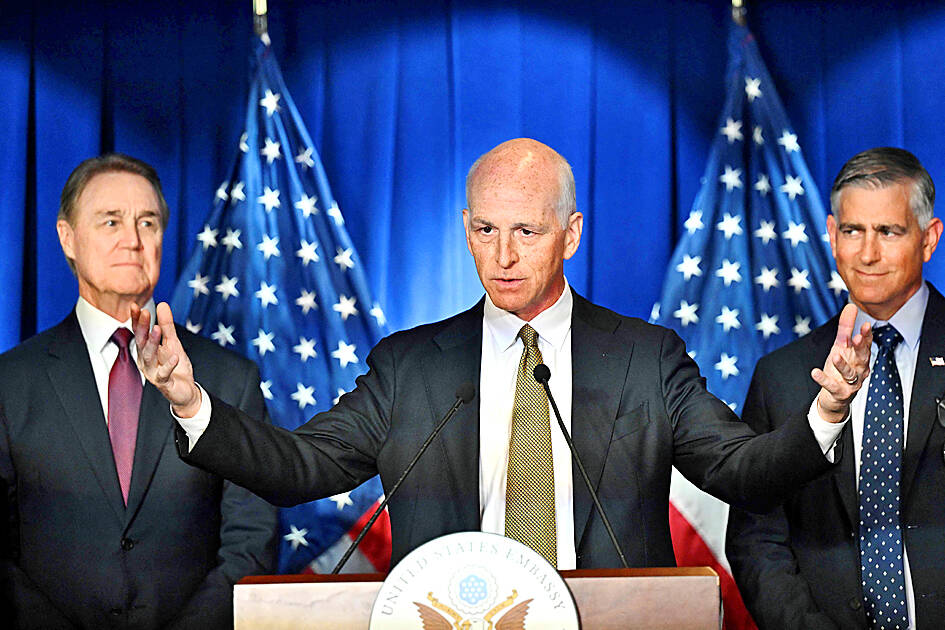
Photo: AFP
“At the height of the Cold War, we had regular conversations, regular treaties with the Soviet Union,” he added.
The four-person delegation — which also includes US representatives Ro Khanna, Chrissy Houlahan and Michael Baumgartner — on Monday met with Chinese Minister of National Defense Dong Jun (董軍), with whom they talked about the importance of “working through our differences” and more candid dialogue, a statement from the US side said.
Dong urged the US to “remove disruptive and restrictive factors” between them, China’s Xinhua state news agency reported.
“AI [artificial intelligence] and drone warfare and cyber and space is moving so rapidly and innovation is happening so quickly. The risk of a misunderstanding of capabilities on one side or the other is great,” Smith said, adding that the two sides need to talk so they “don’t stumble in any sort of conflicts.”
He said they were also having issues communicating with the Chinese side on other issues.
“You have to be willing to start the process of saying: ‘OK, this is where I’m coming from, where are you coming from?’ And we’re not even at that point yet. We’re still sort of talking past each other,” he said.
Smith and Chinese Minister of Foreign Affairs Wang Yi (王毅) struck a warmer tone during a meeting later yesterday, with Wang telling Smith that China’s door was always open to him.
Smith said he saw room for cooperation between the US and China on issues such as combating poverty and public health crises.
“There are many things that we can work together on because the capabilities of China, the capabilities of the US are the greatest in the world,” he said. “If we work together, there’s no end of the things that we can accomplish.”
Additional reporting by AP

Japan has deployed long-range missiles in a southwestern region near China, the Japanese defense minister said yesterday, at a time when ties with Beijing are at their lowest in recent years. The missiles were installed in Kumamoto in the southern region of Kyushu, as Japan is attempting to shore up its military capacity as China steps up naval activity in the East China Sea. “Standoff defense capabilities enable us to counter the threat of enemy forces attempting to invade our country ... while ensuring the safety of our personnel,” Japanese Minister of Defense Shinjiro Koizumi said. “This is an extremely important initiative for
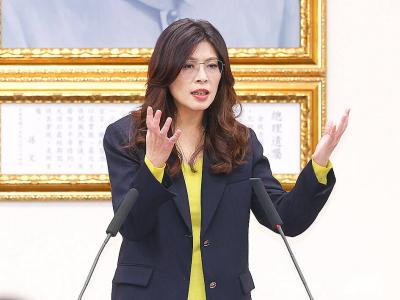
Chinese Nationalist Party (KMT) Chairwoman Cheng Li-wun (鄭麗文) today accepted an invitation from Chinese President Xi Jinping (習近平) to lead a delegation to China next month, saying she hopes to promote the peaceful development of cross-strait relations and bring stability to the Taiwan Strait. “I am grateful and happy to accept this invitation,” Cheng said in a statement from the KMT chairperson’s office. Cheng said she hopes both sides can work together to promote the peaceful development of cross-strait relations, enhance exchange and cooperation, bring stability to the Taiwan Strait and improve people’s livelihoods. At today's news conference, Cheng said any efforts to

MORE POPULAR: Taiwan Pass sales increased by 59 percent during the first quarter compared with the same period last year, the Tourism Administration said The Tourism Administration yesterday said that it has streamlined the Taiwan Pass, with two versions available for purchase beginning today. The tourism agency has made the pass available to international tourists since 2024, allowing them to access the high-speed rail, Taiwan Railway Corp services, four MRT systems and four Taiwan Tourist Shuttles. Previously, five types of Taiwan Pass were available, but some tourists have said that the offerings were too complicated. The agency said only two types of Taiwan Pass would be available, starting from a three-day pass with the high-speed rail and a three-day pass with Taiwan Railway Corp. The former costs NT$2,800

The nation’s fastest supercomputer, Nano 4 (晶創26), is scheduled to be launched in the third quarter, and would be used to train large language models in finance and national defense sectors, the National Center for High-Performance Computing (NCHC) said. The supercomputer, which would operate at about 86.05 petaflops, is being tested at a new cloud computing center in the Southern Taiwan Science Park in Tainan. The exterior of the server cabinet features chip circuitry patterns overlaid with a map of Taiwan, highlighting the nation’s central position in the semiconductor industry. The center also houses Taiwania 2, Taiwania 3, Forerunner 1 and


 RSS
RSS