


North Korean leader Kim Jong-un said there is no reason for the country to avoid dialogue with the US if Washington stops insisting his country give up nuclear weapons, state news agency Korean Central News Agency (KCNA) reported on Monday.
In a speech at the Supreme People’s Assembly of the Democratic People’s Republic of Korea on Sunday, Kim said he still has fond memories of US President Donald Trump, KCNA also reported.
The two leaders met three times during Trump’s first presidency.
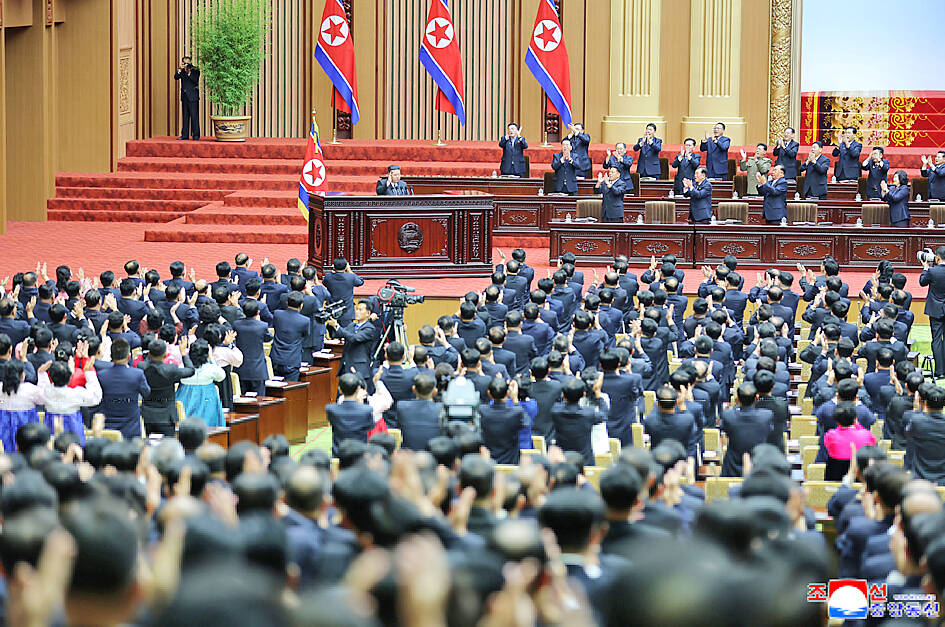
Photo: Korean Central News Agency via EPA
“If the United States drops the absurd obsession with denuclearizing us and accepts reality, and wants genuine peaceful coexistence, there is no reason for us not to sit down with the United States,” Kim was quoted as saying.
It was a matter of survival for the country to build nuclear weapons to safeguard its security in the face of grave threats from the US and South Korea, Kim said.
He said he rejected recent overtures from Washington and Seoul for dialogue as insincere, because their fundamental intent to weaken the North and destroy his regime remains unchanged.
He said a proposal by the South on ending the North’s nuclear programs in phases was proof of that.
South Korean President Lee Jae-myung has made peace overtures since taking office in June, saying dialogue with Pyongyang was necessary, and has proposed steps to build confidence and eventually end the North’s nuclear program.
Lee told Reuters that there are formidable obstacles to reopening dialogue with the North, but he still believed the phased approach on dismantling Pyongyang’s nuclear program was the realistic option.
It was necessary to create the right conditions to bring the North back to the table and Trump has a key role to play in those efforts, Lee said.
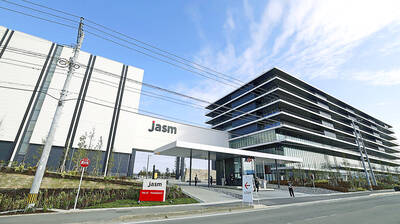
The subsidiary of Taiwan Semiconductor Manufacturing Co (TSMC, 台積電) in Kumamoto, Japan, turned a profit in the first quarter of this year, marking the first time the first fab of the unit has become profitable since mass production started at the end of 2024. According to the contract chipmaker’s financial statement released on Friday, Japan Advanced Semiconductor Manufacturing Inc (JASM), a joint venture running the fab in Kumamoto, posted NT$951 million (US$30.19 million) in profit in the January-to-March period, compared with a loss of NT$1.39 billion in the previous quarter, and a loss of NT$3.25 billion in the first quarter of
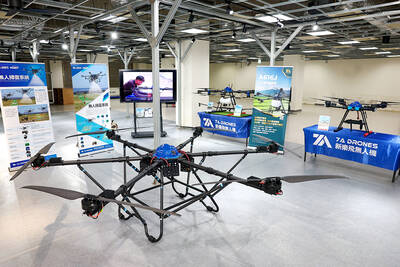
DRONE CENTRAL: Taiwan aims to become Asia’s democratic hub for drones, with most exports focused on high-quality military-grade models, an official said Taiwan’s drone industry is expected to expand significantly by 2030, producing 100,000 units per month and exporting half of them, the Ministry of Economic Affairs said yesterday. Current drone production capacity is about 15,000 units per month, but the industry can quickly scale up as demand increases, Industrial Development Administration Director-General Chiou Chyou-huey (邱求慧) told a news conference in Taipei. Taiwan’s drone output grew 2.5-fold last year to NT$12.9 billion (US$408.3 million) under a government program to develop the uncrewed vehicle sector, he said. The Executive Yuan in October last year approved plans to invest NT$44.2 billion into domestic production of uncrewed aerial
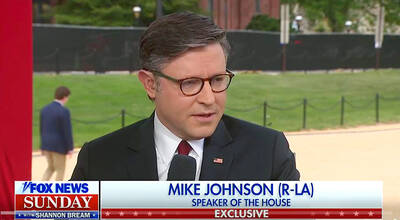
RESOLUTE BACKING: Two Republican senators are planning to introduce legislation that would impose immediate sanctions on China if it attempts to invade Taiwan US House of Representatives Speaker Mike Johnson on Sunday reaffirmed US congressional support for Taiwan, saying the US and “all freedom-loving people” have a stake in preventing China from seizing Taiwan by force. Johnson made the remarks in an interview with Fox News Sunday on US President Donald Trump’s summit with Chinese President Xi Jinping (習近平) last week. In an interview that aired on Friday on Fox News, just as Trump wrapped up a high-stakes visit to China, he said he has yet to green-light a new US$14 billion arms package to Taiwan and that it “depends on China.” “It’s a very good
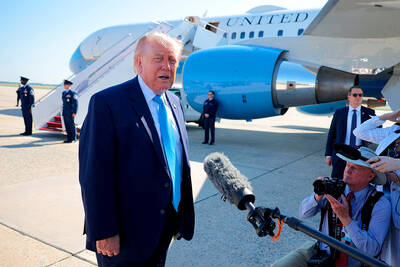
US President Donald Trump yesterday said he would speak to President William Lai (賴清德) as his administration considers whether to move ahead with a US$14 billion weapons sale to Taiwan — a potential arms deal that has drawn criticism from China. “Well, I’ll speak to him. I speak to everybody,” Trump told reporters yesterday when asked if he had any plans to call his counterpart, although he did not offer a time frame for when such a conversation could take place. Trump previously said he would speak to the person “that’s running Taiwan,” without specifying who he meant. “We have that situation very


 RSS
RSS