


Thousands of Filipinos marched in Manila yesterday to vent their anger over a ballooning scandal involving bogus flood-control projects believed to have cost taxpayers billions of dollars.
However, a day of largely peaceful mass protests erupted into violence as riot police deployed water cannons in clashes with scores of mostly young masked people who hurled rocks and shattered the glass of one police outpost.
Police arrested 72 people — including 20 minors — in two separate incidents that saw at least 39 officers injured and a trailer that was being used as a barricade set ablaze, a spokeswoman said.

Photo: AFP
Major Hazel Asilo said it was unclear if those arrested were “protesters or just people who are causing trouble.”
Rage over the so-called ghost infrastructure projects has been mounting in the Southeast Asian country since Philippine President Ferdinand Marcos Jr put them center stage in a July state of the nation address that followed weeks of deadly flooding.
Marcos said early last week that he did not blame people for protesting “one bit.”
Yesterday in the capital began without violence with a morning demonstration at a park that drew about 50,000 people, according to city estimates.
Thousands more joined an afternoon rally at the capital’s EDSA thoroughfare, ground zero for the 1986 movement that ousted Marcos’ dictator father.
“It’s very rare for me to go to rallies, but this situation was bad enough that I was really urged to say: ‘This is enough,’” said Mitzi Bajet, a 30-year-old designer.
Teddy Casino, 56, chairman of left-wing alliance Bagong Alyansang Makabayan, said his group was demanding not only the return of stolen funds, but also prison time for those involved.
“Corruption requires people to go to the streets and express their outrage in the hope of pressuring government to actually do their jobs,” he said.
Renato Reyes, another organizer of the first protest, later said he had been hit in the face with a rock as he tried to leave an area near the Philippine presidential palace.
“They could be provocateurs or they could just be really angry at what is happening,” he said of the masked protesters, adding that the government could not “ignore the problem of corruption.”
Some of those at the clashes could be seen holding aloft the pirate flag seen at recent Indonesian protests sparked by low wages, unemployment and anger over lavish lawmaker perks that left at least 10 dead.
An Agence France-Presse journalist at the scene witnessed police throwing rocks back toward protesters, something Asilo denied.
The Philippine Department of Finance has estimated the Philippine economy lost up to 118.5 billion pesos (US$2.08 billion) from 2023 to this year due to corruption in flood control projects. Greenpeace has suggested the number is closer to US$18 billion.
The scandal has already sparked leadership changes in both houses of the Philippine Congress, with Philippine House of Representatives Speaker Martin Romualdez, a cousin of Marcos, resigning last week as an investigation got under way.
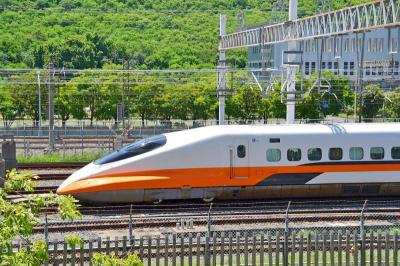
A signaling system malfunction disrupted high-speed rail (HSR) services beginning at 8am today, with trains temporarily reduced to three northbound and three southbound trains per hour as authorities conduct inspections. The malfunction occurred on a section of track in Miaoli County during pre-operation checks early this morning, forcing northbound and southbound trains to use a single track, the HSR operator said. The regular schedule has been replaced with three hourly trains offering only nonreserved seating in each direction, stopping at every station, it said, adding that business class cars would still have reserved seating. Departures from terminal stations are scheduled at the top
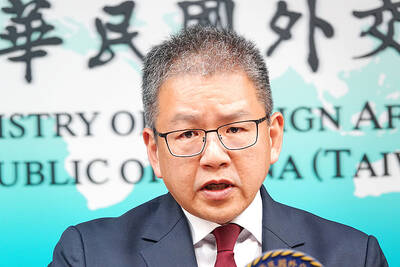
Taiwan is still in the process of assessing the possibility of recruiting workers from Eswatini, the Ministry of Foreign Affairs said yesterday, adding that its goal is to help Eswatini upgrade its vocational training centers. If there are plans to recruit workers from Eswatini, safeguarding national security, protecting public health and ensuring the employment rights of Taiwanese would be prerequisites, Department of West Asian and African Affairs Director-General Yen Chia-liang (顏嘉良) told a news conference. Key considerations would also include filling labor shortages in specific industries, and fostering bilateral professional and technical exchanges, he said. Yen was asked about the progress of labor
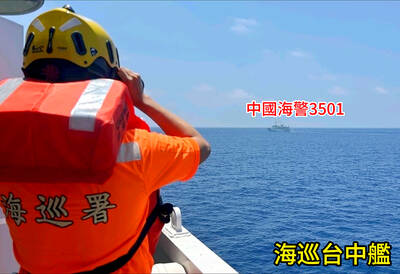
VERBOSE VESSELS: A CGA cutter and a China Coast Guard exchanged verbal barbs for more than a day in Taiwanese-controlled waters before the Chinese vessel left The Taiwanese and Chinese coast guards had a standoff near the strategically located Pratas Islands (Dongsha Islands, 東沙群島) in the north of the South China Sea, the Coast Guard Administration (CGA) said yesterday. The two sides engaged in intense radio exchanges over sovereignty claims during the 33-hour standoff. China Coast Guard vessel 3501 eventually left the restricted waters, 26.6 nautical miles (49.2km) west of the Pratas Islands, at 5pm yesterday, the CGA said. Lying approximately between southern Taiwan and Hong Kong, the Taiwan-controlled Pratas are seen by some security experts as vulnerable to Chinese attack due to their distance — more than

A US uncrewed surface vessel (USV) encountered multiple Chinese warships during an autonomous transit of the Taiwan Strait, US defense company Seasats said in a statement on Wednesday. Seasats announced that a Lightfish USV had completed the first autonomous transit of the Taiwan Strait. Over five days, the USV traversed the entire length of the Strait while constantly monitoring surface vessel traffic, the company said. The Lightfish encountered multiple Chinese warships, one of which was a Chinese People’s Liberation Army Navy (PLAN) Type 056 corvette, it said. The Chinese vessels were operating “well within Taiwan’s exclusive economic zone without transmitting their identity via the


 RSS
RSS