


South Korea’s president yesterday said that South Korean companies would likely hesitate to make further investments in the US unless Washington changes its visa system for their employees, as US authorities released hundreds of workers who were detained from a Georgia factory site last week.
In a news conference marking 100 days in office, South Korean President Lee Jae-myung called for changes to the US visa system as he spoke about the immigration raid on Thursday last week that resulted in the arrest of more than 300 South Korean workers at a battery factory under construction at Hyundai’s sprawling auto plant west of Savannah.
The South Korean Ministry of Foreign Affairs later confirmed that US authorities had released the 330 detainees — 316 of them South Koreans — and that they were being transported by buses to Atlanta’s Hartsfield-Jackson airport, where they were to board a charter flight scheduled to arrive in South Korea this afternoon.
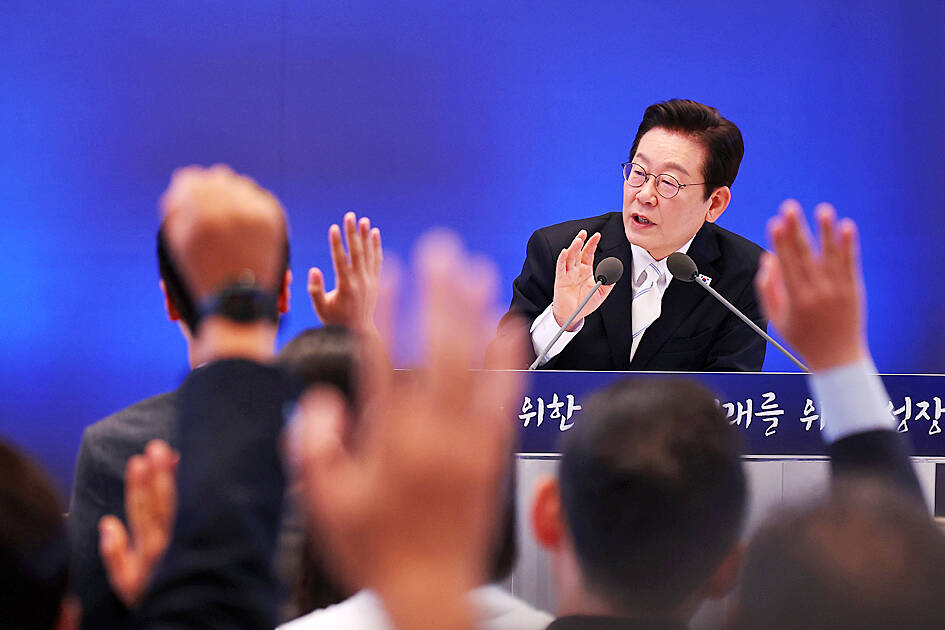
Photo: EPA
The massive roundup and US authorities’ release of video showing some workers being chained and taken away, sparked widespread anger and a sense of betrayal in South Korea.
The raid came less than two weeks after a summit between US President Donald Trump and Lee, and just weeks after the countries reached a July agreement that spared South Korea from the Trump administration’s highest tariffs — but only after Seoul pledged US$350 billion in new US investments — against the backdrop of a decaying job market at home.
Lee said that South Korean and US officials are discussing a possible change to the US visa system, adding that under the current system South Korean companies “can’t help hesitating a lot” about making direct investments in the US.
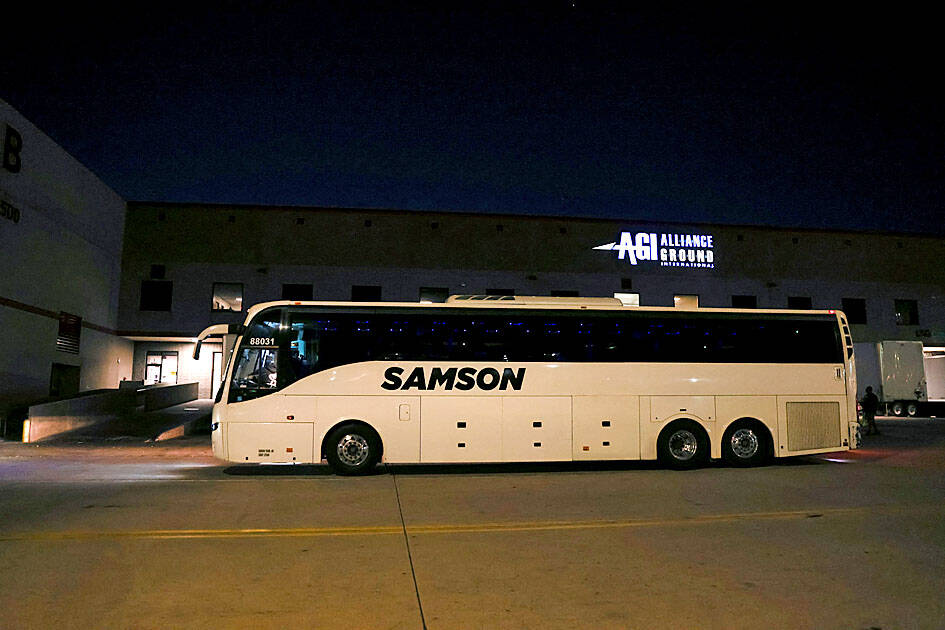
Photo: Reuters
Lee said the raid showed a “cultural difference” between the two countries in how they handle immigration issues.
“In South Korea, we see Americans coming on tourist visas to teach English at private cram schools — they do it all the time, and we don’t think much of it, it’s just something you accept,” Lee said.
“But the United States clearly doesn’t see things that way,” he added.
US authorities said that some of the detained workers had illegally crossed the US border, while others entered legally, but had expired visas or entered on visa waivers that prohibited them from working.
South Korean officials expressed frustration that Washington had yet to act on Seoul’s years-long demand to ensure a visa system to accommodate skilled South Korean workers, although it has been pressing South Korea to expand US industrial investments.
Following a meeting with US Secretary of State Marco Rubio in Washington, South Korean Minister of Foreign Affairs Cho Hyun on Wednesday said that US officials had agreed to allow the workers detained in Georgia to later return to finish their work at the site.
He added that the countries agreed to set up a joint working group for discussions on creating a new visa category to make it easier for South Korean companies to send their staff to work in the US.
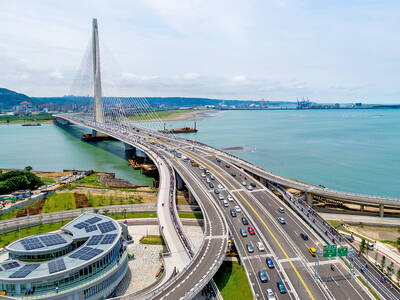
The Ministry of Transportation and Communications yesterday inaugurated the Danjiang Bridge across the Tamsui River in New Taipei City, saying that the structure would be an architectural icon and traffic artery for Taiwan. Feted as a major engineering achievement, the Danjiang Bridge is 920m long, 211m tall at the top of its pylon, and is the longest single-pylon asymmetric cable-stayed bridge in the world, the government’s Web site for the structure said. It was designed by late Iraqi-British architect Zaha Hadid. The structure, with a maximum deck of 70m, accommodates road and light rail traffic, and affords a 200m navigation channel for boats,
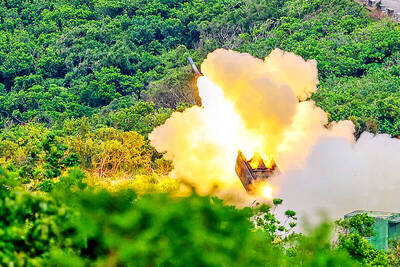
PRECISION STRIKES: The most significant reason to deploy HIMARS to outlying islands is to establish a ‘dead zone’ that the PLA would not dare enter, a source said A High Mobility Artillery Rocket System (HIMARS) would be deployed to Penghu County and Dongyin Island (東引) in Lienchiang County (Matsu) to force the Chinese military to retreat at least 100km from the coastline, a military source said yesterday. Taiwan has been procuring HIMARS and Army Tactical Missile Systems (ATACMS) from the US in batches. Once all batches have been delivered, Taiwan would possess 111 HIMARS units and 504 ATACMS, which have a range of 300km. Considering that “offense is the best defense,” the military plans to forward-deploy the systems to outlying islands such as Penghu and Dongyin so that
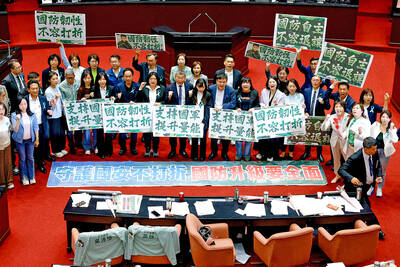
WHAT WAS ALL THAT FOR? Jaw Shaw-kong said that Cheng Li-wen had pushed for more drastic cuts and attacked him, just for the outcome to be nearly identical to his bill The legislature yesterday passed a supplementary budget bill to fund the purchase of separate packages of US military equipment, with the combined amount of spending capped at NT$780 billion (US$24.8 billion). The Chinese Nationalist Party (KMT) and Taiwan People’s Party (TPP) used their legislative majority to pass the bill, which runs until 2033 and has two main funding provisions. One was for NT$300 billion of arms sales already approved by the US for Taiwan on Dec. 17 last year, the other was for NT$480 billion for another arms package expected to be announced by Washington. The bill, which fell short of the NT$1.25
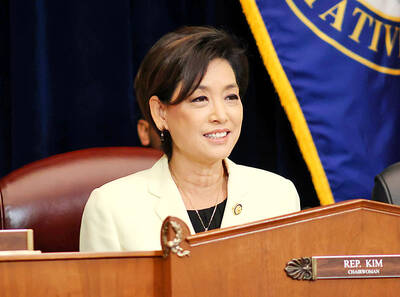
‘CLEAR MESSAGE’: The bill would set up an interagency ‘tiger team’ to review sanctions tools and other economic options to help deter any Chinese aggression toward Taiwan US Representative Young Kim has introduced a bill to deter Chinese aggression against Taiwan, calling for an interagency “tiger team” to preplan coordinated sanctions and economic measures in response to possible Chinese military or political action against Taiwan. “[Chinese President] Xi Jinping [習近平] has directed the People’s Liberation Army to be ready to invade Taiwan by 2027. China has a plan. America should have one too,” Kim said in a news release on Thursday last week. She introduced the “Deter PRC [People’s Republic of China] aggression against Taiwan act” to “ensure the US has a coordinated sanctions strategy ready should


 RSS
RSS